

Executive Summary
The intersection of Prime Minister Mark Carney’s personal financial portfolio, Canada’s conflict-of-interest legislation, and high-stakes policy initiatives has generated one of the most intense ethics debates in recent Canadian political history. Carney’s disclosed holdings number 567 entities, with approximately 91% allocated to the U.S. market and only 0.5% invested directly in Canada. To mitigate direct decision-making conflicts, he has placed over 560 companies in a blind trust and formally recused himself from 103 named entities, including Brookfield Asset Management and Stripe. However, the legal framework governing his disclosures contains a broad policy carveout that exempts macroeconomic and sector-wide decisions from recusal requirements, a provision critics argue effectively neutralizes the screen’s practical impact.
These structural tensions have been amplified by the government’s “Building Canada Strong” housing initiative, which allocates $150 million in federal funding to purchase over 2,200 vacant British Columbia condominiums for conversion into affordable rent-to-own housing. The plan’s intersection with the real estate development sector, combined with reported connections between participating developers and prior political fundraisers, has drawn accusations of a developer bailout and prompted formal ethics probe requests from opposition leaders. While Carney has complied with existing legal requirements and implemented recognized conflict-mitigation measures, the controversy underscores a fundamental question: does legal compliance with outdated ethics legislation equate to trustworthiness in an era of globally diversified political portfolios and overlapping policy sectors? The answer depends heavily on whether one prioritizes statutory adherence or demands stricter divestment, independent oversight, and greater transparency.
I. Financial Holdings & Portfolio Composition

Scale and Geographic Allocation
Prime Minister Carney’s financial disclosure, published by the Office of the Ethics Commissioner, reveals a portfolio of 567 distinct holdings spanning equities, real estate investment trusts, pension fund interests, and private equity stakes [https://www.cbc.ca/news/politics/mark-carney-financial-assets-1.7583443]. Independent analysis of the disclosed data indicates that approximately 91% of these holdings are allocated to the U.S. market, while only three investments—representing roughly 0.5% of the portfolio—are directly invested in Canada [https://www.davemanuel.com/questions/does-mark-carney-have-just-0-5-percent-of-his-portfolio-invested-in-canada/]. This geographic imbalance has drawn sharp criticism, particularly given Carney’s public “Buy Canadian” political messaging and his framing of domestic economic resilience as a cornerstone of his governing agenda.
The disparity between political rhetoric and portfolio composition matters because it shapes public perception of alignment between stated values and private financial interests. When a head of government advocates for domestic industrial policy, housing affordability, and Canadian economic sovereignty while holding a portfolio overwhelmingly tied to American markets, the visual and narrative contradiction becomes politically volatile. Veracity checks on social media claims regarding Carney’s personal life have clarified that his wife and primary residence remain in Canada, though one daughter is confirmed to be studying in the United States [https://x.com/grok/status/2028480858571600307]. This distinction helps separate residency-based legal jurisdiction from investment geography, though it does little to resolve the underlying perception gap.
The Blind Trust Mechanism
To address potential conflicts, Carney has placed over 560 companies in a blind trust administered by a third-party financial institution [https://www.cbc.ca/news/politics/mark-carney-financial-assets-1.7583443]. In theory, a blind trust removes the Prime Minister’s ability to direct, influence, or even know the specific transactions occurring within his portfolio, thereby insulating policy decisions from personal financial gain. In practice, however, the mechanics of how this trust operates in conjunction with his broader holdings remain a subject of scrutiny. Critics note that while the blind trust covers the majority of disclosed entities, it does not automatically extend to all investments tied to his former leadership roles or to indirect exposures through pension fund allocations and corporate structures [https://ntdca.com/details-of-carneys-conflict-of-interest-screen-released-by-ethics-commissioner-103-entities-listed/].
The blind trust is a recognized conflict-mitigation tool, but its effectiveness depends on administrative rigor, independent oversight, and full disclosure of underlying asset classes. When a portfolio exceeds hundreds of billions in associated market exposure, even indirect holdings can create sector-wide alignment with government policy. This reality forces a distinction between legal compliance and ethical sufficiency: Carney has implemented a structurally valid mechanism, but whether it adequately insulates policy from financial interest remains contested.
II. Connected Companies & Sector Exposure
Asset Management, Real Estate, and Fintech
Carney’s financial ties extend across several major sectors due to his decades-long career in global asset management and finance. His conflict screen explicitly names Brookfield Asset Management, Brookfield Corporation, and Stripe as entities from which he has formally recused himself [https://thedeepdive.ca/ethics-screen-bars-canadian-pm-from-decisions-on-103-corporations/]. Beyond these named entities, his holdings span real estate investment trusts, infrastructure funds, renewable energy projects, and fintech ventures. The breadth of this exposure means that Carney’s financial interests are not confined to a single industry but are instead woven into the fabric of Canada’s broader economic activity.
This sectoral diversity is significant because it creates multiple points of potential alignment between private holdings and public policy. Renewable energy transitions, infrastructure spending, housing development, and digital payment regulation all intersect with asset classes present in his portfolio. When a Prime Minister’s financial exposure spans virtually every major Canadian industry, the risk of indirect benefit from policy decisions increases proportionally. Critics argue that this reality transforms the conflict-of-interest screen from a targeted safeguard into a broad institutional buffer, one that may prevent direct trading conflicts but does little to address systemic sectoral alignment.
The Brookfield Effect
Brookfield Asset Management, which Carney previously led, manages a portfolio exceeding $900 billion across real estate, infrastructure, renewable energy, and alternative assets [https://www.stephentaylor.ca/2026/04/27/mark-carneys-ethics-screen-has-a-huge-hole/]. Because Brookfield’s investments touch nearly every major Canadian industry, any macroeconomic or sector-wide policy enacted by the federal government has the potential to indirectly affect Carney’s financial interests. This reality has led analysts to describe the ethics screen as structurally incomplete, noting that recusing oneself from 103 specific corporate entities does not eliminate exposure to the broader ecosystem in which those entities operate [https://ivoteliberal.com/blog/2026-05-01-carney-ethics-screen-loophole-brookfield.html].
The Brookfield connection also highlights a tension between career continuity and public service. Carney’s expertise in asset management and infrastructure financing directly informed his policy priorities, including housing affordability and clean energy transitions. While this expertise is an asset to governance, it simultaneously creates a feedback loop where policy decisions in his area of former professional focus may align with his financial portfolio. This is not inherently corrupt, but it does require exceptional transparency and rigorous conflict management to maintain public confidence.
III. The Ethics Framework & Conflict-of-Interest Screen
How the Screen Operates
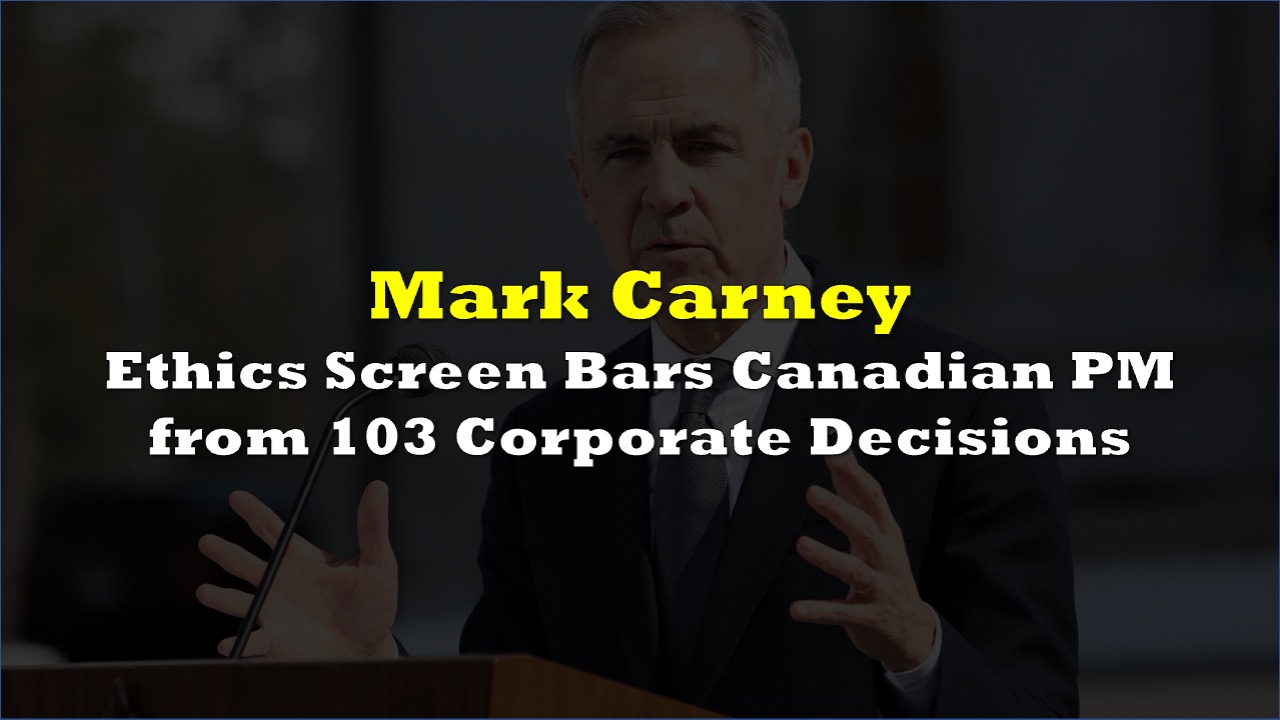
Carney’s conflict-of-interest management relies on a compliance-based ethics screen administered under the Conflict of Interest Act rather than full divestment or traditional blind trust oversight. The screen formally recuses him from 103 named corporate entities, including Brookfield Asset Management, Brookfield Corporation, and Stripe [https://ntdca.com/details-of-carneys-conflict-of-interest-screen-released-by-ethics-commissioner-103-entities-listed/]. The administration of this screen falls to his Chief of Staff and the Clerk of the Privy Council, with the Ethics Commissioner receiving only post-hoc notifications rather than pre-approval authority [https://thedeepdive.ca/ethics-screen-bars-canadian-pm-from-decisions-on-103-corporations/].
In its first year, the screen was formally triggered only six times [https://www.stephentaylor.ca/2026/04/27/mark-carneys-ethics-screen-has-a-huge-hole/]. Analysts note that given the scale of Brookfield’s portfolio and the breadth of Carney’s financial exposure, most macroeconomic and sectoral policies naturally fall outside the scope of direct recusal. This operational reality has led to bipartisan criticism that the current framework is ill-equipped to handle the financial complexity of modern political leadership. A House of Commons committee and multiple ethics reports have recommended that prime ministers be legally required to divest assets or place them in stricter, independently overseen blind trusts, citing outdated legislation that assumes a narrower definition of political conflict [https://www.cbc.ca/news/politics/mark-carney-ethics-blind-trust-9.7174747].
The Carveout Loophole
A critical provision in the Conflict of Interest Act allows Carney to participate in any policy decision of broad economic or sectoral application, even if it indirectly benefits his holdings, provided the impact is not “disproportionately targeted” at his specific interests [https://www.stephentaylor.ca/2026/04/30/the-loophole-that-no-democracy-has-closed/]. This general-application carveout effectively exempts most major government policies from recusal requirements, as nearly all federal initiatives are designed to affect entire sectors rather than single corporations.
Ethics analysts and legal commentators have described this provision as a structural vulnerability with no equivalent in comparable democracies [https://www.stephentaylor.ca/2026/04/30/the-loophole-that-no-democracy-has-closed/]. The carveout was likely intended to prevent paralysis in governance, ensuring that a Prime Minister cannot be blocked from making broad economic decisions due to minor or indirect financial exposure. However, when applied to a portfolio exceeding $900 billion in associated market value, the provision transforms from a practical safeguard into a near-total exemption. Critics argue that the “disproportionately targeted” standard is inherently subjective and difficult to enforce, leaving the integrity of policy decisions largely dependent on the officeholder’s self-assessment.
IV. Policy Context & The Condo Acquisition Controversy
"Building Canada Strong"
In June 2026, Carney and British Columbia Premier David Eby announced the “Building Canada Strong” federal-provincial housing plan, which allocates $150 million in federal funding toward a broader $3.2 billion initiative to purchase over 2,200 vacant B.C. condominiums at below-market rates for conversion into affordable rent-to-own housing [https://www.cbc.ca/news/business/carney-vancouver-condos-affordable-housing-bailout-9.7247279]. The policy explicitly targets the real estate and development sectors, aiming to help young families build equity rather than fund new construction. While framed as a housing affordability measure, the plan’s mechanics directly intersect with the sector where Carney holds broad financial exposure.
The initiative has drawn accusations of a developer bailout due to a lack of transparency regarding acquisition costs, discount structures, and the selection criteria for participating developers. Critics cite connections between certain investors and individuals who attended political fundraisers prior to the plan’s announcement, raising questions about insider access and preferential treatment [https://www.conservative.ca/conservatives-call-for-ethics-investigation-into-carneys-condo-bailout/]. B.C. Premier David Eby’s recent meeting with prominent developer Rick Rennie, widely referred to as the “Condo King,” has further fueled skepticism regarding the policy’s independence from private sector influence [https://www.cbc.ca/news/canada/british-columbia/prime-minister-mark-carney-responds-vancouver-bc-condo-plan-9.7248862].
Political Backlash & Parliamentary Dynamics
Opposition Leader Pierre Poilievre formally requested that the ethics committee launch a probe into the condo buyout plan, citing potential conflicts of interest and lobbying concerns [https://globalnews.ca/news/11942050/poilievre-bc-condo-plan-ethics-committee-probe-request/]. However, the governing Liberals shut down parliamentary debate on the proposed investigation, citing procedural and jurisdictional constraints following Carney’s spring election victory [https://www.thebureau.news/p/liberals-adjourn-debate-on-conservatives]. Liberals have maintained that the policy operates within existing legal boundaries, while adjourning Conservative calls for a formal ethics review [https://cfjctoday.com/2026/07/07/liberals-shut-down-debate-over-proposed-probe-into-b-c-condo-buyout-plan-2/].
Carney and Eby have acknowledged poor communication regarding the rollout, with Carney admitting the governments “haven’t done a good job” explaining the policy and Eby noting they should have waited to release full details before the announcement [https://www.cbc.ca/news/canada/british-columbia/prime-minister-mark-carney-responds-vancouver-bc-condo-plan-9.7248862]. Carney has issued explicit statements defending the program’s intent to address housing affordability while maintaining that all actions comply with conflict-of-interest legislation [https://www.cbc.ca/news/canada/british-columbia/prime-minister-mark-carney-responds-vancouver-bc-condo-plan-9.7248862]. An ethics committee meeting was scheduled for July 7 to discuss the condo plan, though the committee’s ability to pursue a formal investigation remains constrained by political dynamics and the governing party’s parliamentary majority [https://www.thebureau.news/p/ethics-committee-will-meet-tuesday].
V. Assessing Trustworthiness: Compliance, Structure, and Public Perception
Evaluating Carney’s trustworthiness requires separating legal compliance from structural ethics gaps, political allegations, and public perception. On the compliance front, Carney has formally disclosed his assets, implemented a named-entity recusal screen, placed hundreds of companies in a blind trust, and has not been found to have violated the Conflict of Interest Act or engaged in undisclosed trading [https://www.cbc.ca/news/politics/mark-carney-ethics-blind-trust-9.7174747]. Multiple sources, including parliamentary committees and ethics watchdogs, acknowledge that he has operated within existing legal boundaries [https://nationalpost.com/news/mark-carney-ethics-report-conflict-of-interest].
Where sources diverge is in their interpretation of what constitutes sufficient ethical stewardship. Conservative opposition leaders, including Poilievre, have accused Carney of misrepresenting the scope of his conflicts, with Poilievre stating that Carney “lied” about conflicts following the ethics disclosure [https://nationalpost.com/news/canada/mark-carney-lied-about-conflicts-of-interest-pierre-poilievre]. Independent analysts and ethics commentators have characterized the carveout loophole as a structural vulnerability that effectively limits the screen’s practical scope [https://www.stephentaylor.ca/2026/04/27/mark-carneys-ethics-screen-has-a-huge-hole/]. Meanwhile, housing experts and opposition members have raised concerns about potential conflicts in real estate regulation, pension fund management, and renewable energy policy, pointing to the timing and transparency of high-stakes policy initiatives [https://www.cbc.ca/news/politics/mark-carney-ethics-blind-trust-9.7174747].
Sources generally agree on the factual record: Carney’s portfolio is heavily U.S.-allocated, the ethics screen has been triggered six times in its first year, and the condo acquisition plan intersects with the real estate development sector. Disagreement centers on intent and institutional design. Some frame the controversy as a politically motivated attack on a legally compliant leader, while others view it as evidence that Canada’s ethics legislation is fundamentally outdated for leaders with globally diversified portfolios. The communication failures surrounding the condo plan, the lack of transparency regarding acquisition costs, and the perceived speed of policy rollout have further complicated public trust, regardless of legal compliance.
VI. Conclusion
Is Mark Carney a trustworthy leader? The evidence suggests a nuanced answer that hinges on how trustworthiness is defined. If trustworthiness is measured strictly by legal compliance, Carney has operated within the boundaries of the Conflict of Interest Act, implemented recognized conflict-mitigation measures, and avoided documented violations. He has disclosed his assets, recused himself from named entities, and placed the majority of his holdings in a blind trust. By statutory standards, his conduct is defensible.
However, if trustworthiness is measured by structural alignment between public policy and private financial interest, the picture becomes more complex. Canada’s ethics framework contains a broad policy carveout that exempts macroeconomic and sector-wide decisions from recusal requirements, a provision that critics argue effectively neutralizes the screen’s practical impact. Carney’s portfolio, heavily tied to Brookfield Asset Management and spanning real estate, infrastructure, renewable energy, and fintech, creates multiple points of potential alignment with government policy. The “Building Canada Strong” condo acquisition plan, which directly intersects with the real estate development sector, has drawn accusations of a developer bailout and prompted formal ethics probe requests, further complicating public perception.
Ultimately, Carney’s trustworthiness is partially dependent on whether one views compliance with outdated laws as sufficient, or whether stricter divestment, independent oversight, and resolution of outstanding transparency concerns are necessary for modern political leadership. The controversy underscores a broader institutional question: in an era of globally diversified financial portfolios and overlapping policy sectors, does legal compliance equate to ethical stewardship? The answer remains contested, and public trust will likely depend less on Carney’s individual integrity and more on whether Canada chooses to modernize its ethics legislation to match the financial complexity of its political leaders.