
Executive Summary
As of 24 October 2026, the global landscape is defined by a convergence of protracted armed conflicts with deepening humanitarian fallout, a wave of significant elections, accelerating great-power competition, and a historic El Niño with multi-year reach. The most acute crisis remains Ukraine, where Russian attacks on civilian populations and energy infrastructure have surged to record levels ahead of winter, even as US–Ukraine relations show visible strain under public friction between Presidents Trump and Zelenskyy. Elsewhere, a "drone war" in Sudan, a fragile one-year-old ceasefire in Gaza, an Ebola outbreak in eastern DR Congo, and escalating health emergencies in Ethiopia underscore how conflict and disease continue to compound one another.
Simultaneously, the world navigates a dense calendar of elections—from Israel and Brazil to the United States and South Africa—that carry divergent implications for alliances and markets. Great-power competition is intensifying through US–Iran friction and Russian hybrid warfare aimed at European resolve, while capital markets rotate toward defense, healthcare, and infrastructure in response to AI disruption and geopolitical uncertainty. Meanwhile, NOAA is tracking a strong-to-very strong El Niño that climate models describe as historic—potentially stronger than any event in the past three decades—threatening food systems, water availability, and logistics routes well into 2027.
This report synthesizes these developments, analyzes why they matter, and notes where sources agree and where they diverge.
Armed Conflict & Peace Processes
Ukraine: Record Casualties, Winter as a Weapon, and a Strained Alliance
Ukraine remains the epicenter of the world's most consequential war, and the situation has deteriorated sharply as winter approaches. As of 16 October 2026, the UN Human Rights Monitoring Mission reported that September civilian casualties—at least 328 killed and 2,105 injured—were 85% higher than the same month in 2025. Kyiv alone experienced casualties on 22 of 30 days, described by the UN as the most since the full-scale invasion began. The trend deepened into October, with mass-casualty strikes hitting Kharkiv, Zaporizhzhia, Kramatorsk, and Kyiv; as of 13 October, at least six children had been killed. By 24 October, overnight Russian strikes had killed at least 8 and injured 67, while a daytime attack on Chernihiv killed 1 and injured at least 25. Ukrainian President Volodymyr Zelenskyy reported that Russia launched over 100 drones, loitering munitions, and ballistic missiles in a single overnight wave.
The pattern of targeting energy infrastructure is particularly significant. Russia resumed systematic attacks on Ukrainian power facilities, including strikes on Kyiv's three main power stations that left 600,000 people without electricity—despite a US-announced "energy ceasefire." The OHCHR concluded that these energy attacks appeared to violate international humanitarian law, a legal characterization that matters for potential accountability mechanisms. Ukrainian forces, meanwhile, conducted 82 attacks on energy facilities in occupied territory, demonstrating a clear shift toward striking the enemy's energy base.
Ukrainian counterstrikes have grown notably more ambitious. Forces struck an electronics plant in Oryol, launched drone attacks that forced the shutdown of four Moscow airports, and damaged a Russian substation that caused mass blackouts across occupied Crimea. Rosneft reported unsustainable losses from refinery strikes, suggesting that Ukraine's long-range capability is beginning to impose real economic costs on the Russian war economy.
Diplomatically, however, the picture is more complicated. US–Ukraine relations have deteriorated amid public friction between Trump and Zelenskyy, raising concerns about the durability of American support. Secretary of State Marco Rubio has framed the conflict in regional terms ahead of a US peace push, while EU leaders have reaffirmed their commitment to Ukraine and urged Washington to pressure Putin. Notably, an Oleshky ceasefire was confirmed as mediated by Melania Trump, alongside a prisoner swap returning 270 Ukrainians from Russian captivity—an indication that back-channel diplomacy continues even amid public discord.
Support flows persist despite these strains. Denmark supplied F-16 ammunition, the EU imposed new Russia energy sanctions in response to a Trump diesel deal, and Finnish tech firms are backing a sovereign Ukrainian satellite system amid scrutiny of the Starlink crisis. Humanitarian actors—OCHA, the Ukrainian Red Cross, UNICEF, and UNOPS—are providing emergency shelter, rescue, and medical support, with UNOPS restoring schools and building underground shelters in the Mykolaiv region using over $20 million in Danish funding.
Sudan, Gaza, and the Expanding Map of Conflict
Beyond Ukraine, the UN Department of Preventive Diplomacy's weekly briefing reveals a broad map of crises. In Sudan, a "drone war" is fueling a humanitarian crisis, with peace talks in Geneva convened nearly two dozen countries seeking a ceasefire. The proliferation of drones into this conflict is notable—it mirrors patterns seen elsewhere and signals how commercially available technology is transforming modern warfare. In Gaza, a fragile ceasefire now one year in requires renewed peace efforts, suggesting the initial gains have stalled. In eastern DR Congo, conditions are deteriorating amid an Ebola outbreak, a stark example of how conflict undermines health-system capacity and enables disease spread.
In Ethiopia, the WHO is scaling up emergency health operations in the Afar, Amhara, and Tigray regions amid ongoing hostilities. Syria shows progress on an inclusive political transition, including efforts to counter hate speech. Afghanistan's human rights record is worsening, according to the UN. Libya is making progress toward elections under the Smaller Convening Agreement, while Colombia faces challenges implementing its Peace Agreement. Together, these threads illustrate that 2026 is not a year of broad peace consolidation but of many simultaneous, overlapping crises.
Great-Power Competition & Security
The Middle East and US–Iran Friction
A protracted pattern of intermittent US–Iran escalation driven by economic pressure and military leverage is expected to continue. Gulf oil exports through the Strait of Hormuz have recovered to roughly 80% of pre-war levels, while Iran's own exports have ceased—a market rebalancing that has significant implications for global energy prices. The Strait of Hormuz remains a strategic chokepoint, and any disruption would ripple through the global economy.
Russia's Hybrid Warfare Against Europe
Russian hybrid warfare—drones, sabotage, and cyberattacks targeting the Baltics, Poland, and Germany—is anticipated to escalate through 2027 in an effort to undermine European support for Ukraine. This represents a deliberate strategy to erode the political will underpinning the Western coalition, and it complicates European defense planning.
Multilateral Forums
Multilateral activity continues in parallel. The CICA Summit in Baku produced the Baku Declaration, and the UN and World Bank are deepening economic cooperation for Cyprus reconciliation. These efforts reflect the ongoing, if imperfect, machinery of international diplomacy.
Political Transitions & Elections

The period sees a dense calendar of elections with divergent implications. In Israel, an election on 27 October may bring opposition figure Gadi Eisenkot to power, potentially rebuilding ties with the US and avoiding unilateral military expansion. Both the United States and South Africa hold elections cited as sources of political transition and business risk. Brazil's 25 October election could produce a rematch between incumbent Lula and opposition candidate Bolsonaro, with divergent implications for US relations and China policy. In Serbia, President Vučić announced an early resignation and snap elections, while Romania's political crisis is being prolonged by a failed confidence vote.
Where sources diverge: The evidence base here is thinner and more speculative. The EY geostrategic analysis frames elections primarily as "business risk," while ZeroFox emphasizes alliance realignment. Readers should treat these projections as scenarios rather than certainties, particularly for the Brazilian and Serbian cases, where polling and coalition dynamics can shift rapidly.
Global Economy & Markets
Two structural shifts dominate the economic picture. First, capital rotation: private equity is shifting away from technology toward resilient sectors—healthcare, digital infrastructure, power, and defense—driven by AI disruption and geopolitical uncertainty. This reflects a broader reassessment of where value and resilience reside in a more contested global economy. Second, defense spending is accelerating globally, raising fiscal pressures and elevating supply chain security as a strategic priority. Together, these trends signal that geopolitics is increasingly the dominant variable in capital allocation.
Climate & Environment

A Historic El Niño
The most far-reaching non-conflict development is NOAA's projection of a strong-to-very strong El Niño. NOAA's October 2026 outlooks project near-certainty (100% probability) across Sept–Nov 2026 through Jan–Mar 2027, declining to 98% in Feb–Apr and 85% in Mar–May before falling below 50% from April–June 2027 as ENSO-Neutral conditions become most likely. The GFDL SPEAR system forecasts a historic event—stronger than any observed in at least 30 years, with the 1997/98 event in close second—nearing its peak with weakening expected by early winter, though impacts may intensify even as it weakens.
NOAA's updated US Winter Outlook (15 October 2026) projects warmer-than-average temperatures across the northern US, wetter-than-average conditions across the southern tier and Eastern Seaboard, and drought improvement for much of the country, with flash-flood and mudslide risks. The event threatens food production, water availability, logistics routes such as the Panama Canal, and energy systems through 2027.
Disasters and Persistent Poverty
Devastating floods, droughts, and heatwaves are disrupting livelihoods worldwide. On poverty, the UN acknowledges it will miss its 2030 target of eradicating extreme poverty; Secretary-General Guterres has urged the international community to combat inequality and halt the expansion of wars—an explicit link between conflict and economic deprivation.
Monitoring & Provenance
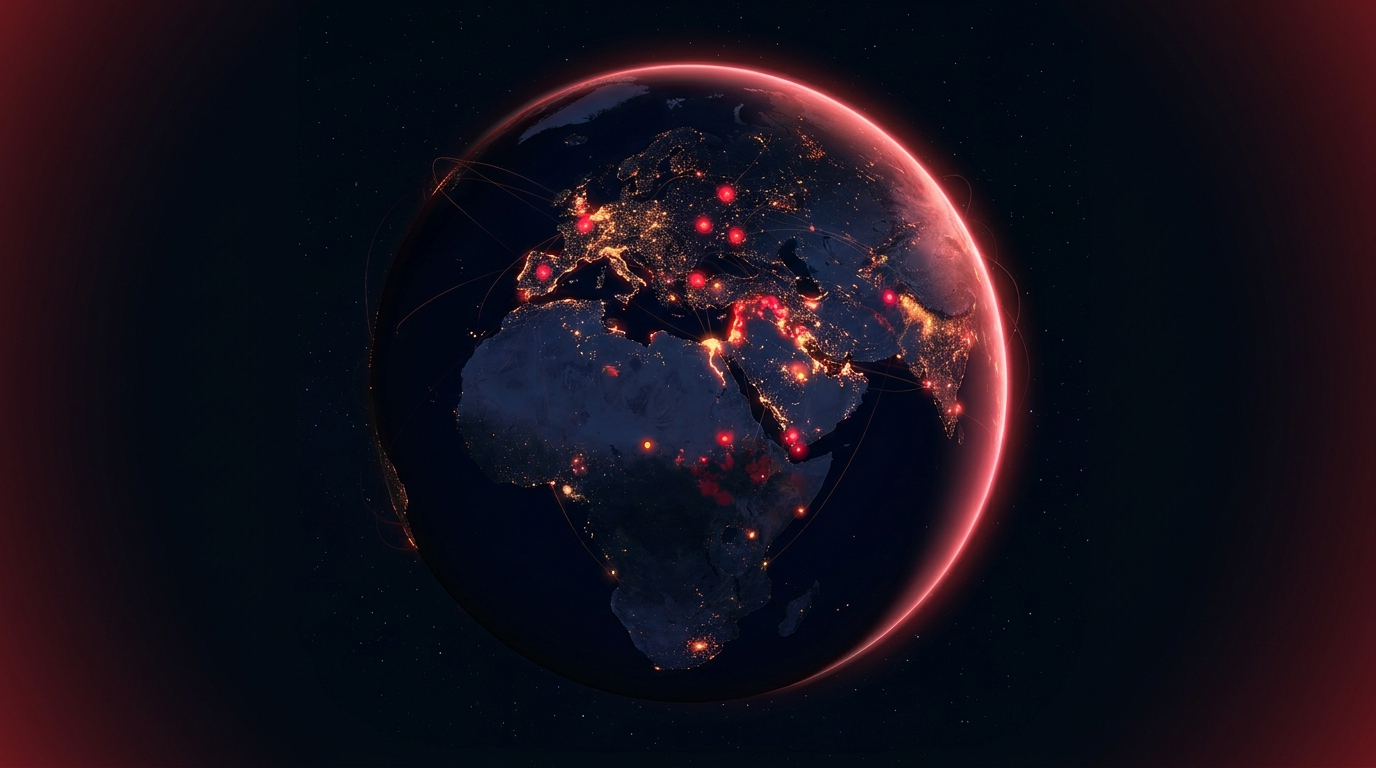
As of 24 October 2026, a live global conflict tracker identifies 29 active theaters, with an intensity classification legend (high intensity through watch/flashpoint) and data-source attributions including NASA imagery, UCDP death records, and Natural Earth borders. This multi-source approach strengthens confidence in casualty and conflict-intensity data, though it also means figures can vary between trackers depending on methodology.
Conclusion

The 24 October 2026 World Brief paints a picture of a world under sustained strain: a war in Ukraine reaching record casualty levels as Russia weaponizes winter, a sprawling map of secondary crises from Sudan to Ethiopia, intensifying great-power competition, a heavy election calendar, and a historic El Niño with multi-year reach. What matters most is the interconnection of these threads—conflict undermines health responses and poverty-reduction goals, geopolitics reshapes capital flows, and climate shocks threaten the logistics and food systems that underpin the global economy. For policymakers and observers alike, the takeaway is that 2026 is defined not by any single crisis but by their compounding effects, demanding coordinated, multi-domain responses rather than isolated reactions.