

A Non-Partisan Synthesis of Consequential Global Developments
Executive Summary
The global landscape in mid-October 2026 is defined by the convergence of four interlocking pressures: an energy-driven inflation resurgence, a "repricing of money" (rising long-term yields and renewed central-bank tightening), elevated sovereign-debt vulnerability, and a cluster of simultaneous geopolitical conflicts. The U.S.–Israel–Iran war—fought largely over the Strait of Hormuz—has produced the most severe disruption to global maritime commerce since the 1970s oil embargo, pushing crude above $100 per barrel and U.S. gasoline to record prices, while a worldwide bond sell-off drives Treasury yields to multi-decade highs. These market strains compound three ongoing conflicts (Russia–Ukraine, the U.S.–Israel–Iran war, and Middle East instability), contested elections, and elevated terrorism risk on the third anniversary of the October 7, 2023 attacks.
The single most consequential macro development is that the world is simultaneously experiencing high inflation and weak growth—a stagflationary configuration that complicates central-bank policy. The U.S. economy added just 29,000 jobs in September (versus 90,000 expected), yet inflation remains sticky above 3% on core measures, sustained by an energy shock. Central banks have resumed tightening rather than cutting, and long-term yields have spiked. Analysts increasingly frame these threads not as isolated events but as mutually reinforcing, part of a broader compounding movement.
Geopolitical & Military Developments

Russia–Ukraine War: A Collapsing Energy Truce
The Russia–Ukraine war has entered a volatile new phase. Ukraine launched a massive drone offensive on October 6, which Russia reported intercepting roughly 900 of; the strikes increasingly reach Russian energy and logistics infrastructure deep inside Russian territory. This coincides with intensified Russian missile and drone campaigns against Ukrainian infrastructure and, critically, a collapsing Russia–Ukraine energy truce. Russia's halt of diesel exports has added a "diesel shock" to global energy markets, pushing diesel near record highs and compounding the inflationary pressures described below.
The strategic significance here is twofold. First, the breakdown of the energy truce removes a channel that had partially decoupled the war from global fuel markets, meaning the conflict now transmits more directly into consumer prices worldwide. Second, the mutual targeting of energy infrastructure creates a feedback loop: attacks on refineries and export terminals raise prices, which funds further war spending, which incentivizes more attacks. The conflict continues to carry major implications for European security and NATO posture, with Europe still the primary theater of conventional risk.
U.S.–Israel–Iran War & the Strait of Hormuz Blockade
The war that began on 28 February 2026 has centered on the Strait of Hormuz—roughly a fifth of global oil and LNG passed through it pre-war. Iran's IRGC-Navy has executed a multi-phase campaign of mine warfare, vessel seizures, and U.S. counter-blockade that shut down the chokepoint, causing Brent crude to peak at $147 per barrel, European LNG prices to quadruple, Asia–Europe freight rates to rise 340%, and war-risk insurance premiums to jump 400–600%, with over 2,000 vessels trapped in the Persian Gulf. Source
Although a ceasefire was declared in late April 2026 and the strait nominally reopened, it remains effectively closed. Tanker attacks have surged to a wartime high—eleven strikes in the week ending October 3, 2026, with at least 12 incidents between September 28 and October 5, including drone strikes and a reported mine strike on a supertanker. Source Source Crude trades above $100 per barrel and U.S. gasoline has hit a record $4.40 per gallon. Source
Where sources disagree: Assessments of the strait's status are sharply divided. Iran has declared Hormuz a "strategic red line," broadened its target range toward UAE waters, and claims full control, asserting the waterway is "closed." The U.S.—through Secretary of State Marco Rubio—disputes this, stating commercial oil flows have largely recovered and the strait remains open, with oil flowing near pre-war levels. Source Source Estimates of disrupted flows vary widely—from roughly 23% to 40% below pre-war baselines, with as few as seven tankers transiting on one recent day versus approximately 88 pre-war. Source Source
Militarily, the U.S. has deployed a third aircraft carrier to the region and maintains a counter-blockade of Iranian ports, disabling the cargo vessel M/V Ocean Molica. Source Diplomatically, the campaign is an endurance test: President Trump has pledged no strikes before the November 3 midterms, citing ongoing discussions and nuclear non-proliferation as his priority, and rejected Iran's seven-day reopening roadmap on September 26. Source The financial unsustainability of the situation is stark—shipping costs have skyrocketed to approximately $1 million per tanker per day—and at least nine sailor deaths have occurred since July, underscoring the human and economic toll of this protracted confrontation.
Middle East: Anniversaries and Spillover
October 7 marked the third anniversary of the October 7, 2023 Hamas attacks, coinciding with the Sukkot holiday. The Gaza ceasefire remains fragile and contested. Renewed Houthi fighting in Yemen continues to threaten Red Sea shipping, while regional instability has spread to Lebanon and Syria, adding to the cluster of conflicts that define the region. The anniversary's symbolic weight, combined with the ongoing Iran war, has raised the global terrorism threat, as noted in the Security section below.
U.S.–China / Taiwan
Taiwan persists as a strategic pressure point in U.S.–China relations, even as broader economic engagement continues. The EU–China interim deal on electric vehicles and rare earths signals a trajectory of managed industrial competition rather than full decoupling, while Europe's €21 billion critical-minerals push reflects a desire for strategic autonomy. The interplay of competition and interdependence remains the defining feature of great-power economic relations.
Geoeconomics & Trade
The global trading system is being reshaped by the same forces driving the security landscape. A Trump–Putin Russian diesel agreement—which had sacrificed sanctions consistency for near-term fuel relief—appears to be collapsing as the Russia–Ukraine energy truce breaks down, reintroducing uncertainty into European fuel supplies. An EU–China interim deal signals managed industrial competition on electric vehicles and rare earths, while Europe launched a €21 billion critical-minerals push to reduce dependency.
The WTO raised its 2026 global trade growth forecast to 3.9%, aided by AI investment, but this headline masks deeper fragility. Shipping costs through the Persian Gulf have skyrocketed to ~$1 million per tanker per day, reflecting the Hormuz premium that is now baked into global supply chains. More broadly, rising sovereign borrowing costs are increasingly constraining fiscal flexibility worldwide, as the repricing of money (detailed below) makes debt servicing more expensive for every major economy. The result is a paradox: trade volumes are growing, but the cost of moving goods and financing governments is rising faster, compressing margins and limiting policy room.
Global Economy: A "Repricing of Money"

The defining macro development is a repricing of money: growth remained resilient—especially in the U.S. and AI-linked sectors—while inflation returned via energy markets. Central banks resumed tightening, and long-term bond yields hit multi-decade highs. The environment is unusual and difficult: high headline inflation (core PCE at/above 3%) coexists with weak job growth—September payrolls came in at just 29,000 versus 90,000 expected, with downward revisions—steepening the yield curve and pinching policymakers between competing mandates.
Rates: The Fed's Hawkish Hold and the December Question
The Fed's last hike was 25 basis points on September 16—its first since July 2023—holding the target range at 3.75%–4.00%. Chair Kevin Warsh has emphasized that inflation remains too high, and Governor Michael Barr has indicated further adjustments are likely. Source
Where the evidence evolves: The market's expectation for the October 28 decision has shifted dramatically. In late September, Barr's hawkish comments led markets to price a ~73% chance of an October hike. Source But after the soft September inflation data and the weak jobs report, markets now price only a 16%–18% chance of an October hike. Source The base case is now a hawkish hold, with a December hike (December 9 meeting) considered more likely (75%–85%)—aided by the proximity to the November midterms, which creates political incentive to defer tightening. Source Source
Notably, the Fed has nonetheless telegraphed a further quarter-point hike before year's end, with labor market near full employment and economic activity expanding. Consumers continue spending despite a sour mood, which keeps the case for tightening alive even as the weak jobs report argues for patience. Other central banks held: the BoE at 3.75%, the ECB at a 2.50% deposit rate, and the BOJ policy rate at 1.25%.
Yields: A Worldwide Bond Sell-Off
The U.S. 10-year and 30-year Treasury yields reached approximately 5.3% (5.28%–5.35%, highest since 2002) and 5.6%, while the 2-year traded above 4.9%. Source Source The worldwide bond sell-off has been broad and synchronized: Japan's 10-year yield hit 3% (highest since 1996), and Euro area yields reached 10-year highs. Source
The drivers are cumulative: the September Fed hike, a rising term premium, heavy Treasury supply, the diesel shock, and reduced foreign demand for U.S. Treasuries as global yields rise elsewhere. This is the mechanism through which the energy shock transmutes into a fiscal shock—higher yields make existing debt more expensive to roll over, which worsens deficit projections, which in turn pressures yields further.
Debt Vulnerability
Sovereign debt risk is elevated across major economies, with debt-to-GDP ratios near ~203% in Japan, ~138% in Italy, ~118.5% in France, and 125.8% in the U.S. Source The October risk ranking places Japan first (Extreme, worsened), followed by the United States and France (both Very High, worsened)—reflecting that rising yields now compound existing debt and deficit vulnerabilities even for strong borrowers. The irony is that the same bond sell-off that reflects economic resilience is also the channel through which that resilience becomes financial fragility.
Security & Threat Landscape
- Terrorism: The October 7 anniversary and Sukkot holiday are expected to elevate the global terrorism threat, with Jewish and Israel-linked soft targets in Europe, North America, and the Middle East likely to remain priorities for opportunistic, small-scale attacks.
- AI governance: The International AI Summit in Dublin faces elevated disruption risks from activists, prompting enhanced security.
- Multilateral meetings: The IMF/World Bank meetings in Bangkok are occurring amid geostrategic tensions and trade/energy risks.
- Elections: Six national elections—including contested votes in Brazil, Serbia, and Israel—are unfolding against a backdrop of political instability.
Cross-Cutting Theme
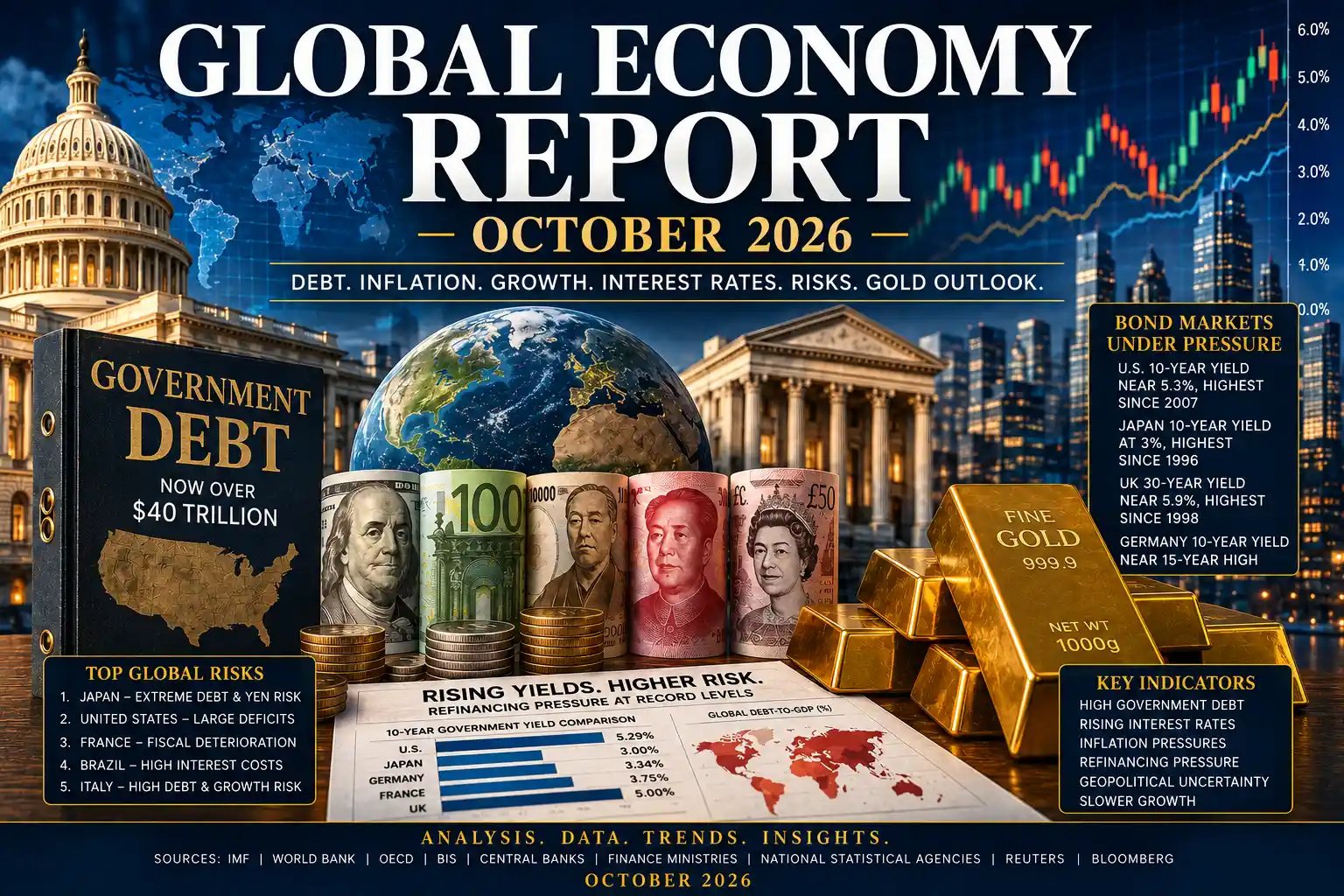
The dominant analytical takeaway is interconnectedness: security, energy, markets, and diplomacy are mutually reinforcing. Energy-driven inflation feeds bond-yield spikes; the Iran and Ukraine wars drive both oil prices and fiscal strain; and the October 7 anniversary links conflict diplomacy to domestic security threats. The Fed's hawkish hold, the Hormuz blockade, and the Russia–Ukraine energy truce collapse are not separate stories—they are the same story told through different lenses. These dynamics are increasingly part of a broader, compounding historical movement rather than discrete events, and treating them as such is essential for accurate forecasting and policy.
Conclusion
To answer the question directly: as of October 17, 2026, the world is navigating a period of simultaneous stress across security, energy, and financial markets. The most consequential developments are: (1) the U.S.–Israel–Iran war over the Strait of Hormuz, which has produced the worst maritime disruption since the 1970s embargo and pushed crude above $100; (2) the repricing of money, with the Fed likely to hold in October but signal a December hike, and worldwide bond yields at multi-decade highs; (3) a stagflationary configuration where high inflation coexists with weak job growth; and (4) a cluster of interlocking conflicts—Russia–Ukraine, the Middle East, and contested elections—that amplify one another. The key analytical insight is that these threads are interconnected and mutually reinforcing, and the central policy challenge is managing an economy that is too hot for rate cuts yet too weak for aggressive hikes. Non-partisan synthesis, therefore, must resist framing these developments as isolated events and instead treat them as components of a single, compounding global transition.
Sources
- Weekly Geopolitical News Bulletin: October 2–9, 2026
- Global Geopolitical Brief | October 7, 2026
- Global Outlook for October 2026
- Global Economy Report October 2026: Debt, Rates & Gold
- Fed Telegraphs Another Interest Rate Hike This Year
- Fed Rate Decision October 2026: Hike or Hold on 28 Oct?
- Market sees next Fed hike in October, following Barr comments
- Macro Monthly, October 2026: US Treasury Yield Assessment
- Iran Blockade Strait of Hormuz 2026: Timeline, Scenarios & Analysis
- Tanker Attacks in Strait of Hormuz Hit Wartime High
- Strait of Hormuz Attacks Surge as Iran Steps Up Campaign
- Iran Hormuz Oil Analysis
- Tanker Attacked Off Qatar as Iran Claims Route Transporting Oil
- Crude Oil Tanker Strait Hormuz Iran Attack