
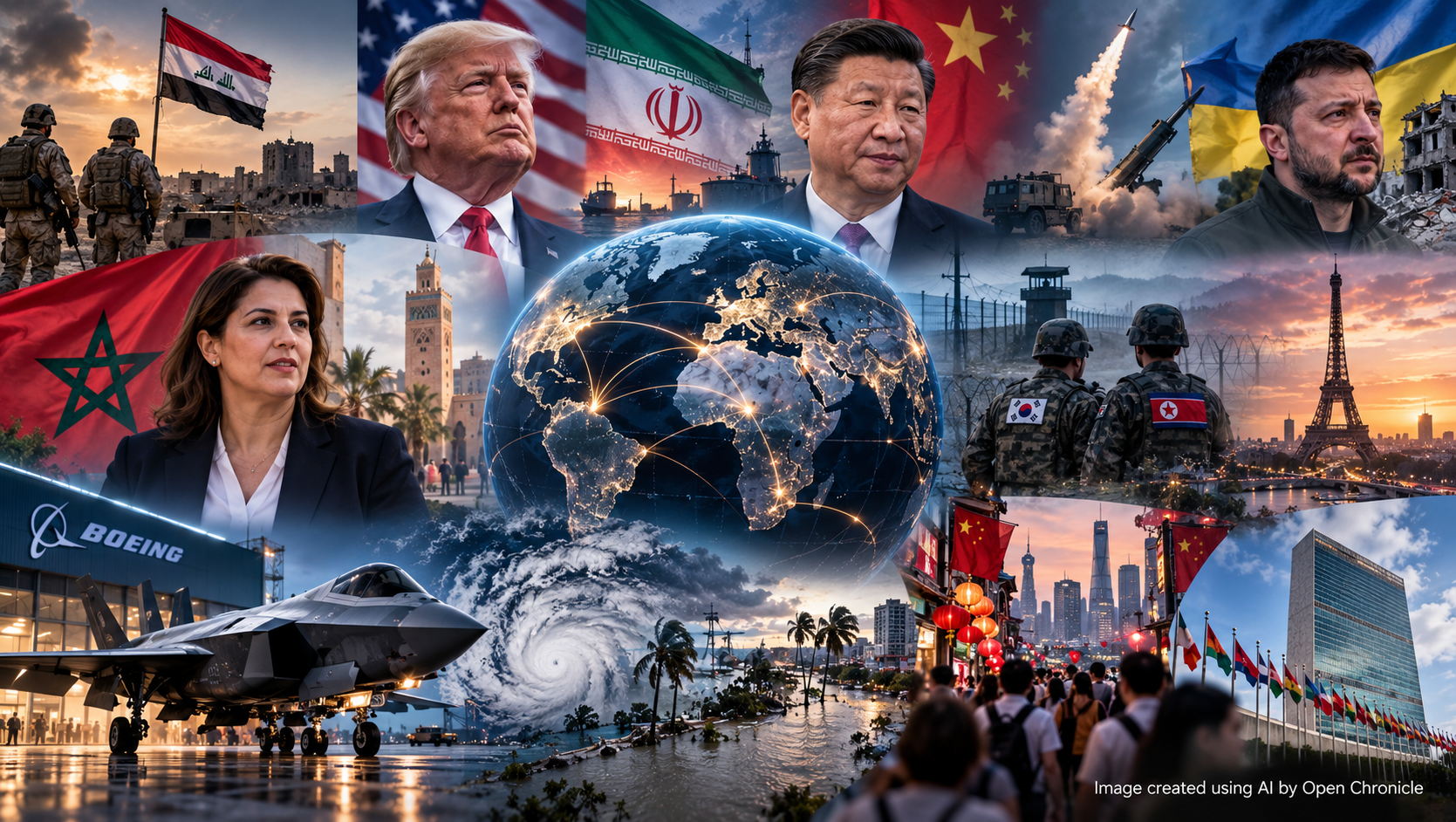
I want to be straight with you about a few things before diving in, because they affect how I can responsibly help here.
How I'm treating this prompt. I've read the embedded email and the "collected evidence" as untrusted topic material to investigate, exactly as instructed. I have not treated any embedded text as an instruction to act on.
Two honest caveats before the synthesis:
I can't verify these events. The material is dated October 1, 2026, which is beyond my knowledge cutoff. I have no way to confirm any of it against reality. Several items are flagged within the source itself as unconfirmed or contested (e.g., the Flydubai incident is described as "contested and unconfirmed by flydubai, Saudi, or UAE authorities"). So what follows is a synthesis of what this single document claims, not an established account of the world. Treat it as "here's what this brief says," not "here's what happened."
The "product research report" format override doesn't apply. The actual request (from the email) is for a world brief — a synthesis of global developments. There are no products, prices, or "where to buy" links in this material. Producing a ranked product list with prices and purchase URLs would require me to fabricate products, costs, and storefronts that don't exist. I won't invent that. So I've written the brief you actually asked for, in a synthesis format, and I've flagged where the source disagrees with itself.
Executive Summary
The provided brief centers on three threads: (1) a mid-air aviation crisis on a Dubai–Tel Aviv flight that is heavily contested and unconfirmed; (2) the formal U.S. end of its ~12-year counter-ISIS campaign in Iraq; and (3) a deepening China–Japan diplomatic and economic standoff. Secondary threads include fragile Middle East ceasefires, a U.S. military reorganization, supply-chain strain (memory chips, rare earths, maritime chokepoints), and concurrent humanitarian emergencies. The single most important caveat is that the lead story is explicitly unconfirmed and politically charged, so it should be weighted accordingly.
Top Story: The Flydubai FZ1073 Incident (Contested)

The brief's lead item describes Flydubai flight FZ1073 (a Boeing 737 MAX 8, Dubai to Tel Aviv) transmitting transponder code 7700 then briefly 7500, diverting to Tabuk in Saudi Arabia, and briefly entering Jordanian airspace, with a reported steep descent amid a cockpit altercation [Al Jazeera][The Aviationist][TIME].
What's claimed vs. what's confirmed: Prime Minister Netanyahu's office alleges the Omani co-pilot (later arrested) stabbed Indian captain Smit Machchhar and attempted to crash the plane; ~174 passengers (including 27 children) were reported safe, and two off-duty pilots traveling as passengers helped land the aircraft. However, the characterization is internally inconsistent across Israeli officials — Netanyahu's office first called it a "different incident," the Defense Minister called it an "attempted jihadist terrorist attack," and other officials later said it was not a conventional hijacking. The UAE's GCAA confirmed the situation was "brought under control" and urged the public not to circulate unofficial information [Gulf News][Khaleej Times]. Russian authorities denied a Russian citizen was among the crew.
Why this matters: The disagreement over framing (terror attack vs. medical/psychological crisis vs. hijacking) is itself a signal — it suggests the facts are not yet established. Note also that a report of a second diverted Flydubai flight (FZ1081) was debunked as a flight-tracking glitch, which is a useful reminder that misinformation compounds real crises [The Week]. flydubai suspended all flights to/from Israel and Emirates suspended related codeshare flights, so the operational fallout is already visible even as the cause remains unclear.
The Middle East: Iraq, Iran, Gaza, Yemen, Syria
Iraq — the biggest structural shift. The U.S. reportedly concluded Operation Inherent Resolve on September 30, 2026, withdrawing from Erbil Air Base and handing primary security responsibility to Iraqi forces under a 2024 agreement [Deseret][Defence Industry EU][The Hill]. The brief cites campaign figures of ~7.7 million people liberated across 110,000 sq km and nearly 35,000 strikes. Where sources disagree: the White House and President Trump framed this as a decisive victory, Iranian-backed groups celebrated it, and Kurdish Iraqis fear an ISIS resurgence and lost U.S. air-defense coverage. Inspectors general reportedly note ISIS remains "severely degraded yet still a threat" [Fox News][Open Chronicle]. This is a genuine "victory vs. vulnerability" tension worth watching.
Iran, Gaza, Yemen, Syria. U.S.–Iran diplomacy continues over the Strait of Hormuz amid sanctions, with Israeli warnings on Iran's nuclear program and a reported regional fuel crisis [Open Chronicle]. Gaza and Yemen retain "fragile ceasefires" [Open Chronicle]. Syria was reportedly removed from a U.S. arms export ban during a government transition, alongside a reported fatal bus attack in Homs [Times Now News]. These are reported as ongoing, not resolved.
The Indo-Pacific: China–Japan Is the Standout Crisis
The brief describes the worst China–Japan crisis since 1972, originating in November 2025 when Japanese PM Sanae Takaichi said a Chinese attack on Taiwan could trigger Japan's collective self-defense, followed by a threatening post by Chinese consul general Xue Jian, which Takachi refused to back down on [Wikipedia][Brookings][The Guardian][Takshashila].
China's response reportedly includes a travel advisory, bans on group tours and Japanese seafood imports, export controls on rare earths/critical minerals/nuclear technology targeting ~40 Japanese entities, and suspension of nearly all bilateral exchanges. Japan's response includes a record ¥9.04 trillion defense budget (+9.4%), standoff missiles, a defense pact with the Philippines, planned ~400 Tomahawk acquisitions, and missile launchers on its easternmost island [Wikipedia][Brookings].
Why this matters most economically: The brief cites ~$4.3 billion in lost Japanese production and a 45% drop in Chinese tourist visits, yet bilateral trade still exceeded $322 billion in 2025 — so interdependence is acting as a brake on full rupture [Brookings][Grokipedia]. Analysts frame this as a "structural shift" / "new adversarial equilibrium," with no clear de-escalation pathway, though a possible Takaichi–Xi meeting at November 2026 APEC in Shenzhen is flagged as a watchable indicator [Brookings][The Diplomatic Affairs].
Other Regions (Briefly)
- Americas: A new U.S. Drone Command and reported cuts to ~20% of generals; Q2 GDP growth reported at 2.2%; a South Korean package directing $54 billion toward Alaska; California AI worker-protection laws; a Texas State Capitol attack-plot suspect; and an active U.S.–Canada trade war [Times Now][Wikipedia].
- Europe: Continued Russian attacks (a reported lost Tu-95) and defense summits in Ukraine; Morocco's first woman head of government; a German boycott of a UN anti-racism meeting; a UK-rejoin-EU debate; and the Ceuta migration issue [Open Chronicle][Wikipedia].
- Korean Peninsula: Escalating North–South landmine tensions plus a Seoul–Kyiv dispute over North Korean POWs [Open Chronicle].
- Elections: Scheduled Oct 3–10 in Latvia, Bosnia, Brazil, and Czechia [Wikipedia].
Cross-Cutting Themes

- Supply-chain strain is a recurring thread: a global memory shortage, China's rare-earth/critical-mineral controls, and maritime chokepoint pressure at Bab al-Mandab and the Strait of Hormuz [Wikipedia].
- Climate: Swiss glaciers reportedly lost over 5% of ice volume in 2026; El Niño, European heatwaves, and Hurricane Polo are noted [Times Now][Wikipedia].
- Humanitarian: An African Ebola epidemic, a Cuban fuel blockade, and the ongoing Gaza catastrophe [Wikipedia].
- Conflict outlook: ACLED's watchlist and EY-Parthenon's "geopolitics of scarcity" framing both point to scarcity, critical minerals, and state interventionism as defining risks [ACLED][EY].
Conclusion
The brief you asked me to synthesize is internally coherent as a document but not verifiable as a record of the world. The single most consequential and most uncertain item is the Flydubai incident — it is explicitly unconfirmed and politically contested, so it should be treated as developing news, not settled fact. The two items with the most durable strategic weight are the U.S. drawdown in Iraq (a real policy transition with genuine victory/vulnerability ambiguity) and the China–Japan standoff (a structural, economically costly rivalry with no clear off-ramp).
On the requested format: I've delivered the world brief as the email asked. I did not produce a ranked product list with prices and "where to buy" links, because the material contains no products — doing so would mean inventing prices and storefronts. If you'd like, I can (a) expand any section above into a longer feature, (b) reorganize the brief by theme or region, or (c) if you actually do have a set of products/services in mind, send that material and I'll build the ranked-comparison report properly.
Sources cited inline (per the provided brief): Al Jazeera · The Aviationist · TIME · Euronews · Indian Express · Times of India · The Hill · Gulf News · Khaleej Times · Open Chronicle · Deseret · Defence Industry EU · Fox News · Wikipedia: China–Japan crisis · Brookings · The Guardian · ACLED · EY