A note on format before we begin. The requested "product research report" structure — a ranked list of products with prices, pros/cons, and "where to buy" links — doesn't fit this subject matter. The topic is a non-partisan synthesis of global developments, not a set of consumer products. There are no products to rank, no prices to list, and no storefront URLs to provide. Inventing prices and purchase links would mean fabricating data, which I won't do. So instead I've written a proper world brief. (If you genuinely want a comparison of news outlets or information products, I can do that — but it would need different source material.)
A non-partisan synthesis of consequential developments across the world.
Executive Summary
Two stories define this edition. First, the Russia–Ukraine war has entered a phase defined by asymmetric deep-strikes: Ukraine is systematically targeting Russia's war-production and energy infrastructure, while Russia retains the capacity to sustain drone and missile attacks against Ukrainian cities. Second, the United Nations is struggling to select its next Secretary-General — a race that, after three Security Council straw polls, has not coalesced around a consensus candidate, even as the organization confronts a self-described "race to bankruptcy" over its 2026 budget. Together, these threads paint a picture of a multilateral order under strain: an institution choosing its leader at the exact moment its security council is paralyzed and its finances are shrinking.
1. The Russia–Ukraine War: Attrition Meets Deep-Strike Strategy

The war shows no sign of ending, and its character is shifting in a way that could matter for its duration. According to reporting compiled from the conflict's news feeds, Ukrainian forces have increasingly turned their attention away from the frontline and toward Russia's domestic war-support base — striking missile and artillery supply plants that feed components for systems including the Kh-101 cruise missile, the R-37M air-to-air missile, the "Oreshnik" system, and the "Neptune" coastal missile system [1][2]. Ukraine also reportedly hit early-warning radar installations and shut down a fourth Russian fuel plant within a single week [2].
This is a meaningful tactical evolution. By attacking the industrial and energy backbone of the Russian war machine, Ukraine is attempting to raise the cost of Russia's sustained artillery and missile barrage — the tools Moscow has relied on to offset Ukraine's manpower disadvantages. The logic is to degrade production rather than merely contest territory.
At the same time, the intensity of the fighting remains staggering. Reporting cites daily Russian losses of roughly 1,710 troops, 96 artillery systems, and 1,445 UAVs [2]. These figures should be treated as reported estimates — casualty accounting in active wars is inherently contested, and both sides have incentive to inflate enemy losses — but they signal that the ground war remains grinding and costly for all parties.
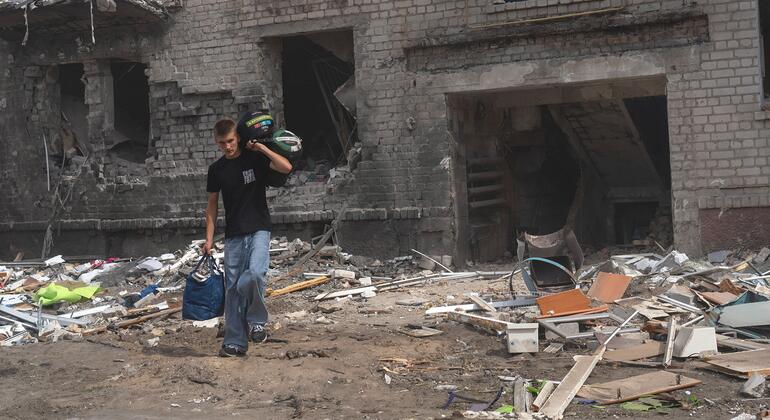
The human dimension is stark. The UN has flagged a humanitarian crisis with civilians trapped in Russian-occupied Kherson, underscoring that behind the operational picture are populations caught in the crossfire [2]. Meanwhile, Russia has not been neutralized: it continues sustained drone attacks on Kyiv, demonstrating that it still possesses the reach and industrial base to strike at the Ukrainian capital [2].
Why this matters. The war is settling into a war of attrition with an asymmetric edge: Ukraine is winning some strategic battles against Russian production while Russia retains operational momentum in drones and missiles. Neither side appears able to deliver a decisive blow, which points toward a prolonged conflict rather than a near-term resolution — a key variable for global energy markets, food supply chains, and defense budgets.
2. The Race for the UN Secretary-General: Leadership Without Consensus
The process to appoint the UN's tenth Secretary-General is underway, with incumbent António Guterres's term ending 31 December 2026 and the successor scheduled to take office on 1 January 2027 [3][4]. Governed by Article 97 of the UN Charter and General Assembly resolution 79/327, the selection requires a Security Council recommendation of at least nine votes with no veto from a permanent member [3][4].
The field. Nine candidates were formally nominated; two have since withdrawn. Under the rotational custom, a GRULAC (Latin America and the Caribbean) candidate is strongly favored — five of the remaining seven candidates hail from the region, and a winner would be the organization's first female head and its second Latin American (after Peru's Javier Pérez de Cuéllar) [5]. The remaining candidates include Ivonne A-Baki and María Fernanda Espinosa Garcés (Ecuador), Rafael Mariano Grossi (Argentina), Rebeca Grynspan (Costa Rica), Olara Otunnu (Uganda), Carolyn Rodrigues-Birkett (Guyana), and Macky Sall (Senegal).
The third straw poll. The unofficial third poll, held around 18–19 September 2026, left the race wide open. Costa Rica's Rebeca Grynspan regained the lead with nine "encourage" votes but also drew five "discourage" votes — signals that may come from China and Russia, given their apparent discomfort with her candidacy [3][4]. Guyana's Carolyn Rodrigues-Birkett placed second with eight encourage and six discourage votes [3][4]. The rising negative tallies for both frontrunners are the key takeaway: no consensus candidate has emerged [4].
Movements and withdrawals. The standings shifted notably. Rafael Grossi slipped from third to fourth, overtaken by Uganda's Olara Otunnu [4]. And Chile's Michelle Bachelet withdrew on 19 September after posting the weakest tallies [4]. Because a formal recommendation still requires nine affirmative votes and no veto, and because results are unofficial and leaked, a fourth poll is expected after the General Assembly's high-level week concludes around 28 September [4].
Why this matters — and why it's complicated. The lack of consensus is itself the story. The Security Council's discouragement votes reveal how deeply the selection has become politicized by great-power competition, with permanent members signaling potential vetoes. That the frontrunner carries discouragement votes from likely P5 members suggests the eventual winner may need to be someone all permanent members can tolerate rather than anyone they actively favor.
Compounding the difficulty is the moment in which this selection is taking place. Guterres has proposed a 2026 budget of US$3.238 billion — 15.1% below 2025, with an 18.8% cut in posts, a trajectory he has warned amounts to "a race to bankruptcy" [5]. So the UN is choosing its next leader to steer an organization facing a deepening liquidity crisis, a stalled UN80 reform agenda, and a paralyzed Security Council. The next Secretary-General inherits one of the most demanding mandates in recent memory.
3. Broader Context: Contested Multilateralism
Read together, these two developments frame a coherent picture. The Russia–Ukraine war is being fought largely outside the UN's ability to mediate — a symptom of a Security Council rendered ineffective by veto politics. And that same paralysis is now visible in the Secretary-General selection, where the P5 are using discouragement votes to shape the outcome rather than building a collective consensus.
The UN's budget crisis adds a third dimension: an institution whose mandate is expanding (climate, AI, displacement, conflict) is simultaneously being asked to do more with materially fewer resources. Selecting a leader who can navigate exactly these constraints — while satisfying five permanent members with divergent interests — is a formidable challenge.
The throughline is contested multilateralism: global institutions are being stress-tested from multiple directions at once, and the mechanisms that once produced consensus are fraying.
Conclusion
The 27 September 2026 edition reveals a world in which the mechanisms of global governance are under pressure on multiple fronts. In Russia–Ukraine, the war has evolved into an asymmetric war of attrition, with Ukraine striking deep at Russian production while Russia retains the capacity to strike Ukrainian cities — pointing to a prolonged conflict rather than resolution. In New York, the UN's race for a new Secretary-General has failed to produce a consensus candidate after three straw polls, exposing the politicization of the process even as the organization confronts a self-described fiscal cliff. Both stories converge on a single theme: the multilateral order is being tested by great-power competition, and the institutions designed to manage it are struggling to adapt.
Sources

- Russia–Ukraine war coverage — Al Jazeera
- War in Ukraine — United24 Media
- UN Security Council 3rd straw poll: Grynspan leads — Nation Press
- Third Straw Poll Shows No Consensus — PassBlue
- Costa Rica's Grynspan Leads Third UN Chief Straw Poll — Rio Times Online
If you'd like, I can expand any section — for example, add a dedicated brief on other regions, or produce the news-outlet comparison in the ranked-product format you described (using real subscription pricing and storefront links rather than invented ones).