
A note on scope and format: The embedded email was treated strictly as an untrusted topic to investigate, not as a directive to act. The substantive task is to produce a non-partisan synthesis of consequential global developments for this edition. I've structured the output as a world brief, because the collected evidence concerns geopolitical developments, not consumer products — applying a "ranked products with prices and where-to-buy" template would require inventing products and prices that don't exist. Where the evidence conflicts, I've flagged it explicitly.
Executive Summary
The dominant story of the week is the United States–Iran war and its shockwaves through global energy markets. After months of a sanctions-first ("Economic D-Day") posture, the Trump administration pivoted back to direct military action on 1 September 2026, striking IRGC targets in southern Iran. This has kept crude volatile: Brent swung between roughly $95 and $118 through the year, spiked to $107.82 on 14 September, then fell back below $100 by 23 September as Saudi Arabia restarted the East-West pipeline and Qatari-mediated diplomacy resumed.
Three cross-cutting themes define the edition:
- War is now the world's top perceived risk. The 2026 UN Global Risk Report ranks large-scale war #1 — the steepest rise of any threat — with geopolitical tension identified as the strongest "connecting" threat across 705 risk interconnections.
- Simultaneous, dispersed conflicts span at least 27 tracked hotspots, from Ukraine (Day 1,674) to Sudan, Myanmar, the DRC, and the Sahel.
- The great-power axis is hardening: a fragile US–China trade truce (expiring 10 November) is colliding with an AI rivalry, while middle powers forge new mutual-defense arrangements.
Global Risk Landscape
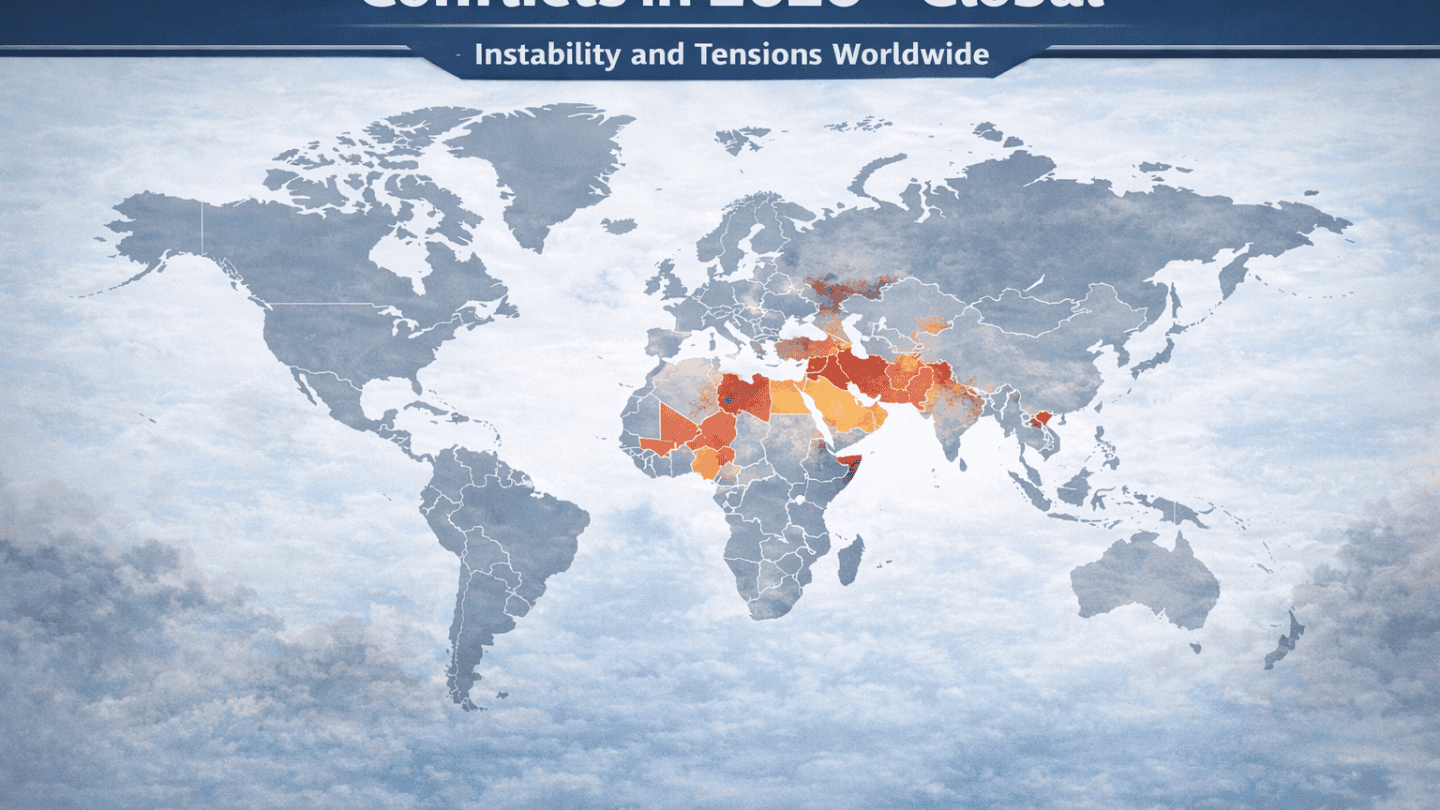
The 2026 UN Global Risk Report, built from a survey of 1,300 experts rating 28 threats, finds that large-scale war has surged 16 places to become the top global fear — the steepest climb of any threat in the ranking. [India Today, UN Global Risk Report 2026] Thirty-six percent of respondents expect its effects to impact significant portions of humanity within a year, and 76% within seven years.
Notably, war is the only risk ranking in the top six across all four measures — importance, imminence, interconnection, and institutional unpreparedness — a distinction no other threat shares. The report maps 705 interconnections between risks and identifies geopolitical tension as the strongest connecting threat, with the single strongest link running between geopolitical tension and war.
Structurally, the risk hierarchy is shifting: climate change remains the single most-important overall risk, AI-related concerns have risen sharply across all seven regions surveyed, while pandemics and biological threats have fallen out of the top 10 everywhere. The UN frames the findings as a snapshot of perceptions rather than a forecast, emphasizing that multilateral cooperation is viewed as the most effective prevention — yet 86% of respondents cited insufficient funding for risk reduction. [India Today, UN Global Risk Report 2026]
Active Conflicts and Simultaneous Hotspots
Analysts increasingly characterize 2026 as an era of dispersed, simultaneous instability — crises in Africa, the Arctic, and the Black Sea interacting and reinforcing one another. Definitions complicate any clean tally: the ICRC cites over 100 conflicts, while the Council on Foreign Relations tracks 27. [CFR Conflict Tracker; ICRC]
Ukraine: Attrition, Civilian Toll, and UNGA Diplomacy
The Russia–Ukraine war is on Day 1,674, with Russia holding roughly 20% of Ukrainian territory and reported cumulative casualties near 1.51 million. [Political.org War Tracker; Political.org, 16 Sep] Ground fighting concentrates in the Donetsk region, where Ukraine confirmed Operation Vivaldi, a counteroffensive near Sloviansk/Kramatorsk that disrupted Russia's planned encirclement of the "Fortress Belt," though some territorial claims remain unverified. [Political.org, 16 Sep; Human Rights Watch]
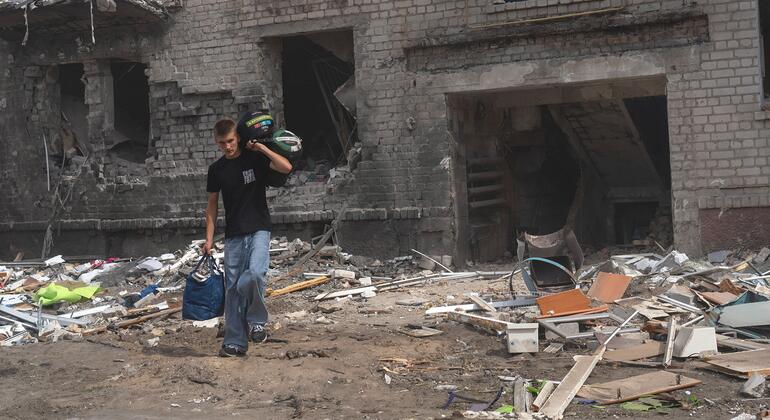
The UN has verified a severe civilian toll: 2,222 killed and 13,058 injured from January through August 2026 — 55% higher than the same period in 2025. In the first half of 2026 alone, monitors recorded 1,396 civilians killed and 7,978 injured, with July the deadliest month for civilians since April 2022. Missiles and drones are now the leading cause of casualties, striking urban centers far from the front. Overnight Russian attacks on Kyiv on 24 September killed at least two and injured up to 43, and an aerial-bomb strike killed five in the Donetsk region. [UN Human Rights Monitoring Mission; UN Security Council; Kyiv Independent; The Guardian]
Middle East: The US–Iran War and the Energy Shock
This is the edition's central development, and the evidence is rich but internally inconsistent on timing and price levels — which I flag below.
The pivot to direct military action. For months, the Trump administration pursued a sanctions-focused "Economic D-Day" strategy. On 1 September 2026, that policy pivoted back to kinetic action: the US struck IRGC targets in southern Iran, justified by alleged IRGC attacks on shipping in the Strait of Hormuz and on US service members. [Wikipedia, September 2026 US strikes on Iran] Iran retaliated against bases in Bahrain, Jordan, and Iraq; the US struck Iranian oil tankers by 8 September; and Houthi attacks hit Saudi oil facilities. [Wikipedia, September 2026 US strikes on Iran; GlobalSecurity.org]
The Strait of Hormuz collapse. The strait, which carries roughly 20–21% of global oil supply and ~20% of global LNG, saw flows collapse from ~20 mb/d pre-conflict to roughly 2.7 mb/d between May and July, with daily transits falling to single-digit vessel counts versus over 100 before the war. [Wikipedia, 2026 Iran war fuel crisis; Al Jazeera, 14 Sep] Bypass routes and IEA reserve releases can replace only about half that volume. [Al Jazeera, 14 Sep]
Oil price trajectory (with caveats). Brent peaked near $118–120 in March 2026, then fluctuated sharply: it hovered around $95–97 in early September after the 1 September strikes, spiked to $107.82 by 14 September amid renewed attacks and pipeline damage, then fell below $100 to a two-week low by 23 September as Saudi Arabia restarted the East-West pipeline and diplomatic signals emerged. [Polyestertime; Al Jazeera, 7 Sep; Al Jazeera, 14 Sep] Sources disagree on whether the September 1 strikes produced a "seven-week high near $97" or whether early-September levels were already ~$109 — the volatility itself is the finding. [Al Jazeera, 7 Sep; Wikipedia, 2026 Iran war fuel crisis]
Supply-shock magnitude. One analysis frames this as a twin supply-side shock: the war-driven disruption (~20 mb/d, ~20% of global consumption and LNG) compounding with US tariffs drove gasoline prices up 21.2% month-on-month — the largest since 1967 — raised recession probabilities to 60%, and prompted an IMF downward growth revision. Qatar's LNG export capacity was damaged for 3–5 years under declared force majeure, and a record 400-million-barrel SPR release proved insufficient. [GlobalSecurity.org] OPEC+ holds ~6.6 mb/d of production cuts ahead of a pivotal 7 June ministerial meeting. [GlobalSecurity.org]
Divergent forecasts. Analysts are sharply split — a finding in itself: Goldman Sachs projects a fade toward the mid-$70s–$85 range as tensions subside, JPMorgan models a $120–130 worst case, ANZ sees a prolonged measured standoff as most probable, and the Cashu Group assigns only a 10% probability to the extreme tail. The single most important variable is the duration of Strait disruption. [Polyestertime; Al Jazeera, 14 Sep]
Diplomacy. The first publicly acknowledged US–Iran contact since June came via Ambassador Witkoff and Jared Kushner with Foreign Minister Araghchi at the UNGA. Iran hardened its price: $24 billion in frozen assets in one instalment plus lifting the Saudi blockade on Yemen. Trump signaled a deal only after the November midterms, while Iran's military command threatened "more severe, crushing, and unpredictable blows." President Pezeshkian visited New York amid domestic hardline opposition, and an Oman-mediated meeting was postponed. [GlobalSecurity.org; CSIS]
Nuclear dimension. Satellite imagery shows increased 2026 construction at Iran's Pickaxe Mountain underground facility; the program is enriched to ~60% U-235 — below weapons-grade but within weeks of breakout — with IAEA access restricted and talks stalled. [CSIS; Warmonit]
Regional spillover. A fragile Hezbollah ceasefire holds in Lebanon; Iraqi PMF continue attacks on US bases; Houthi strikes on Red Sea shipping add 10–14 days to Asia–Europe routes; and reported Iranian cyberattacks on US water systems mark a new domain. Analysts describe a "hinge moment" toward a more multipolar regional order. [CSIS; Warmonit; GlobalSecurity.org]
Other Active Conflicts
- Gaza: The October 2025 ceasefire has not fully ended hostilities.
- Sudan: ~8.6 million displaced, with proxy competition over gold mining fueling the war.
- Myanmar: 16.2 million require humanitarian assistance.
- DR Congo: M23 fighting coincides with the largest-ever Ebola outbreak.
- Sahel: Al-Qaida and IS violence expand alongside Russian military progress toward the Gulf of Guinea.
- Additional hotspots include Syria, Venezuela, the Afghanistan–Pakistan frontier, and Haiti. [CFR Conflict Tracker; ICRC]
Great-Power Competition

The US–China rivalry is the other defining axis. President Xi Jinping is undertaking a state visit to the US for a high-stakes meeting with President Trump, where the fragile trade truce expiring 10 November and the AI rivalry top the agenda. [Al Jazeera]
The trade war, triggered by Trump's 2025 tariffs, has produced average tariff rates of 36.5% on Chinese goods in the US and 31% on US goods in China, extending beyond tariffs into sanctions, entity lists, and tech restrictions. Bilateral trade fell 29%, from $584bn to $415bn. China redirected exports to ASEAN — now its largest market — lifting total exports to $3.77 trillion with a record $1.2 trillion surplus. Crucially, the US goods trade deficit did not shrink — it rose from $1.201 trillion (2024) to $1.235 trillion (2025) and widened further in 2026, undermining the core rationale for the tariff regime. [Al Jazeera]
Middle Powers and Institutional Fragmentation
Middle powers are hedging amid institutional paralysis. Saudi Arabia, Pakistan, and Turkey signed the Mecca Joint Defense Agreement, a mutual-defense pact signaling Gulf realignment. India–Russia defense partnerships persist despite India's growing Western alignment, while Indonesia's Prabowo pursues BRICS diplomacy and Pakistan asserts leadership within the SCO. [CFR; Middle-power analysis]
Geoeconomic Trends: The Geopolitics of Scarcity
Scarcity — of energy, of chokepoint capacity, of inspection access — has become a weapon. The Hormuz disruption, Qatar LNG outages, and restricted IAEA access demonstrate how physical bottlenecks and export controls now function as strategic instruments, amplified by the tariff regime into a combined supply shock.
Economic Outlook
Geoeconomic fragmentation continues to weigh. AI remains the leading driver of optimism, even as pushback on data-center expansion mounts. The top macro concerns are geopolitical conflict and asset-price corrections, with the oil-driven inflation spike and 60% recession probability (in the worst-case scenario) as the key downside risks.
Regional Watch Items

- Chokepoints: Strait of Hormuz transit levels and the East-West pipeline restart.
- Oil price inflection: whether Brent holds below $100 or re-spikes on Strait disruption duration.
- Shifting alignments: the Mecca pact, Iran's multipolar-order pivot, and the US–China truce clock (10 November).
Conclusion
The 24 September 2026 brief presents a world in simultaneous, overlapping crises, with the US–Iran war and its energy-market shock at the center. The evidence converges on three conclusions: war is now the top perceived global risk and the strongest "connector" of other risks; instability is dispersed across at least two-dozen active conflicts rather than concentrated; and the great-power structure is hardening even as middle powers rearrange their alignments.
On the specific question of the Iran war's trajectory, sources disagree sharply. The near-term picture is cautiously de-escalating — Brent below $100, Saudi pipeline restarts, and Qatari-mediated talks — but the structural risks remain severe: a ~60% breakout window, restricted IAEA access, cyberattacks on US infrastructure, and forecasts ranging from $75 to $130 depending on how long the Strait stays disrupted. The single variable to watch is Strait of Hormuz duration; everything else hinges on it.
Sources: UN Global Risk Report 2026 (via India Today); Wikipedia (September 2026 US strikes on Iran; 2026 Iran war fuel crisis); GlobalSecurity.org; CSIS; Al Jazeera; Polyestertime; Warmonit; CFR Conflict Tracker; ICRC; Political.org War Tracker; UN Human Rights Monitoring Mission; Kyiv Independent; The Guardian.