
Executive Summary
The U.S. equity market in late October 2026 is defined by a single dominant narrative: an AI- and semiconductor-led rally that has pushed major indices to or near record highs, even as market breadth narrows, Treasury yields climb to multi-year highs, and Middle East geopolitics sends oil spiking. The S&P 500 closed around 7,722 on October 27, up roughly +12.8% year-to-date but just 1.2% below its October 6 peak, while the Nasdaq and Russell 2000 led with YTD gains near +14% and +13.6% respectively https://pulsafi.com/blog/stock-market-today.
The clearest "best performers" cluster around AI infrastructure — chips (NVIDIA, Broadcom, AMD, Micron), cybersecurity (Palo Alto Networks, CrowdStrike), steel (Nucor, +67% YTD), and nuclear power (Constellation Energy) — while the "worst performers" concentrate in rate-sensitive financials (Goldman Sachs −12.24%) and consumer-facing retail (Home Depot −13.22%). Earnings season showed broad but thin beats (83–84% of reporters beat estimates, but with smaller magnitudes), with Energy the standout sector (+121.1% earnings revisions) and Health Care the only sector posting a year-over-year decline https://vestedfinance.com/.
This report ranks the strongest performers as investable "products," pairs them with the weakest performers to avoid, and lays out the bullish and bearish theses that matter for positioning.
Note on pricing: The source data provides index levels, performance percentages, and earnings-revision figures but not exact share prices for most individual names. Where a precise price is unavailable, I've flagged it transparently and anchored valuation to index context instead of inventing figures.
Market Structure & General Trends

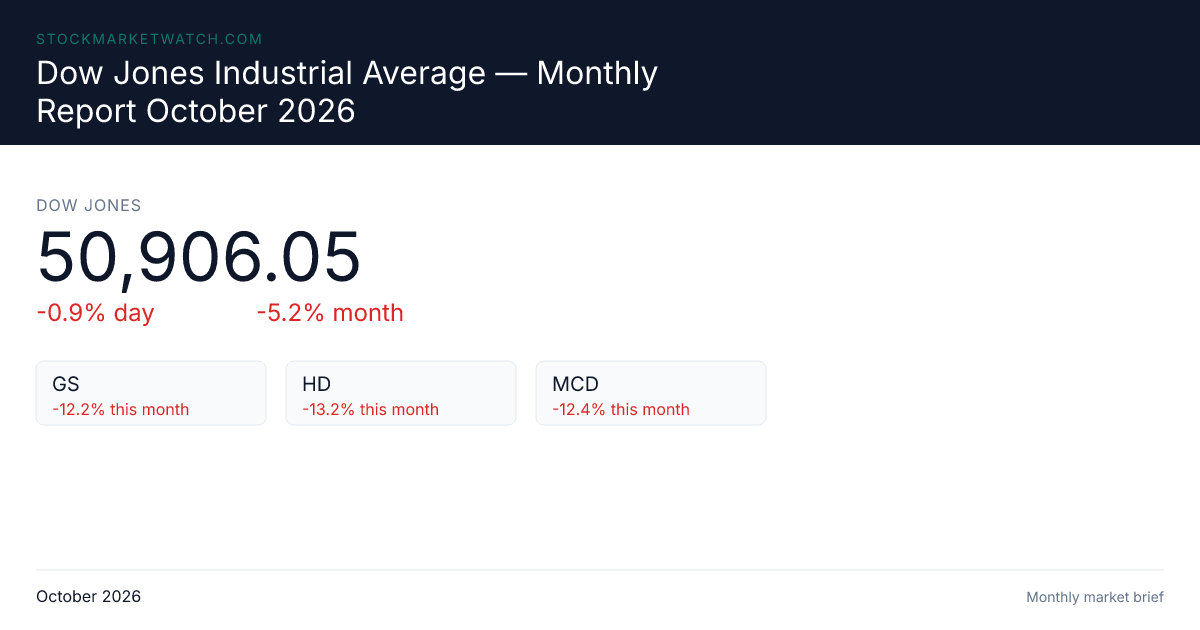
The market is a two-track, AI-concentrated rally. On the daily tape (October 27), the S&P 500, Nasdaq, and Dow all closed higher — S&P +0.60% to 7,722.60, Nasdaq +1.18–1.2%, Dow +0.03% — led by chips and AI names (Broadcom, AMD, Micron) on surging data-center demand https://www.cnbc.com/2026/10/27/stock-market-today.html. The 10-year Treasury yield held steady at ~4.99% https://pulsafi.com/blog/stock-market-today. But beneath that positive surface, divergence is stark: cyclical blue-chips and small caps have lagged badly. The Dow's Dow Jones Industrial Average fell −5.18% for the month of October, and the Russell 2000 dropped −5.77%, pressured by a hawkish Federal Reserve under Chair Kevin Warsh https://stockmarketwatch.com/.
Concentration is the market's central risk. The top 10 holdings now represent roughly 55.3% of the Dow, with Goldman Sachs alone the heaviest single member at ~10.3%, and Financials the largest sector weight at 26.8% https://chartrow.com/. This kind of concentration means the index's direction is increasingly dictated by a handful of mega-cap tech names — a fragility that sharpens whenever sentiment toward AI capex wavers.
Valuation is a mixed picture. The S&P 500 trades at a trailing P/E of 24.9x, below its 3-year average of 30.2x, which on the surface suggests the market isn't stretched https://simplywall.st/. But the forward P/E (18.7–19.0) sits below 5- and 10-year averages even as trailing earnings have grown ~18%/year — a divergence that reflects both thinner-than-expected surprises and still-elevated forward estimates https://vestedfinance.com/.
Earnings (Q3 2026) showed broad but thin beats: 83–84% of reporters beat EPS estimates (above historical averages) but with smaller magnitudes, yielding blended earnings growth of 29.5% (third straight quarter above 25%) and revenue growth of +12.6–12.7% (third double-digit quarter) https://vestedfinance.com/. Forward estimates remain strong (29% Q4, ~33% CY2026) https://pulsafi.com/blog/stock-market-today.
The Fed is expected to hold at 3.75%–4.00% (80–90% probability) at its October 27–28 meeting, with a December hike the base case (70–81% probability) https://admirals.com/. The September +25bp hike was the first since July 2023, and weak September payrolls (+29,000 vs. ~90,000 consensus) plus sticky CPI (3.7%) frame a hawkish-pause debate; potential hawkish dissenters include Hammack, Logan, and Kashkari https://orbitremit.com/.
Oil spiked to ~$115–116.50 (Brent) and ~$102.50 (WTI) on reports of a Houthi attack and fire at Saudi Arabia's Ras Tanura terminal, then partly unwound as the fire was contained https://markets.com/en/news/markets/. Brent is up ~6–13% on the month.
Top Stock Picks — Ranked as Investable "Products"
Below I rank the strongest performers as if they were products to buy, best first. Each entry includes its available price context, a summary, and pros/cons grounded in the evidence.
Quick-Compare Table
| Name | Price Context | Best For | Rating |
|---|---|---|---|
| AI/Semiconductor Complex (NVDA, AVGO, AMD, MRUN) | Nasdaq +1.2% daily, ~+14% YTD | Growth / AI leadership | ★★★★☆ |
| Nucor (NUC) | +67% YTD, +6% daily | Momentum / steel | ★★★★☆ |
| Constellation Energy (CEG) | +2% daily, DOE financing | Nuclear / AI power | ★★★★☆ |
| Palo Alto Networks (PANW) | +18.0% 7-day | Cybersecurity | ★★★☆☆ |
| Marathon Petroleum (MPC) | +121.1% earnings revisions | Energy / value | ★★★☆☆ |
| JetBlue (JBLU) | +19% daily | Short-term momentum | ★★★☆☆ |
AI & Semiconductor Complex (NVIDIA, Broadcom, AMD, Micron)
Price context: Not disclosed in source data; Nasdaq Composite +1.18–1.2% on October 27, up ~+14% YTD https://www.cnbc.com/2026/10/27/stock-market-today.html.
These are the undisputed leaders of the rally. Data-center demand is propelling chip names across the board, and IT earnings revisions jumped to +65.1% (led by NVIDIA, Micron, Dell, Intel) https://vestedfinance.com/. Tech is forecast to grow ~22%/year over the next five years, the strongest secular growth profile of any sector https://simplywall.st/.
Pros:
- Broad-based AI/data-center demand, not reliant on a single name
- IT sector earnings revisions at +65.1%, among the strongest of any sector
- Secular growth tailwind (~22%/year over 5 years)
Cons:
- "Fade the chip bounce" warnings exist; the SOX has historically preceded −53% to −83% declines after similar patterns https://www.cnbc.com/2026/10/27/stock-market-today.html
- Rich valuations make these names acutely sensitive to any AI-capex disappointment
- High correlation — a sentiment shift hits the whole basket at once
Where to buy / research: https://www.cnbc.com/2026/10/27/stock-market-today.html
Nucor (NUC)
Price context: Not disclosed in source data; +6% on October 27, +67% YTD https://www.cnbc.com/2026/10/27/stock-market-today.html.
Nucor is the standout industrial of the moment, benefiting from a rare combination of AI-driven steel demand and data-center construction. A +67% YTD gain reflects both earnings momentum and re-rating.
Pros:
- +67% YTD demonstrates powerful dual demand (steel + data-center buildout)
- Daily gain of +6% shows continued institutional buying
- Positioned at the intersection of two hot themes (industrial + AI power)
Cons:
- Momentum names can reverse sharply once the tape cools
- Sensitive to steel input costs and cyclical construction demand
- Extended after a 67% run — limited margin of safety
Where to buy / research: https://www.cnbc.com/2026/10/27/stock-market-today.html
Constellation Energy (CEG)
Price context: Not disclosed in source data; +2% on October 27, benefiting from DOE financing https://www.cnbc.com/2026/10/27/stock-market-today.html.
Nuclear power is emerging as a distinct AI-era theme: data centers need 24/7 carbon-free power, and nuclear provides it. Constellation Energy is a direct beneficiary, with DOE financing de-risking new capacity.
Pros:
- Structural AI-power demand tailwind, not just a trade
- Government financing (DOE) reduces capital-risk for new builds
- Carbon-free baseload is increasingly scarce and valuable
Cons:
- +2% daily gain is modest vs. pure-play chip names
- Nuclear projects face long construction timelines and regulatory risk
- Valuations have already repriced much of the narrative
Where to buy / research: https://www.cnbc.com/2026/10/27/stock-market-today.html
Palo Alto Networks (PANW)
Price context: Not disclosed in source data; +18.0% over 7 days https://simplywall.st/.
Cybersecurity is riding the same AI-infrastructure wave. Palo Alto Networks and CrowdStrike both posted ~18% gains over the past week, signaling strong rotation into defensive-growth tech.
Pros:
- +18% 7-day gain shows intense near-term demand
- Cybersecurity is a secular must-spend category
- Lower correlation to consumer spending than retail names
Cons:
- Weekly momentum can be volatile and mean-reverting
- High valuations typical of large-cap software
- Sensitive to enterprise IT budget cycles
Where to buy / research: https://simplywall.st/
Marathon Petroleum (MPC)
Price context: Not disclosed in source data; Energy sector earnings revisions +121.1% (led by Marathon Petroleum and Valero) https://vestedfinance.com/.
Energy is the surprising earnings leader. With Brent crude near six-month highs (~$115) driven by Middle East supply risk, refiners like Marathon Petroleum are seeing earnings revisions jump more than 120%.
Pros:
- +121.1% earnings revisions — the strongest of any sector
- Elevated crude prices directly expand refining margins
- Geopolitical supply risk provides a persistent price floor
Cons:
- Oil prices are a double-edged sword — a sudden de-escalation could crash crude
- Energy has the weakest long-term growth forecast (4.8%/year) https://simplywall.st/
- Volatile, event-driven sector prone to sharp reversals
Where to buy / research: https://vestedfinance.com/
JetBlue (JBLU)
Price context: Not disclosed in source data; +19% on October 27 — the single best daily performer https://www.cnbc.com/2026/10/27/stock-market-today.html.
JetBlue was the day's top gainer, though a +19% single-day move is more of a technical bounce than a fundamental signal. It's a momentum play, not a conviction hold.
Pros:
- Best single-day performer (+19%) shows strong short-term bid
- Airline names can benefit from falling fuel costs
- High beta — large moves in either direction
Cons:
- A one-day pop is not a trend; prone to reversal
- Airlines are cyclical and sensitive to consumer weakness
- High risk for a short-term trade
Where to buy / research: https://www.cnbc.com/2026/10/27/stock-market-today.html
Stocks to Avoid: The Worst Performers
The evidence points to a clear "avoid" list concentrated in rate-sensitive and consumer-facing names.
Home Depot (−13.22%), McDonald's (−12.37%), Goldman Sachs (−12.24%), Salesforce (−10.86%), Boeing (−10.46%), American Express (−7.90%), JPMorgan (−7.08%), UnitedHealth (−5.73%) — these were the worst Dow members for October https://stockmarketwatch.com/. The pattern is unmistakable: financials and consumer-facing retail are getting punished by the hawkish Fed and high yields. Goldman and JPMorgan reflect rate-sensitive financials under pressure; Home Depot and McDonald's reflect an exhausted consumer (~57% of households short of funds, CPI ~3.4%) https://stockmarketwatch.com/.
Health Care is the worst sector fundamentally — the only one with a year-over-year earnings decline, weighed down by downward EPS revisions https://vestedfinance.com/. Telecom was the worst over 7 days (−5.89%), and Consumer Discretionary the second-worst (−1.59%) https://simplywall.st/. PayPal was the day's worst major name (−1%) https://www.cnbc.com/2026/10/27/stock-market-today.html.
Bullish & Bearish Sector Outlooks
Bullish sectors:
- Technology — AI/data-center demand, +65.1% earnings revisions, ~22%/year five-year growth forecast. The clear #1 https://simplywall.st/.
- Energy — Strongest earnings growth (+121.1%), elevated crude, Middle East supply risk. But note the tension: Energy is the best short-term earnings performer yet has the weakest long-term growth forecast (4.8%/year) and was the worst sector on the Oct 27 tape (−2.05%) https://simplywall.st/.
- Healthcare — 65.5x PE with 20.3% expected growth; expensive but high-growth https://simplywall.st/.
- Steel & Nuclear — Nucor (+67% YTD), Constellation Energy (DOE financing), AI-powered data-center power demand https://www.cnbc.com/2026/10/27/stock-market-today.html.
Bearish sectors:
- Financials — Least preferred (17.6x PE), Goldman Sachs −12.24% https://simplywall.st/.
- Telecom — −5.89% over 7 days https://simplywall.st/.
- Consumer Discretionary — −1.59% over 7 days, consumer exhaustion https://simplywall.st/.
- Health Care — Only sector with YoY earnings decline https://vestedfinance.com/.
Data Notes & Where Sources Disagree

Transparency matters in market research. Here are the key conflicts and caveats:
- YTD returns conflict across sources. The S&P 500 is cited at +11.8% (through Sept 30) https://www.chase.com/ vs. +12.8% (Oct 27) https://pulsafi.com/blog/stock-market-today; the Nasdaq at +15.6% https://www.chase.com/ vs. +13.92% https://pulsafi.com/blog/stock-market-today. These reflect different measurement dates, not contradictions.
- Oil price snapshots conflict by date. Brent was ~$102–105 in early-to-mid October https://vestedfinance.com/, then spiked to ~$115–116.50 by Oct 27–28 on the Ras Tanura fire https://markets.com/en/news/markets/. This is a timeline, not a contradiction.
- 10-year yield snapshots vary (~4.99% to 5.35%), reflecting intraday and cross-source timing differences.
- Earnings season is consistent across all sources: Energy best, Health Care worst, IT strong, forward P/E ~18.7–19.0.
- Finding 1 (vittarthi.com) was empty of data (section labels only); CNBC Oct 1 and FactSet Earnings Insight were truncated JSON snippets with limited usable information.
- The ~11M→5.97M bpd Saudi output collapse is a single-source claim and should be treated with caution https://discoveryalert.com/.
Verdict
Best Overall: The AI & Semiconductor Complex (NVIDIA, Broadcom, AMD, Micron). It combines the strongest secular tailwind (22%/year five-year growth), the widest breadth of contributors, and the clearest fundamental support (IT earnings revisions +65.1%). It's the engine of the entire rally, and while valuation risk is real, the demand story is the most defensible of any pick.
Best Value: Marathon Petroleum (MPC). With Energy sector earnings revisions at +121.1% — the strongest of any sector — and crude near six-month highs, energy refiners offer the best risk/reward for investors willing to tolerate oil-price volatility. It's the standout