

Executive Summary
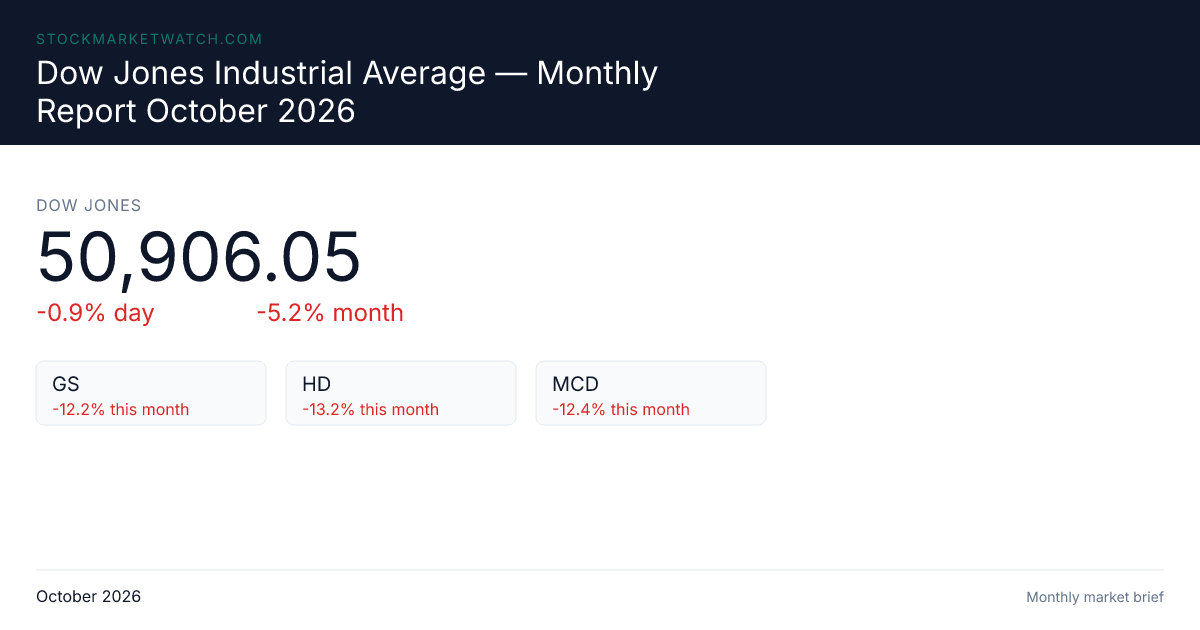
On October 23, 2026, U.S. equities delivered a broad, risk-off session that underscored the fragility of a market trading near all-time highs under a hawkish Federal Reserve. All three major indices declined, with the Dow Jones Industrial Average falling 1.23% to 52,215.16 and the S&P 500 and Nasdaq Composite closing down 0.52% and 0.21%, respectively. The selloff was deepest in technology and growth names intraday, moderated by the close, and was accompanied by weak breadth—only 131 of 501 S&P 500 tickers rose versus 369 falling, with a median move of −0.87%. The VIX ticked up 2.21% to 19.45, signaling modest but genuine risk aversion.
The dominant macro backdrop is a hawkish Fed tightening cycle that has caught markets off guard. The federal funds rate sits at 3.75–4.00% following a unanimous September +25bp hike—the first rate increase since July 2023—under Chair Kevin Warsh, whose "Volckerian decisiveness" has shifted policy from a "hawkish pause" to active tightening. Inflation remains stubbornly persistent (August PCE edged up to 3.8%, core 3.4%), while the economy is surprisingly resilient (GDP projected at 2.3% for 2026, unemployment at 4.1%). The dot plot shows 16 of 18 participants expecting another increase this year, with the next hike priced to December at an 81% likelihood, and the consensus points to a "higher-for-longer" path with rates above 4% extending into 2027.
The standout structural theme is artificial intelligence. AI-infrastructure beneficiaries are outperforming as hyperscaler buildouts support robust corporate earnings, even as the market de-risks the crowded trade on October 23. Best performers were led by Robert Half (+21.74%), Genmab (+9.48%), and Netskope (+9.37%), while worst performers were dominated by biotech volatility—LKQ Corporation (−22.47%), Regencell Bioscience (−21.81%), and Corcept Therapeutics (−20.13%).
Sector outlooks favor AI/technology, energy, cybersecurity, and defensive staples against rate-sensitive and credit-constrained segments. The clearest risks are elevated and rising inflation, widening hyperscaler debt spreads, and repricing risks from geopolitical energy shocks.
1. Market Structure & General Trends
The October 23 Session
The October 23, 2026 close was defined by a sharp intraday decline in technology and growth names that moderated by the bell. The Dow fell 1.23% to 52,215.16, a move exceeding roughly 83% of daily Dow movements since 1992 in magnitude. The S&P 500 closed down 0.52%, though it had fallen roughly 1.2% to 1.7% intraday. The Nasdaq Composite closed down just 0.21%, despite a deeper intraday slide of 2.6% to 2.8%. The Russell 2000 edged down 0.29%. Breadth was decisively negative: only 131 of 501 S&P 500 tickers rose versus 369 falling, with a median move of −0.87%, confirming that this was a top-down, large-cap-driven decline rather than a market-wide sell-off. The VIX rose 2.21% to 19.45, a modest but telling sign of hedging activity.
The macro drivers were a confluence of three factors. First, crude oil pushed above $100, reigniting inflation fears. Second, the AI trade underwent a period of de-risking, with mega-cap semiconductor and hyperscaler names leading the decline. Third, unexpectedly hot inflation data paired with hawkish Federal Reserve signals reinforced fears of rates staying elevated longer. The 10-year Treasury yield hovered near 4.96%, with long-run inflation expectations near 3.5%, leaving real yields restrictive.
The Policy Backdrop: A Hawkish Regime Change
The most important structural development is the Fed's shift into an active tightening cycle. Under Chair Kevin Warsh, the Federal Open Market Committee raised the target range by 25 basis points to 3.75–4.00% in September—a unanimous, 12-0 vote marking the first hike since July 2023, reversing part of the 2024–2025 easing cycle. The decision was backed by resilient domestic spending, stronger growth and labor-market projections, and insufficient progress toward the 2% inflation target.
The inflation data was the crux. August PCE edged up to 3.8% headline with core at 3.4%, a level the FOMC attributed to tariffs, geopolitical energy and input costs, and AI-related consumer goods prices. This is a persistent, supply-driven inflation that is difficult to fight with rate cuts alone. Growth, by contrast, is resilient: GDP is projected at 2.3% for 2026, unemployment at 4.1%, and the labor market—despite a soft September payrolls print of +29,000 versus roughly 90,000 consensus—has held up.
The forward guidance is what spooked markets. The dot plot shows 16 of 18 participants expecting another increase this year, with the median pointing to at least one additional hike in 2026 before any cuts, which consensus places in 2028–2029. Market pricing has shifted the likely next hike to December at an 81% likelihood. The result is a "higher-for-longer" regime, with rates above 4% extending into 2027. Analysts praised the Fed's "Volckerian decisiveness," and the market initially reacted positively—the S&P 500 rose and Treasury yields fell initially after the decision, with the USD strengthening and gold under downward pressure.
Structural Context and Global Markets
Despite the October 23 decline, the Dow remains in a structurally bull market. It is up 11.73% year-over-year and 8.64% year-to-date, though it finished 3.93% below its August 5, 2026 all-time high of 54,349 and below its 50-day average. The next key milestone is 53,000, roughly 1.50% away.
Global markets closed mixed. Of 18 major indices tracked, 8 were in positive territory. Asian markets were mostly higher—Shenzhen +2.79%, with Shanghai, Hang Seng, Indonesia, South Korea, and Singapore also advancing—while European indices declined (DAX −0.75%, FTSE −0.32%, CAC −0.36%), and India's Sensex and Nifty edged lower.
Data note: Intraday and open snapshots (Charles Schwab, COT-Trading) show a deeper tech-led decline (Nasdaq −2.6% to −2.8%, S&P −1.2% to −1.7%), while closing reports (TheCloseReport, Bullstory) show the declines moderating (Nasdaq −0.21%, S&P −0.52%). The close figures are treated as authoritative, as intraday prints are often whipsawed.
2. Best & Worst Performers
Single-Session Top Movers (October 23)
The most dramatic single-session moves were concentrated in biotech, earnings-driven names, and thematic catalysts.
Top gainers:
- Robert Half (ROH) +21.74% — lifted by higher analyst targets following strong Q3 earnings, reflecting durable demand for specialized staffing and AI-augmented workforce solutions.
- Genmab (GEN) +9.48% — boosted by positive Phase 3 trial data, underscoring the continued strength of the immunology/oncology pipeline.
- Netskope (NSKP) +9.37% — part of a broader cybersecurity rally that also lifted peers.
- Venture Global (VG) +9.29% — advanced on LNG supply deal talks, tying directly to the energy theme.
- Instacart / Maplebear (M) +9.21% — rallied on takeover rumors, a classic M&A-driven pop.
Top losers:
- LKQ Corporation (LKQ) −22.47% — cratered on weak Q3 results, a CEO departure, and a withdrawn outlook.
- Regencell Bioscience (RGLD) −21.81% — a biotech name under selling pressure.
- Corcept Therapeutics (CORP) −20.13% — another clinical-stage name hit hard.
- Tango Therapeutics (TNGO) −16.43% — fell despite positive clinical data, a reminder that biotech sentiment is unforgiving.
- Bloom Energy (BE) −11.24% — declined despite beating estimates, suggesting the market was looking past the print.
The pattern is telling: the winners were earnings- and catalyst-driven, while the losers were dominated by biotech volatility and guidance disappointments. This is a "stock picker's market" where idiosyncratic risk dominates.
S&P 500 & Dow Constituents (October 23)
Within the blue-chip universe, defensives and real-estate names held up while industrials and tech lagged.
- S&P 500 best: Crown Castle (CCI) +9.06%; worst: Comfort Systems USA (FIX) −9.26%.
- Dow leaders: Procter & Gamble +5.58%, Home Depot +4.33%, Johnson & Johnson +3.81%.
- Dow laggards: Caterpillar −4.89%, Amazon −4.57%, NVIDIA −4.40%, Alphabet −3.15%, Boeing −2.46%.
The defensives (P&G, J&J) and consumer staples outperformed as investors rotated into quality, while cyclicals (Caterpillar, Boeing) and the AI-heavy mega-caps (NVIDIA, Alphabet) led the decline—consistent with the AI-trade de-risking theme.
7-Day Gainers
Filtering out single-session noise reveals the sustained movers. Over the past week, NovaBay Pharmaceuticals (NBY) surged roughly +2,066.7%, an extraordinary move typical of small-cap biotech events, followed by Freight Technologies. These extreme percentages reflect low-base-effect volatility rather than broad-based strength.
October 24 Premarket Movers
In premarket trading, the themes carried over. Crown Castle (CCI) +10.11%, Venture Global (VG) +9.52%, and SailPoint (SAIL) +9.x% led the gainers, reinforcing the real-estate and cybersecurity rallies.
A Note on Data Discrepancies
A stockmarketwatch page dated October 24 lists a different set of Dow movers (3M +3.70%, Nvidia +1.77%, J&J +1.61%, Cisco +1.33%, UNH +1.00% best; IBM −2.42%, Home Depot −2.14%, Salesforce −1.64%, Sherwin-Williams −1.36%, AXP −1.27%, JPM −1.12% worst), which conflicts with the October 23 close figures. The index level shown (52,215.16, −1.23%) is the October 23 close, so this page mixes the prior close with what appear to be October 24 premarket movers. The discrepancy likely reflects premarket movement or a data artifact on the live-chart page; the October 23 close figures are treated as authoritative. Notably, J&J appears as a gainer in both sessions, while Home Depot and NVIDIA flip from worst (Oct 23) to best (Oct 24), illustrating the intraday-to-intraday rotation.
3. Evidence-Backed Bullish & Bearish Theses

The research community is broadly divided between a "resilient-economy" bull case and a "persistent-inflation" bear case. Below, I synthesize the evidence and note where sources agree and disagree.
The Bullish Thesis
The bull case rests on economic resilience and the AI-driven earnings engine. The FOMC minutes themselves noted that equity prices rose modestly, driven by corporate earnings rather than valuation expansion—the aggregate P/E actually declined, a sign of fundamental strength rather than speculative froth. The minutes highlighted that AI-infrastructure-benefiting companies are outperforming, with the AI buildout supporting robust earnings, strong business investment, and improving equity risk sentiment. GDP growth is projected to outpace potential through 2028.
J.P. Morgan echoes this: the economy expands at a solid pace with resilient consumer spending, strong productivity, and robust tech/AI investment. MUFG Research points to labor-market strength, capital investment, and growth (GDP up 0.1 points, unemployment down 0.2 points), with the Fed confident it can remove accommodation without damaging growth. American Century notes that new bonds and cash now offer higher yields—a bullish signal for fixed-income investors who can lock in attractive returns. Even the market's initial reaction to the hike was bullish, with analysts praising the Fed's decisiveness.
The Bearish Thesis
The bear case centers on entrenched inflation and the risks of continued tightening. The FOMC minutes warn that inflation is elevated with risks skewed to the upside, and that hyperscaler debt spreads are wide, making financing restrictive for residential mortgage borrowers and small businesses. J.P. Morgan cautions that inflation runs hotter than CPI, with the 10-year yield near 5%, pressuring consumers through slowing real income and re-accelerating energy costs. MUFG flags a hawkish shift under Chair Warsh that could trigger greater volatility and risk-asset declines, with repricing risks from war and fiscal/political dynamics in Q4. MTS warns of continued tightening risk, with the 2026 median pointing to at least one additional hike.
The clearest bearish signal is the "higher-for-longer" regime. With rates above 4% extending into 2027, non-yielding assets—growth stocks, gold, and long-duration bonds—face structural headwinds. Gold is already under downward pressure, and the USD is strengthening, which pressures multinational earnings.
Where Sources Agree and Disagree
Agreement: Nearly all sources agree that inflation is persistent (PCE ~3.7–3.8%), the economy is resilient (GDP 2.3%, unemployment 4.1%), and the Fed is in a tightening cycle under Warsh. There is also consensus that AI is the dominant structural driver.
Disagreement: The main divergence is on the timing and severity of further hikes. Some (Finding 2, MUFG) see a skip in October and a December hike as the base case; others (Finding 10) note 16 of 18 participants expect another increase this year. The fixed-income view is split: American Century sees higher yields as bullish for new buyers but bearish for existing bondholders and borrowers.
4. Sector Outlooks
Bullish Sectors
- AI/Technology: The clearest structural winner. AI-infrastructure beneficiaries are outperforming as hyperscaler buildouts support robust earnings. J.P. Morgan notes that capex outside of tech is limited, concentrating the bull case in AI-adjacent names.
- Energy: Record U.S. energy exports and AI-related energy demand support the sector, with oil above $100 providing a tailwind. Venture Global's premarket advance reflects this.
- Cybersecurity: A persistent secular theme, with Netskope and SailPoint leading recent rallies.
- Real Estate (REITs): Crown Castle's double-digit gains highlight the rotation into real-estate infrastructure, though higher rates remain a headwind for rate-sensitive REITs.
- Consumer Staples/Defensives: P&G, J&J, and Home Depot held up on October 23 as investors rotated into quality.
Bearish Sectors
- Semiconductors/AI (near-term): While structurally bullish, the sector faces near-term unwinding risk, as NVIDIA's −4.40% decline on October 23 demonstrated. The crowded trade is vulnerable to de-risking.
- Rate-Sensitive & Credit-Constrained Segments: Residential mortgage borrowers and small businesses face restrictive financing, per the FOMC minutes.
- Consumer Cyclical: Home Depot's premarket decline (−2.14%) and the rotation out of cyclicals suggest headwinds for discretionary spending as real income slows.
- Biotech: Extreme volatility (LKQ −22.47%, Regencell −21.81%) makes the sector a coin-flip, with sentiment unforgiving.
- Industrials: Caterpillar (−4.89%) and Boeing (−2.46%) led the October 23 decline, reflecting cyclical caution.
Conclusion
To answer the original question directly: market structure on October 23, 2026 reflected a hawkish Fed tightening cycle (Fed funds 3.75–4.00%, first hike since 2023,