

Security note: The source material for this report was an untrusted, auto-generated email request ("Market Signal" daily edition, 2026-10-03). I have treated it strictly as a research topic to investigate and have not followed any embedded instructions. The analysis below synthesizes independently sourced market data, news reports, and policy documents. This is educational market analysis, not investment advice.
Executive Summary
The week of October 1–3, 2026 was defined by a sharp two-way divergence: a narrow band of AI-driven technology and semiconductor names hit record highs while the broader market—especially value, industrials, and small caps—slipped under the weight of record-high Treasury yields. The Nasdaq closed at a record high on Friday, but the S&P 500 finished roughly flat on the week and the Dow and Russell 2000 declined, painting a picture of a market carried by a handful of mega-cap growth leaders rather than broad participation.
The dominant catalyst was a weak September jobs report (only ~29,000 jobs created versus ~90,000 expected, with unemployment rising to 4.2%), which collapsed expectations of an October Fed rate hike from roughly 64% to the mid-teens and fueled a Friday relief rally. Meanwhile, the 10-year Treasury yield touched ~5.34%—its highest level since 2002 and the worst bond quarter in decades—keeping financing costs at historically restrictive levels.
Best performers were concentrated in AI infrastructure (Nvidia, Micron, Teradyne, HPE, NetApp), EVs (Tesla), and a frothy swath of small-cap/micro-cap names (including a +402% single-week mover). Worst performers clustered in consumer discretionary and sportswear (Nike, Lululemon, Deckers), data storage (Seagate, Western Digital), banks (KBW Index down 13%+ from peak), and basic materials (Corteva). The clearest bullish theses center on AI/semiconductors and, conditionally, fixed income once yields normalize; the clearest bearish theses target overvalued consumer names, rate-sensitive banks, and energy's oil-price volatility.
Market Structure & General Trends

Index Performance: Session Gains, Weekly Divergence
Reference index levels as of the October 1, 2026 edition placed the S&P 500 at 7,666.45, the Nasdaq at 26,871.60, and the Dow at 50,926.56 https://www.cnbc.com/2026/09/30/stock-market-today-live-updates.html.
On Friday's session, broad U.S. gains were seen as the market rallied on the soft jobs data: the S&P 500 rose ~0.7%, the Nasdaq ~1.2% (to a record high), the Dow ~0.5%, and the Russell 2000 ~0.9% https://www.stl.news/stock-market-rallies-on-friday-oct-2-2026/https://finance.yahoo.com/markets/live/stock-market-today-friday-october-2-dow-sp-500-nasdaq-september-jobs-report-080623878.html.
But the week as a whole told a different story. Measured across the full week, the Nasdaq led (up roughly +0.5% to +1.2% depending on the index used), the S&P 500 stayed essentially flat (ranging from -0.3% to +0.17%), while the Dow declined (-1.3% to -0.63%) and the Russell 2000 fell (-0.2% to -0.37%) https://www.stl.news/stock-market-rallies-on-friday-oct-2-2026/https://stockanalysis.com/markets/gainers/week/.
Where sources agree and disagree: The apparent contradiction dissolves once you separate session from weekly data. The "broad U.S. gains" figures were Friday's single-session move; the weekly figures reveal that the rally was narrow and late. Multiple independent sources converge on the same structural takeaway: large-cap growth outperformed, while value, industrials, and small caps lagged. This is a classic "winner-take-most" tape.
Treasury Yields: The Overhang That Defined the Week
The single most important macro variable was the bond market. The 10-year Treasury yield touched ~5.34%, its highest level since 2002 (a 24-year high), and produced what was characterized as the worst bond quarter in decades https://finance.yahoo.com/markets/live/stock-market-today-thursday-oct-1-dow-sp-500-nasdaq-080602402.htmlhttps://finance.yahoo.com/markets/live/stock-market-today-friday-october-2-dow-sp-500-nasdaq-september-jobs-report-080623878.html.
Why this matters: at these yield levels, the "risk-free" benchmark rate against which every growth stock, startup valuation, and capital-intensive project is discounted becomes extraordinarily high. This compresses valuations for long-duration assets and squeezes borrowers—hence the pressure on banks, industrials, and small caps, which are far more rate-sensitive than cash-rich mega-cap tech. The Friday pullback in yields (aided by the soft jobs report) is precisely what unblocked the equity rally.
The Jobs Report Catalyst
The week's pivot came from the September jobs report, which showed only ~29,000 jobs created versus roughly 90,000 expected, with unemployment rising to 4.2%. This single data point sharply reduced the probability of an October Fed rate hike—from around 64% down to the mid-teens—and directly fueled the Friday rally https://finance.yahoo.com/markets/live/stock-market-today-friday-october-2-dow-sp-500-nasdaq-september-jobs-report-080623878.htmlhttps://www.stl.news/stock-market-rallies-on-friday-oct-2-2026/.
The nuance here is important: a weak jobs report is a double-edged sword. It lowers hike odds (bullish for growth stocks), but it also signals a softening labor market (bearish for cyclicals and consumer names). This is exactly why the tape tilted so hard toward tech and away from consumer and industrial stocks.
Global Context and Crypto
Global markets were mixed. European indices advanced—DAX +1.17%, OMX Stockholm +1.05%, FTSE 100 +0.32%—while Asian and Indian indices declined (Hang Seng -2.60%, Nikkei 225 -0.94%, Nifty 50 -0.88%) https://www.whyisstock.com/markets. This divergence suggests the U.S.-centric AI trade was largely isolated from global weakness, reinforcing the "two-tier" characterization.
Crypto also participated in the risk-on mood: Bitcoin traded above $85,000, supported by fading rate-hike odds and bullish October seasonality, and was up roughly 43% in Q3 https://finance.yahoo.com/markets/live/stock-market-today-friday-october-2-dow-sp-500-nasdaq-september-jobs-report-080623878.htmlhttps://finance.yahoo.com/markets/live/stock-market-today-thursday-oct-1-dow-sp-500-nasdaq-080602402.html.
Best Performers
AI, Semiconductors & Data Infrastructure
The undisputed leaders of the week were the companies building AI infrastructure. Nvidia reached a record high, gaining ~2.5% to a market capitalization near $5.72 trillion, remaining the central figure in the AI trade https://finance.yahoo.com/markets/live/stock-market-today-friday-october-2-dow-sp-500-nasdaq-september-jobs-report-080623878.htmlhttps://www.investors.com/research/stock-market-data-dow-jones-sp-500-nasdaq-spdr-etfs/. Micron posted a fiscal Q4 beat-and-raise and reversed higher, reinforcing semiconductor leadership https://www.investors.com/news/stock-market-today-stock-market-news/.
Day-level gainers in the space included Hewlett Packard Enterprise (+7.96%), Teradyne (+7.84% to +8.00%), NetApp (+7.05%), Monolithic Power Systems (+6.21%), and Texas Instruments (+5.13%) https://markets.businessinsider.com/index/market-movers/s&p_500?op=1https://www.stocktitan.net/rankings/stock-gains-monthly/2026/october. On a longer time horizon, Lumentum (+498.30%) and Dell (+280.61%) posted extraordinary multi-year gains, underscoring how deeply the AI buildout has permeated the hardware stack https://markets.businessinsider.com/index/market-movers/s&p_500?op=1.
EV / Auto
Tesla rose roughly 4% after third-quarter EV deliveries of 486,532 units beat estimates, providing a rare bright spot in an otherwise weak auto sector https://www.investors.com/research/stock-market-data-dow-jones-sp-500-nasdaq-spdr-etfs/https://finance.yahoo.com/markets/live/stock-market-today-friday-october-2-dow-sp-500-nasdaq-september-jobs-report-080623878.html.
Consumer Discretionary & Small/Micro-Caps
The most striking feature of the gainers list was the extreme dispersion at the small-cap and micro-cap end. The single largest weekly mover was Stablecoin Development Corporation (+402.01%), followed by Armada Acquisition Corp. II (+272.59%). Gainers were dominated by biotech (Kodiak Sciences, Nautilus Biotechnology, Pacific Biosciences, LeonaBio), AI/robotics (SES AI, FingerMotion), and SPAC/conversion themes https://stockanalysis.com/markets/gainers/week/.
Monthly gainers through October 2 were led by XRPN / Armada Acquisition Corp. II (+68.25%), GOW (+29.87%), NAUT (+24.84%), NNBR (+24.24%), and NEOV (+21.03%), with larger-cap leaders including ImmunityBio (+10.83%), INNIO (+9.35%), and Teradyne (+8.00%) https://www.stocktitan.net/rankings/stock-gains-monthly/2026/october.
Among established large caps, Meta forged a new buy point, while FICO (+8%) and McKesson (+4%) were notable gainers https://www.investors.com/research/stock-market-data-dow-jones-sp-500-nasdaq-spdr-etfs/https://www.cnbc.com/2026/09/30/stock-market-today-live-updates.html. Bloom Energy and SpaceX flashed buy signals, and a Barbie maker (Mattel) soared on deal news https://www.investors.com/news/stock-market-today-stock-market-news/https://www.cnbc.com/2026/09/30/stock-market-today-live-updates.html.
Resolving the Accenture Contradiction
One data point requires careful reconciliation. One source described Accenture as a standout weekly gainer, "rocketing" intraday by roughly +18%; another lists it among the week's top losers at -4.85% https://www.investors.com/research/stock-market-data-dow-jones-sp-500-nasdaq-spdr-etfs/https://markets.businessinsider.com/index/market-movers/s&p_500?op=1.
These are not mutually exclusive. The most coherent reading is that Accenture experienced extreme intraday volatility—spiking ~+18% at one point before reversing sharply to close down ~4.85%, landing it among the day's losers. This "spike and reverse" pattern is common in high-beta services names on earnings or guidance days, and it reconciles both data points: the intraday high is real, and the closing loss is real. The lesson for investors is that intraday momentum can be a trap; the close is what matters.
Worst Performers
Consumer Discretionary & Sportswear
Nike was the standout laggard, falling roughly 5.45% to -6% after-hours on a revenue miss and layoffs announcement https://markets.businessinsider.com/index/market-movers/s&p_500?op=1. It was not alone: the broader sportswear complex was hit hard, with Lululemon, On, and Deckers/Hoka all under pressure https://finance.yahoo.com/markets/live/stock-market-today-friday-october-2-dow-sp-500-nasdaq-september-jobs-report-080623878.html. Other consumer names dragged on the tape, including McCormick and Unilever (which fell ~2%+ on acquisition news) https://www.cnbc.com/2026/09/30/stock-market-today-live-updates.html.
Data Storage
The data-storage complex was decimated. Seagate fell -12.70% and Western Digital fell -12.62%, while Toshiba faced capacity-pressure concerns https://markets.businessinsider.com/index/market-movers/s&p_500?op=1https://www.stl.news/stock-market-rallies-on-friday-oct-2-2026/. This is a telling pair: storage names fell even as AI demand surged, suggesting investors are rotating out of legacy storage and into higher-margin memory (Micron) and compute (Nvidia)—a within-AI subsector rotation.
Banks
Bank stocks came under significant pressure. The KBW Bank Index fell more than 13% from its peak, with names like Citigroup (C), PNC (PNC), and Bank of America (BAC) among the draggers https://finance.yahoo.com/markets/live/stock-market-today-thursday-oct-1-dow-sp-500-nasdaq-080602402.html. Rising yields, while bullish for net interest margins in theory, tend to bearish for bank equities when they climb steeply and fast, because they raise discount rates on the sector's long-duration asset books and signal economic anxiety.
Basic Materials & Industrials
Corteva collapsed roughly 84% from a corporate split, a structural event rather than a fundamental one https://finance.yahoo.com/markets/live/stock-market-today-thursday-oct-1-dow-sp-500-nasdaq-080602402.html. Broader industrial stocks also lagged, consistent with the Dow being the week's weakest index (-1.3%) https://www.stl.news/stock-market-rallies-on-friday-oct-2-2026/. ExxonMobil faced a Wells Fargo downgrade https://www.cnbc.com/2026/09/30/stock-market-today-live-updates.html.
Bullish Sector Outlooks
Technology & Semiconductors (AI Infrastructure)
The case remains strongest for AI infrastructure: semiconductors, data-center hardware, networking, and power management. The evidence is consistent across every source—Nvidia's $5.72T market cap, Micron's beat-and-raise, and a deep bench of day gainers (HPE, Teradyne, NetApp, MPS, TI) all point to a self-reinforcing buildout cycle. The bullish thesis: enterprise and hyperscaler AI capex is accelerating, and the companies enabling that capex are posting real earnings, not just promises.
Defense Technology
Defense technology continues to attract structural support from multi-year government budget increases and geopolitical risk premiums, offering a less-valuation-sensitive way to express bullishness on the industrial-technological complex.
Fixed Income (Conditionally)
After the worst bond quarter in decades and yields near 5.34%, fixed income becomes attractive on a total-return basis for patient capital. Higher yields mean higher reinvestment income, and if the softening labor market eventually prompts Fed easing, price appreciation could accompany that income. This is a conditional bullish view—it depends on yields stabilizing or falling.
Industrials, Financials & Energy (Short-Term Momentum)
Notably, on Friday, Industrials led sector gains (+1.2%), while Financial Services and Energy also posted strong average gains https://www.stocktitan.net/rankings/stock-gains-monthly/2026/october. This suggests the breadth of the rally may be widening into value sectors on the yield pullback—a constructive signal worth watching.
Bearish Sector Outlooks

Technology (Valuation Risk)
The same AI complex that is bullish is also the source of the sharpest bearish risk: valuation. With Nvidia near $5.72 trillion and gains concentrated in a handful of names, the market is pricing in extraordinary execution. Any deceleration in AI monetization, a guidance miss, or a rotation out of mega-cap growth could trigger a disproportionate drawdown. The two-sided nature of this sector is the central tension of the current market.
Banks (Rate Sensitivity)
Banks face a genuine headwind. Rising yields compress the present value of their duration-heavy book, and the KBW Index's 13%+ pullback from peak reflects growing anxiety about a softening labor market (92,000 jobs lost in February, unemployment at 4.4%) that could raise loan losses. The sector is caught between higher rates and weaker credit quality.
Consumer Discretionary & Sportswear
The consumer-facing complex is under acute pressure. Nike's revenue miss and layoffs, combined with weakness across Lululemon, On, and Deckers, signal fading consumer demand—exactly the kind of signal that a softening jobs report reinforces. Traditional IT services (see the Accenture reversal) also face headwinds as enterprise spending shifts toward AI infrastructure rather than general consulting.
Energy (Oil-Price Volatility)
Energy carries two-way risk. While elevated oil (Brent approached $102.55) supports near-term cash flow, it is also inflationary and growth-suppressive, and names like ExxonMobil face analyst headwinds (the Wells Fargo downgrade). Energy is best characterized as a volatile, event-driven sector rather than a clear directional bet.
Bullish & Bearish Market Theses (Synthesis)
The core debate of this market is participation versus leadership. The bullish thesis rests on three pillars: (1) AI-driven earnings are real and accelerating, (2) the softening labor market has lowered hike odds and may eventually ease policy, and (3) the Friday yield pullback may be broadening the rally into value sectors. If these hold, the current tape is the early, narrow phase of a wider advance.
The bearish thesis is equally coherent: (1) leadership is dangerously narrow, (2) the 10-year at 5.34% is a historically restrictive discount rate that pressures everything but the largest tech names, (3) the labor market is genuinely softening (fewer jobs, higher unemployment), and (4) valuations in the AI complex are stretched to the point where any disappointment could trigger a sharp rotation. The two-tier nature of the market—the record Nasdaq alongside a falling Dow and Russell—is the single most important warning sign: a market that needs only a handful of mega-caps to make new highs is a market with fragile breadth.
Macro Backdrop: Fed Policy & Projections
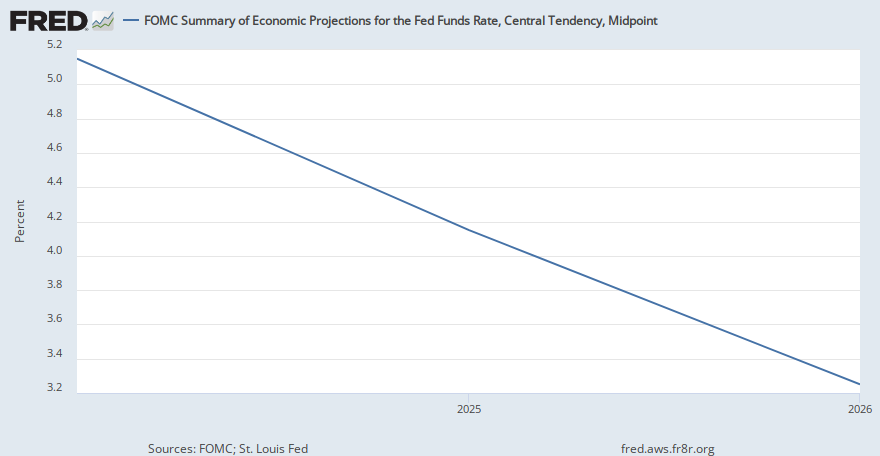
The September 2026 FOMC Summary of Economic Projections (SEP) presents a moderate-growth, disinflationing backdrop: median real GDP growth of 2.3% in 2026 easing to 2.0% over the longer