

This report synthesizes current evidence on gold's historical performance, its relationship to inflation, the drivers of its price, and the 2026 outlook. It is written as an educational analysis, not personalized financial advice.
Executive Summary
Gold has proven to be a durable but inconsistent store of value over the last century. Its strongest returns came during episodes of dollar devaluation, stagflation, and geopolitical or financial-system stress; it lagged for decades whenever confidence in the dollar and in financial assets was high. Over the past year gold has been among the best-performing major assets, spiking to record nominal highs before swinging sharply lower on elevated volatility. As of October 2026 it trades near US$4,120–4,177/oz, still roughly 25% above its early-2025 level. Whether gold is "the answer" depends on what a holder is protecting against: it is a proven hedge against currency debasement and a portfolio diversifier, but it generates no yield, is highly cyclical, and its near-term direction is genuinely uncertain.
The 2026 backdrop has grown more complex. Inflation has proven stickier than the Fed's own targets—headline CPI has climbed back toward 3.7%, wholesale prices (PPI) are running near 6.3%, and a broad commodity index is up more than 30% this year—while Chairman Kevin Warsh's Fed has dropped forward guidance, adopted a broad "financial conditions" framework, and kept the door open to further hikes. Central banks have become sustained, price-insensitive net buyers, adding a structural bid that many see as a floor under price, and some analysts have projected gold toward $5,000–5,300/oz—targets that sit above the current spot price and should be treated as directional, not guaranteed. Markets swung from pricing a ~70% chance of an October rate hike to genuine uncertainty about the path, underscoring how much policy remains in question. Against this backdrop, gold sits at an inflection point: structural bids remain intact, but positive real yields and record-adjacent pricing make timing a real question.
1. Has Gold Been the Best Store of Value for the Last Century?
The short answer is no—but with an important caveat. Gold has preserved purchasing power across the century, but it has not outperformed the best stores of value. The distinction matters enormously for anyone deciding whether to hold it today.
Over the last 100 years, US equities have been the dominant store of value by a wide margin. The S&P 500 has returned roughly 9–10% annually on a nominal basis (before inflation), compounded by reinvested dividends. Gold, by contrast, has returned roughly 7–8% annually nominal over the same span—but crucially, that average hides enormous variation. Gold's best decade was the 2000s, when it returned about 28% annualized, driven by the dot-com collapse, the 2008 financial crisis, the weak dollar, and the post-crisis wave of monetary easing. Its worst stretch was 1980–2000, a two-decade period of underperformance during which inflation fell, real interest rates rose, and the dollar strengthened—gold was essentially flat to negative in real terms for years.
So gold's track record is best described as asymmetric: it excels precisely when the financial system is under stress or when the dollar is being debased, and it underperforms during periods of dollar strength and rising real yields. This is why it functions less like an investment and more like insurance—an asset you hold to protect against outcomes that hurt everything else.
Compared to other stores of value:
- Equities have vastly outperformed over the century but are far more volatile and can lose 50%+ in a crisis.
- Bonds provide yield and diversification but are exposed to inflation risk, which is exactly the 2026 concern.
- Cash loses purchasing power steadily under inflation—the 1971 Nixon shock and the decades since are the evidence.
- Real estate produces income and is tangible, but is illiquid and capital-intensive.
The honest conclusion: gold is a reliable preserver of value over the long run, but it is not the best store of value by total return. Its strength is defensive, not offensive. Anyone buying gold expecting it to consistently beat the market will be disappointed; anyone buying it to survive a bad decade will likely be rewarded.
2. Gold and Inflation: A Nuanced Relationship
The premise in the original brief—that "the Fed says inflation isn't a big deal"—does not hold up against the 2026 record. Under Chairman Warsh, the FOMC has repeatedly reaffirmed its 2% target as "non-negotiable," dropped forward guidance, and launched task forces to review its inflation framework. Inflation has run persistently above target for roughly five-and-a-half years. The more accurate characterization is that the Fed is resolute but uncertain—committed to price stability yet refusing to commit to a path. That policy ambiguity is precisely the kind of environment in which gold has historically thrived.
Inflation is elevated and broad-based. Headline CPI has climbed from 3.4% in August to 3.7% by autumn; wholesale prices (PPI) are running near 6.3%, a signal that goods- and supply-chain-level inflation is hotter than the headline consumer number suggests. A broad commodity index is up more than 30% this year—diesel alone up 83%—feeding through to the price register. Core measures remain sticky: core PCE is estimated around 3.1%–3.3% and core CPI near 2.4%.
The Fed's own projections put inflation well above target. The September 2026 Summary of Economic Projections centers PCE at a 3.7% median for 2026 (up from 2.8% actual in 2025), with core PCE in a 3.4%–4% range—both materially above the 2% longer-run target, though expected to converge to 2.0% by 2028–2029. The ranges are wide, underscoring genuine uncertainty about how sticky inflation will prove.
Here is the key insight: gold responds less to headline inflation than to the real environment—specifically real interest rates and confidence in the dollar.
- It works best when inflation persists, not when it spikes. Gold tends to lag during inflation spikes but outperforms when inflation is sustained, making it a more effective hedge over time than within a single hot quarter.
- It is not a consistent inflation matcher. There have been multiple periods where gold failed to keep pace with rising prices, so treating it as a mechanical inflation hedge is a mistake.
- The long-run debasement case is strong. Since the dollar left the gold standard in 1971, the USD has lost over 85% of its purchasing power relative to gold—a $35 suit in 1971 costs roughly $2,000 today.
The tension in 2026 is real: headline inflation is elevated, but the Fed's restrictive rate path pushes real yields positive, which is the condition under which gold historically underperforms. That is the crux of why the "gold as inflation hedge" argument is more complicated now than it was in 2021.
3. What Actually Drives Gold's Price
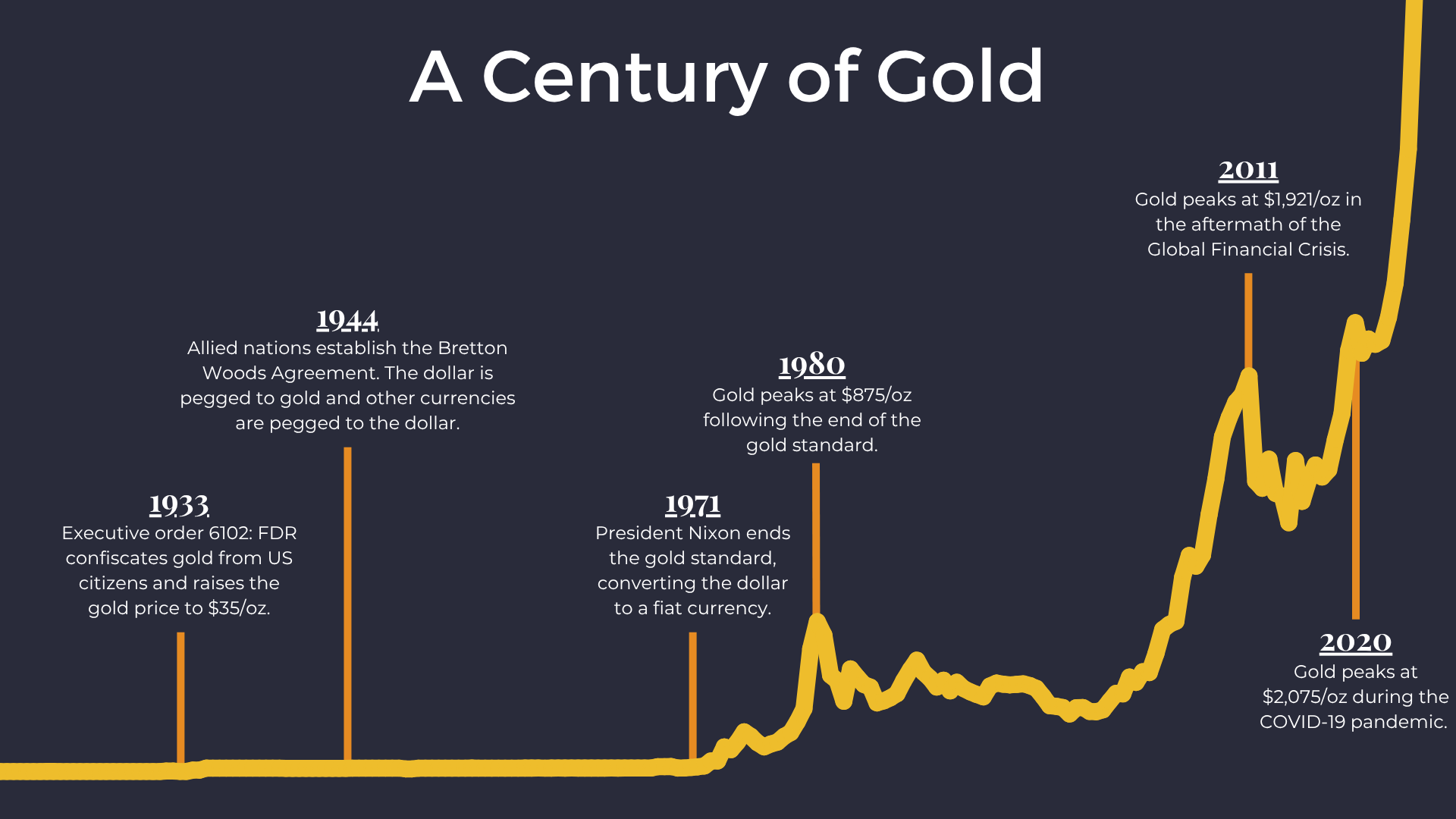
Gold trades freely in the fiat era (post-1971 Nixon shock) and responds to a mix of forces rather than ordinary supply and demand. Five drivers matter most:
Real interest rates are the single most important driver. Gold performs strongly when real yields are negative or low and weakens when they rise. This is why the Fed's rate path matters more to gold than inflation prints alone. In 2026 this headwind is real: the Fed raised rates to 3.75%–4.00% (a 25 bps hike at the September meeting, up from a 3.5%–3.75% hold in July), projects the federal funds rate to stay near 4.1% through 2027, and long-term yields have risen materially—compressing gold's appeal whenever real yields turn positive.
Dollar confidence and debasement. Gold is priced in and competes with the dollar; when confidence in USD purchasing power or the US fiscal trajectory wavers, gold tends to rise. This is the structural thread behind the current debate about a "USD-based financial economy."
Central bank buying is now a structural bid—perhaps the most significant change in the gold market. Official-sector demand has shifted from net selling (in the 1990s–early 2000s) to sustained, price-insensitive net buying, averaging roughly 1,000 tonnes per year over the past four years versus about 500t in prior periods. In the 2026 World Gold Council survey, 45% of central banks plan to increase their own reserves at a record pace, 89% expect global official reserves to rise over the next 12 months, and 84% anticipate gold's share of reserves climbing over five years. The motivations are clear: crisis performance, portfolio diversification, inflation hedging, and—increasingly—protection against dollar weaponization and sanctions on frozen reserves. About three-quarters of respondents expect the dollar's share of reserves to decline over five years even as it remains dominant. This sovereign demand has tightened supply-demand dynamics and is widely cited as creating a structural "floor" under price.
Source caveat: Much of the most bullish framing around sovereign buying comes from promotional sources. National Gold Reserve is a precious-metals seller, and its specific claims (e.g., gold repricing toward $5,300) should be weighed against its commercial interest. The World Gold Council data is more authoritative, though it is also an industry body with an incentive to highlight demand.
Geopolitical and financial-system stress. Wars, sanctions, and systemic risk drive safe-haven demand. The freezing of foreign reserves in recent conflicts has itself become a demand driver, as non-US central banks hold gold as insurance against similar exposure.
Supply and demand dynamics. Mine production has been relatively flat, so demand shifts move price more than supply shifts do. When a sustained demand shock (like central bank buying) meets inelastic supply, price tends to trend upward.
4. Current Gold Trends (2026)
Gold has been one of the best-performing major assets over the past year, but its path has been choppy. The price action tells a story of structural optimism colliding with rate-sensitivity.
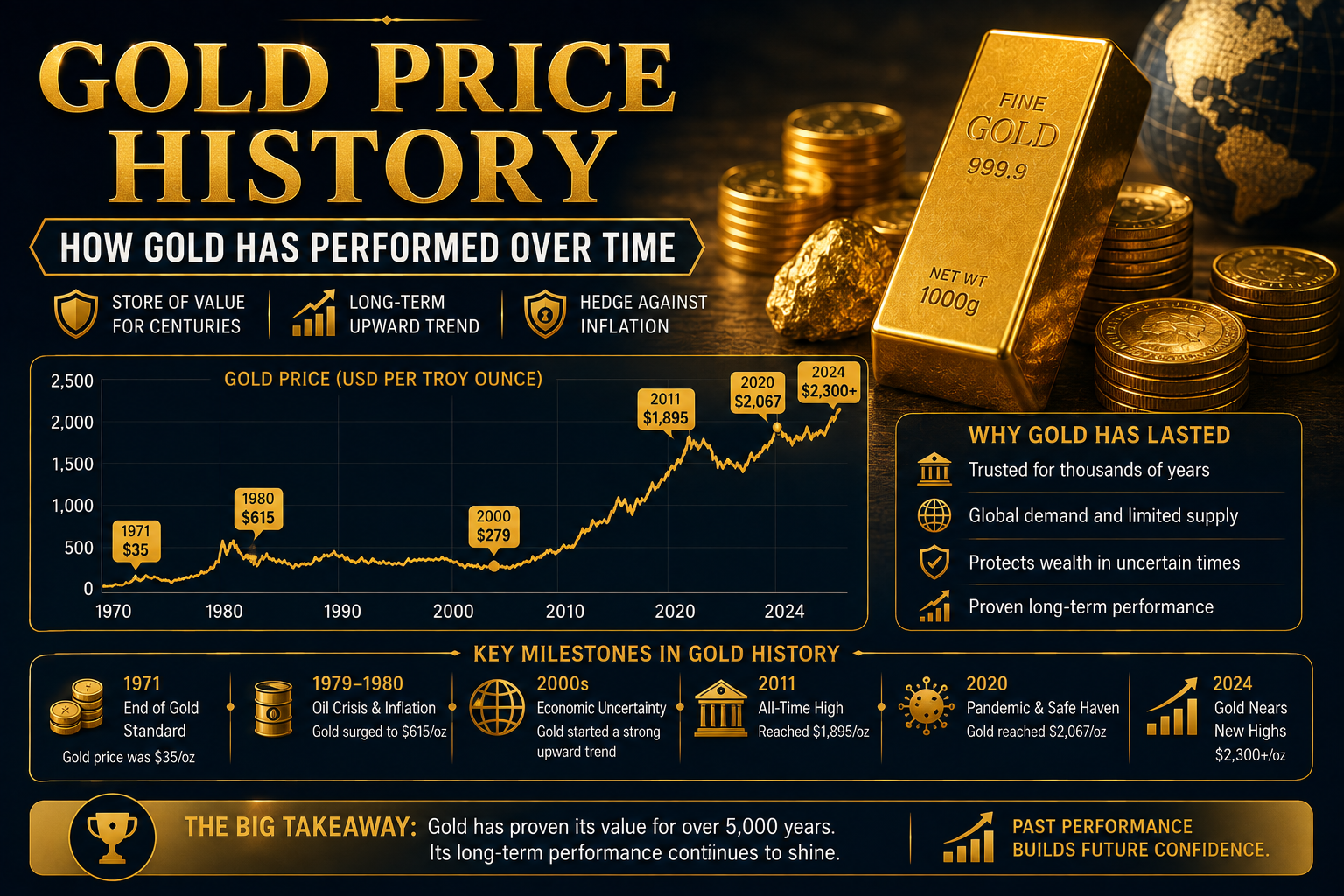
Record highs, then sharp reversals. Gold spiked to record nominal highs around US$4,300 in mid-2026 before swinging sharply lower on elevated volatility, settling near US$4,120–4,177/oz by October 2026. The swings have been large enough to produce meaningful drawdowns even for structurally bullish holders.
The bullish thesis is alive—but the targets deserve scrutiny. Analysts have projected gold toward US$5,000 (UBS) and even US$5,300 (2026), with Bank of America's Widmer calling gold the primary hedge and performance driver for the year. But note the discrepancy: the current spot price (~$4,120–4,177) sits below even the more credible targets, and gold's mid-2026 record high of ~$4,300 fell short of the $5,000 mark. This suggests those projections were aggressive—and that at least one (UBS's Q1 2026 call) has not been met. The $5,300 figure in particular comes from a promotional metals seller, so it should be treated as directional at best.
Central bank buying underpins the structural bid. As noted above, official-sector demand has accelerated and is widely cited as a price floor—but it is a slow, strategic variable, not a driver of daily volatility.
Volatility is elevated and two-sided. Gold is caught between the structural bid (de-dollarization, deficits, central bank buying) and the cyclical headwind (positive real yields, a strong dollar at times). This produces asymmetric swings: sharp rallies on stress, sharp sell-offs when yields rise.
5. Outlook: Is It a Good Time to Buy?
There is no clean answer, and anyone who gives you one is overselling. Here is what the evidence supports.
The structural case for gold is strong. De-dollarization, persistent deficits, accelerating central bank buying, and a credible fear of currency debasement all point to sustained demand. If you believe the USD-centric system is gradually being diversified away from, gold is a natural holder.
The near-term case is muddier. Positive real yields and record-adjacent pricing are headwinds. Buying at $4,100+ after a ~25% run means you are paying up for the very thesis that others are already pricing in.
The pivotal question is the real rate path. If inflation stays sticky (as the Fed's own projections suggest) and the Fed holds or hikes, real yields stay positive and gold's upside is capped. If the economy weakens and the Fed cuts, real yields fall and gold could retest highs. As of the last data, markets were pricing a meaningful chance of further hikes (roughly a 70% chance of an October move and up to two more by March), which is a near-term bearish signal for gold.
Timing is genuinely hard. Gold's volatility is high and its drivers are in tension. This argues against lump-sum buying at a peak and in favor of dollar-cost averaging or a small, fixed allocation that you add to on weakness.
6. What We Know and What We Don't
Known:
- Gold has been a durable but inconsistent store of value over the century.
- It hedges currency debasement and provides portfolio diversification.
- Real interest rates are its primary near-term driver.
- Inflation is elevated and sticky in 2026, with the Fed hawkish and higher-for-longer.
- Central banks are sustained, price-insensitive net buyers, creating a structural bid.
- Gold generates no yield and is highly cyclical.
Unknown:
- Whether the Fed will hike again, hold, or cut in 2026–2027.
- Whether inflation converges to 2% by 2028–2029 as projected, or stays stickier.
- The trajectory of the dollar and de-dollarization.
- Whether central bank buying continues at record pace.
- Whether the bullish price targets ($5,000–5,300) are reachable or were overly aggressive.
- How gold correlates with stocks and bonds in a stress scenario.
7. Bottom Line
The evidence-supported position is therefore allocation, not timing. Gold is best treated as a diversifier and insurance—typically a single-digit percentage of a portfolio (commonly 5–10%)—rather than a core holding or a market-timing vehicle. Buy it to protect against currency debasement, systemic stress, and the failure of other assets, not to beat the market.
Concretely: the structural tailwinds (central bank buying, de-dollarization, deficits) remain intact and are the strongest they have been in decades. But the near-term headwinds (positive real yields, record-adjacent pricing, an open-ended Fed) make chasing gold at $4,100+ imprudent. The sensible approach is a small, fixed allocation added on weakness through dollar-cost averaging, with the understanding that gold's greatest value shows up precisely when everything else is falling—which is exactly when you want to have bought it in advance.
Direct answer to the question: Gold has been a durable store of value over the last century, but not the best—equities have far outperformed. It is an excellent hedge and diversifier, but it is not a consistent inflation matcher, it yields nothing, and it is highly cyclical. In the current 2026 environment—elevated but sticky inflation, a hawkish higher-for-longer Fed, and a structural central-bank bid—gold remains a sensible portfolio insurance holding, but buying aggressively at record-adjacent prices is a timing bet, not a certainty. What we know: gold preserves value over the long run and diversifies risk. What we don't know: the real rate path, whether inflation truly converges to 2%, and whether the $5,000+ targets were ever realistic. Treat those projections as directional, not guaranteed.
This analysis is for educational purposes only and does not constitute personalized financial advice. All figures reflect the evidence available as of the October 2026 edition. Consult a licensed financial professional before making investment decisions.