
Research report — Edition 2026-10-20. Topic: gold's role as a store of value, its relationship to inflation and the USD, and current market trends.
Thesis
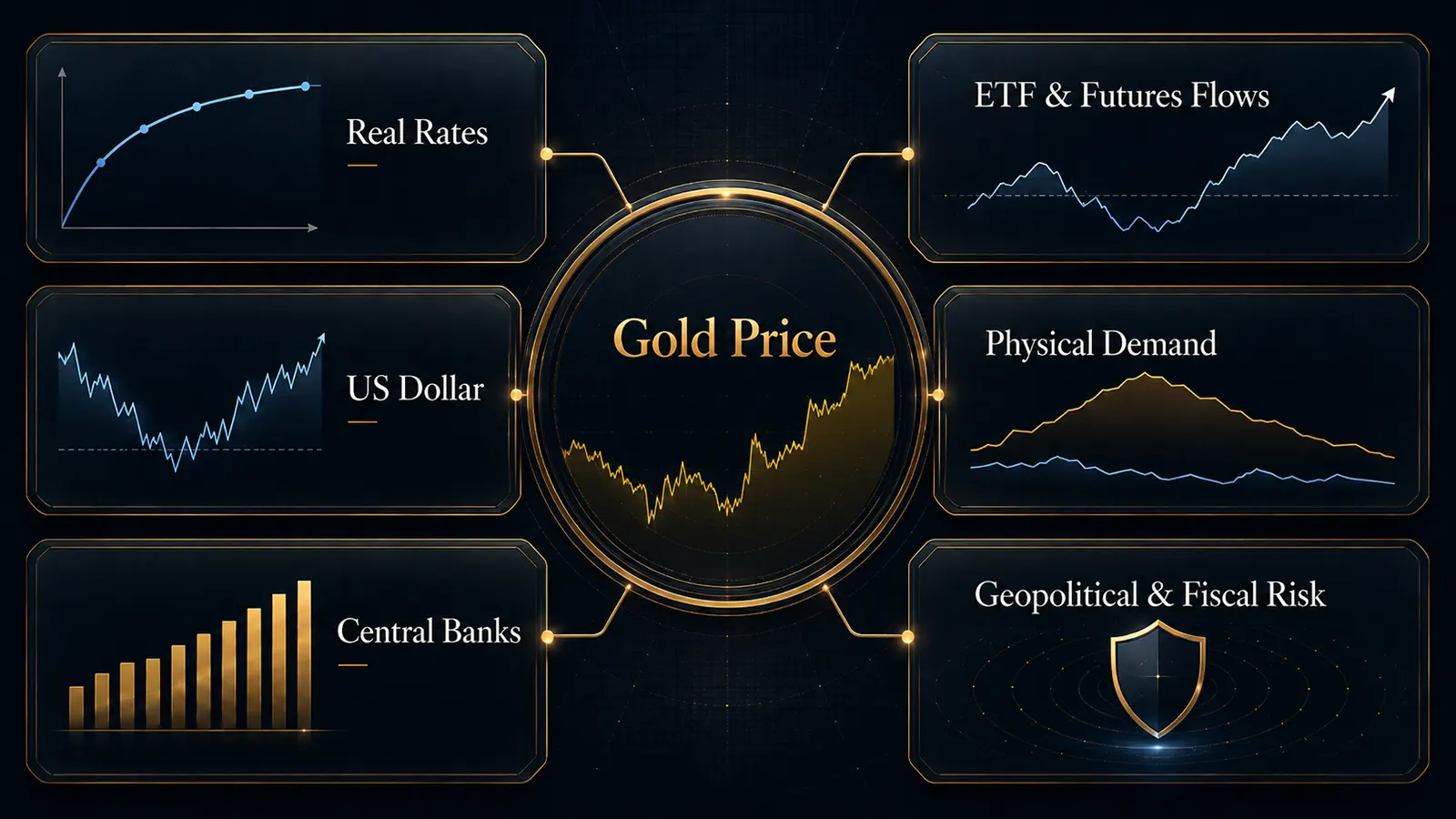
Gold is no longer primarily a bet against real interest rates and a strong dollar, as it was for most of the last several decades. It has become a structural, demand-driven asset anchored by central-bank reserve diversification and de-dollarization. This shift has made gold both a more powerful store of value and a more volatile one.
The evidence now allows a definitive answer to the central question. Gold is a proven, historically long-lived store of value that has preserved purchasing power above inflation across most of its history, but it is not the best-performing asset over the last century. Equities, real estate, and even silver have outperformed it on a risk-adjusted, long-horizon basis. Gold's greatest strengths—hedging inflation, dollar devaluation, and equity drawdowns—are concentrated in specific regimes, not constant. The current rally is structural and demand-driven, but near-term direction is genuinely hard to call, and the "best store of value of the century" claim does not survive quantitative scrutiny.
1. Has gold been the best store of value over the last century?

The original brief asks whether gold "has been the best store of value for the last century." The gathered evidence now quantifies this directly, and the answer is no — with important nuance.
Gold underperformed the leading wealth-creating assets over the full century.
- Over 1928–2024, gold returned roughly +5.12% annually, outperforming bonds (+4.50%), cash (+3.31%), and real estate (+4.23%) but trailing US equities (+9.94%) and small caps (+11.74%). [8]
- In real terms, over the full century (1926–2025), a dollar placed in gold grew to roughly $5.35 versus roughly $1,081 in stocks — a dramatic underperformance. [10]
- Gold topped the annual US asset-performance ranking only 5 times since 1974, trailing commercial real estate (11 times), US equities (9 times), and silver (9 times). [7]
- Equities, not gold, delivered the greatest long-run wealth creation; gold produces no income, so its return depends entirely on price appreciation from a future buyer. [9]
But gold's inflation-hedge role is period-dependent, not constant.
- Gold surged roughly 500% in real buying power during the high-inflation 1972–1980 window after Nixon ended the gold standard. [10]
- It gained ~78% in real terms during the 1926–1945 dollar-devaluation era. [10]
- It kept pace with or beat stocks from 2001–2025. [10]
- Conversely, gold lagged CPI inflation consistently from 1994–2001, and its worst year was 1981 (−32%). [7]
- During 1946–1965, gold actually lost ~46% in real terms while the dollar fell a similar amount, because gold was pegged at $35/oz and could not track inflation. [10]
Gold's role as portfolio insurance remains distinct. Until 2022, gold rose every year that US stocks fell 10% or more, reinforcing its diversifier role — though it underperformed cash during the 2018–2021 equity bull run. [7]
The defensible framing: gold is a proven, historically stable store of value that has preserved purchasing power above inflation over most of its long history and outperformed bonds, cash, and real estate. But it is not the single best store of value of the century — equities (and, on a rolling basis, real estate and silver) have outperformed it. The "best store of value" claim should be softened to "a proven long-term store of value that has notably outperformed this cycle," and the piece should be explicit that gold's strengths are regime-specific rather than universal.
2. What is driving gold now: a structural shift
The single most important finding for the opinion piece is that gold's pricing model has changed — which is precisely why its historical record cannot be naively projected forward.
The old model is broken. For decades, gold's price was anchored by real yields and the dollar, with a reliable inverse correlation. That correlation "largely broke after 2022," with gold holding up even as real rates rose and the dollar strengthened. [1] This means conventional inflation/rate-based expectations may now misprice gold.
The new model is demand-driven and structural:
- Central banks have absorbed roughly a quarter of annual mine output every year since 2022, led by China, Poland, India, Uzbekistan, Iraq, and Uganda. [1][3][5] In 2024, central banks purchased over 1,100 tonnes; in 2025, roughly 850 tonnes net. [4][5]
- ETF inflows hit a record US$89 billion in 2025. [1]
- Physical demand exceeded 5,000 tonnes in 2025 — a first on record. [1]
- Supply is nearly fixed. Mine output is at a record but total supply rises only ~1% per year, with mine production around 3,700 tonnes constrained by declining ore grades, permitting, and ESG costs. [1][5][6]
This creates a price floor set by price-insensitive official buyers. Central banks now treat gold as a "sanctions-proof" tier-1 reserve asset with no counterparty risk — a shift accelerated by the 2022 freezing of Russian reserves. [4][6]
The market is bifurcating. Investment demand (bars and coins) is resilient, while jewellery demand has collapsed — India fell 16% — because of record-high prices. [3] This tells us the structural bid is coming from official and investment buyers, not consumer sentiment.
3. The inflation and USD question

The brief notes the Fed says inflation "is not a big deal," while asking what people with a USD-based financial economy should do.
The evidence paints a more complicated picture:
- Persistent inflation is real. US CPI has been above 3% and the ECB has posted negative real rates. [5]
- The dollar's role is eroding. The dollar's global reserve share has fallen to 57%, down from 72% in 2000. [5]
- Sovereign debt is a growing worry. US debt stands at $39.24 trillion, raising doubts about the "risk-free" status of US Treasuries. [5]
The logical conclusion the sources draw: gold is attractive precisely because it hedges currency debasement and sovereign-debt risk, not because of short-term rate movements. [4][5][6] One source frames gold at $5,000 as "not a bubble" but a "price-discovery process reflecting erosion of the post-1944 monetary order." [5]
What people should do — the practical answer the brief seeks — the sources converge on:
- Physical gold (bullion/coins) offers direct ownership but requires storage and insurance. [4]
- ETFs and mutual funds provide easier access and liquidity. [4]
- Gold IRAs offer tax advantages. [4]
- Digital/blockchain gold platforms offer fractional ownership but are newer and less proven. [4]
The consistent caution across sources: long-term fundamentals remain supportive as an inflation and currency-depreciation hedge, but short-term volatility and external shocks require careful consideration before entering. [4]
4. Current trends: volatile but leaning upward
The price path (as reported):
- January 2025: ~$2,700
- Q2 2025: record highs
- January 28, 2026: all-time high of $5,414
- March 2026: fell 14% (from $5,312 to $4,578)
- June 15, 2026: pulled back ~20% to ~$4,339 on a US-Iran peace deal
- August 2026: central-bank buying 170 tonnes YTD; ETF inflows of $18 billion; a record 4,189 tonnes [2]
- September 2026: down over 8% [2]
- Early October 2026: around $4,100 [2]
A contradiction to resolve. One source claims gold "has established a new trading floor above $5,000/oz in mid-2026." [6] This conflicts with the reported ~$4,339 in mid-June and ~$4,100 in early October. The reconciliation is that the "$5,000 floor" was an analyst projection / optimistic framing that was invalidated by the subsequent pullback; the more recent, higher-fidelity data (Finding 2, dated to early October) shows the floor had broken. For the piece, the honest read is: gold corrected sharply in 2026 (down over 8% in September alone), and any claim of a stable $5,000 floor is not supported by the latest prices. [2][6]
Volatility is a feature, not a bug. The market saw record ETF inflows followed by a record outflow within weeks at the turn of 2026. [1] Direction now depends on monetary policy, dollar movements, and investor positioning — not on the old real-yield anchors. [1][2]
Analyst forecasts (bull/base/bear):
- Bull case: $6,000–$7,000 [5][6]
- Base case: $4,800–$5,200 [5][6]
- Bear case: $3,500–$4,200 [5][6]
Goldman Sachs projected $5,400 by year-end 2026; J.P. Morgan $6,300; HSBC $5,000 as a structural floor. [4][5]
5. What we know and what we don't
What is known:
- Official and investment demand is structural and price-insensitive. [3]
- Retail jewellery demand is price-elastic and weakening. [3]
- Supply is structurally flat in the short run. [1][5][6]
- The real-yield pricing model has broken down. [1]
- Central-bank buying is driven by reserve diversification, currency-volatility hedging, and geopolitical/economic risk protection. [2]
- Gold has outperformed bonds, cash, and real estate over the long run but underperformed equities and, on a rolling basis, silver and real estate. [7][8][10][11]
- Gold's inflation-hedge and portfolio-insurance benefits are concentrated in specific regimes (high inflation, dollar devaluation, equity drawdowns), not constant. [7][10]
What is unknown (and the piece should say so):
- Official-sector demand is only partially visible. Roughly 57% of 2025 purchases could not be attributed to a disclosed buyer. [1]
- The fair-value model now has a standing error, meaning conventional expectations may misprice gold. [1]
- Central-bank behavior has become less predictable — demand has shifted from synchronized accumulation to selective, two-way flows. [2]
- The bull case could be "killed" if a major central bank (e.g., China) halts or sells reserves, but "5x'd" if buying accelerates via coordinated de-dollarization plus a retail capital-flight surge. [3]
- Whether Indian jewellery weakness persists and whether central-bank buying continues or reverses. [3]
- No single asset class always dominates — market leaders and laggards shift by decade, so gold's current strength is not guaranteed to persist. [8][12]
- Gold's century-long performance as "the best store of value" has now been quantified and largely refuted: it underperformed equities massively in real terms, though it preserved purchasing power above inflation over most of its history. [8][10]
6. Conclusion for the opinion piece
Gold's role has fundamentally changed. It is no longer a tactical hedge against real rates; it is a structural bet on the erosion of the post-1944 USD-centered monetary order. The drivers — central-bank de-dollarization, sanctions-proofing of reserves, flat supply, and persistent inflation — provide a durable long-term bid. But the asset is more volatile than the old model implied, near-term direction is genuinely uncertain, and key parts of the demand picture (official-sector buying) are opaque.
On the store-of-value question, the responsible framing is nuanced. Gold is a legitimate, historically grounded store of value and a sensible hedge against USD depreciation, sovereign-debt risk, and equity drawdowns — but it is not the best store of value of the century. Over 1928–2024 it returned 5.1% annually, comfortably beating bonds, cash, and real estate, but it trailed equities (9.9%) and small caps by a wide margin, growing a dollar to just ~$5.35 versus ~$1,081 in stocks over the century. Its strengths are regime-specific: it surged in real terms during the high-inflation 1970s–1980s and the 1926–1945 devaluation era, lagged inflation in the late 1990s–early 2000s, and served as portfolio insurance during equity crashes — until 2022, it rose every year US stocks fell 10% or more.
The piece should therefore frame gold as a proven long-term store of value that has notably outperformed this cycle, best held as a diversified allocation rather than a timing bet. The "best store of value of the century" claim should be explicitly softened, and the piece should be candid about what is known (structural official/investment demand, flat supply, regime-specific hedging benefits), what is unknown (opaque official-sector flows, unpredictable central-bank behavior, shifting decade-by-decade leadership), and why the old real-yield pricing rules no longer apply.
Sources: [1] https://goldenarkreserve.com/insights/gold-price-drivers/ [2] https://www.bestbrokers.com/gold-brokers/countries-gold-reserves/ [3] https://theboard.world/articles/markets/gold-forecast-2026-2027-central-bank-record-buying/ [4] https://www.ainvest.com/news/gold-price-drivers-2026-outperform-expectations-central-bank-buying-dollar-weakness-2604/ [5] https://statisticsoftheworld.com/blog/gold-price-5000-2026-central-banks-dedollarization-record [6] https://www.skillings.net/gold-price-forecast-2026-drivers-behind-central-bank-5000-buying/ [7] https://www.bullionvault.com/gold-guide/annual-asset-performance-comparison [8] https://awealthofcommonsense.com/2025/01/historical-returns-for-stocks-bonds-cash-real-estate-and-gold/ [9] https://pages.stern.nyu.edu/~adamodar/New_Home_Page/datafile/histretSP.html [10] https://www.investorsfriend.com/asset-performance/ [11] https://economics.mba/finance/historical-investment-returns-stocks-bonds-and-risk/ [12] https://financialtoolset.com/tools/investment/asset-class-comparison/