

Executive Summary
The question at the heart of this report is deceptively simple: over the last century, has gold been the best store of value? The evidence-supported answer is yes and no, simultaneously. Gold is not the best store of value on a raw total-return basis — equities have decisively outperformed it since 1971. But gold is arguably the best store of value against the specific threats that matter most to ordinary wealth preservation: currency debasement, sovereign default, and systemic crisis. It has preserved purchasing power across roughly 5,000 years of history, a record no fiat currency can approach, and it has never lost more than 10% in a single calendar year in the modern era.
The 2026 backdrop makes the case more urgent, not less. Under Chair Kevin Warsh, the Federal Reserve has resumed rate hikes — now at 3.75%–4.00%, its first increase since 2023** — with officials insisting inflation remains "too high and has been for too long." Headline inflation sits at 3.7%, broader PCE at 3.8%, and the Fed projects a return to its 2% target only by 2029. A large share of that inflation is now energy-driven, tied to the war with Iran and elevated Brent crude near $106. Meanwhile the dollar has been depreciating even as nominal rates rise, and central banks have been accumulating gold at record pace.
Gold itself has been dramatic and volatile: up roughly 65% in 2025 to record highs above $5,500/oz, then correcting sharply in 2026 (roughly -3.9% year-to-date as of mid-October, with spot around $4,156). The near-term picture is genuinely uncertain, with markets split on the Fed's next move. But the structural engine — sovereign buying, tightening supply, and a depreciating dollar — continues to provide support.
The bottom line: Gold is best understood not as a "get rich" asset but as insurance against the failure of the system it sits inside. For self-protection in a USD-based financial economy, a disciplined 3–7% allocation, combined with broad diversification, is a defensible position — provided you treat it as a multi-year hedge against debasement rather than a trade on the next CPI print.
1. The Question: Has Gold Been the Best Store of Value Over the Last Century?

The instinctive answer is "yes." Gold has guarded wealth through every major crisis in recorded history, and that reputation is not entirely unearned. But the evidence is more nuanced than the instinct, and the nuance matters for anyone deciding how to protect their wealth.
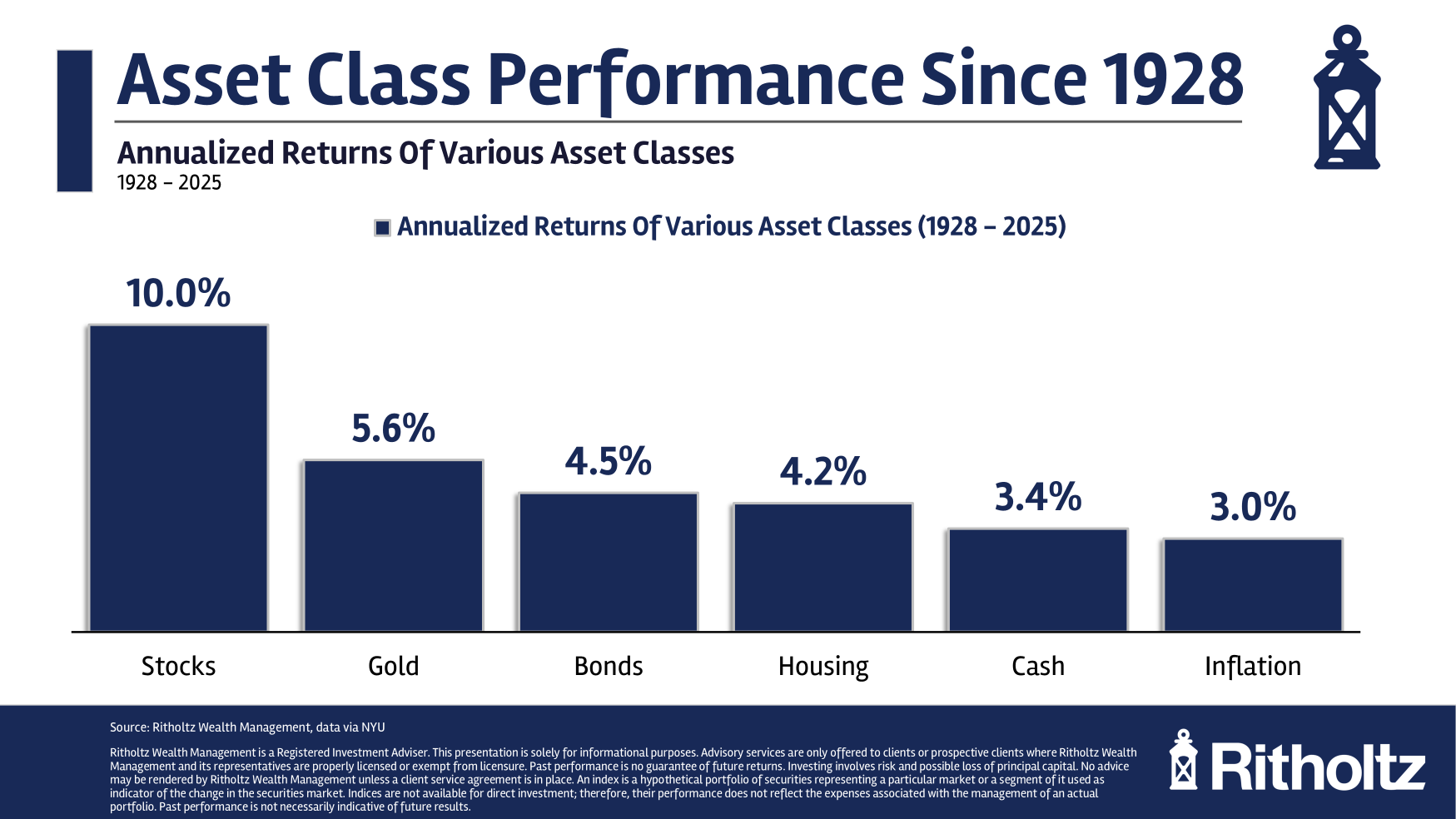
Gold's modern trading era began in 1971, when the US severed the dollar's convertibility to gold and ended the Bretton Woods system. Since then, its record has been highly variable by decade — delivering double-digit annual returns in just 3 of the past 6 decades, a "feast or famine" pattern [https://awealthofcommonsense.com/2026/01/historical-returns-for-stocks-bonds-cash-housing-gold-2025/]. Its long-term returns tend to remain relatively stable even as they swing wildly from year to year, which is precisely why it earns its keep as a diversifier rather than a growth engine [https://awealthofcommonsense.com/2026/01/historical-returns-for-stocks-bonds-cash-housing-gold-2025/].
The long-horizon numbers reinforce this mixed picture. Over 2015–2025, gold returned roughly +133% (~8–9% CAGR), slightly outpacing official CPI inflation, with low volatility (12–15% annualized) and a maximum drawdown of 20% in recent cycles [https://minexrponline.com/blog/bitcoin-vs-gold-store-of-value-2026]. Over the shorter 2016–2026 window, total return was about **+52% (4.3% CAGR)** — far below Bitcoin's explosive gains but with dramatically lower volatility, and a record that has never produced a negative 10-year real return [https://earnifyhub.com/blog/crypto/bitcoin-vs-gold-store-of-value-2026]. Gold has never lost more than 10% in a single calendar year, and its worst single-year return in the modern era was only about -4% [https://cryptonewsbytes.com/bitcoin-vs-gold-2026-store-of-value/].
The century-long and multi-decade records are even more striking. Gold has gained roughly +964.6% since 1996 (up ~27% in 2024 and ~65% in 2025 alone), and it has preserved purchasing power across roughly 5,000 years of history — a track record no fiat currency can match [https://goldprice.dev/blog/gold-price-consensus-2026][https://investormint.com/small-business/bitcoin-vs-gold-inflation-hedge-2026]. Over the past five years gold is up +135.99%, and over ten years +233.13% — long-horizon gains that compound the case for gold as a store of value even as near-term price swings remain sharp [https://www.goldpricedata.com/en/gold-price-forecast/].
But even this long record includes brutal drawdowns. Gold fell roughly 45% between 2011 and 2015, a multi-year stagnation that tested holders and produced zero real returns for years [https://www.dadaltinvestments.com/article/gold-vs-bitcoin-which-is-the-better-hedge]. This is the counterweight to the "always wins" narrative: gold can and does stagnate for extended periods.
So has it been the best store of value? Compared to stocks, no. The S&P 500 has broadly outperformed gold on a total-return basis since 1971, especially when dividends are reinvested [https://cedargoldgroup.com/gold-vs-stocks/]. Gold's roughly 7% decade return trails equities over full bull markets [https://www.dadaltinvestments.com/article/gold-vs-bitcoin-which-is-the-better-hedge]. But gold's edge appears in specific regimes: it has dominated during high-inflation and crisis periods, and it has preserved purchasing power during stock market crashes when equities fell [https://cedargoldgroup.com/gold-vs-stocks/][https://commodity.com/blog/gold-compared/].
The verdict: gold is a strong store of value, but not the best in a simple total-return sense. It wins in crises and against currency debasement, and loses to equities over full bull markets. The distinction between these two frames — growth vs. preservation — is the key to the entire report.
2. Gold vs. Stocks vs. Real Estate vs. Bitcoin
Comparing asset classes over time clarifies gold's specific role in a portfolio.
Stocks (S&P 500)
Stocks offer the highest long-term total returns, but with significant drawdowns and emotional toll. Gold has historically held its value during crashes where equities fell — most notably the 2008–2009 financial crisis, when gold rose ~25% while the S&P fell ~57% [https://cedargoldgroup.com/gold-vs-stocks/][https://dadaltinvestments.com/article/gold-vs-bitcoin-which-is-the-better-hedge/]. The trade-off is clear: equities grow wealth; gold protects it.
Real Estate
Real estate provides income and leverage, but is illiquid and location-dependent. Gold's advantage is portability and global liquidity — it can be moved, sold, or inherited across borders far more easily than property [https://commodity.com/blog/gold-compared/].
Bitcoin
Bitcoin offers far higher long-term returns (a +4,200% decade gain versus gold's +52%) but with 3–4x the volatility (40–80% versus 12–20%) and a demonstrated failure as a safe haven during acute stress [https://earnifyhub.com/blog/crypto/bitcoin-vs-gold-store-of-value-2026][https://goldpricetools.com/blog/gold-vs-bitcoin-2026]. During the March 2020 pandemic selloff and the 2022 crypto winter, Bitcoin fell alongside — and often more than — gold. It is a higher-beta store of value, not a lower-volatility one.
Gold
Gold pays no yield, but is non-correlative, geologically scarce (only ~1.5% of above-ground stock is mined per year), and a proven crisis hedge. With a market cap of roughly $12–14 trillion, it is a deep, liquid diversifier [https://www.dadaltinvestments.com/article/gold-vs-bitcoin-which-is-the-better-hedge][https://commodity.com/blog/gold-compared/].
A key caveat worth emphasizing: gold does not hedge liquidity-driven crashes. During the March 2020 pandemic selloff, gold fell alongside risk assets as investors sold anything liquid to raise cash [https://www.dadaltinvestments.com/article/gold-vs-bitcoin-which-is-the-better-hedge]. It is a hedge against debasement and fear, not against a scramble for cash. This distinction explains why gold's correlation to equities can spike to near 1.0 during acute stress — and why it matters for anyone relying on it as a "safe" asset.
3. The Inflation Question: The Fed Says It's Not a Big Deal

Here is a point often overlooked: inflation in the 2020s, while painful, was actually lower than the 1940s, 1970s, and 1980s, and remains near the historical average of roughly 3% [https://awealthofcommonsense.com/2026/01/historical-returns-for-stocks-bonds-cash-housing-gold-2025/]. So the Fed's relative calm has some empirical backing — though "not a big deal" historically does not mean "no damage," especially when compounded over time on wages and cash savings.
But the 2026 backdrop is more inflationary than the Fed's calm suggests, and the Fed is no longer calm. Under Chair Kevin Warsh, the Fed has resumed rate hikes — delivering its first increase since 2023, now at 3.75%–4.00% — with officials insisting inflation is "too high and has been for too long." Nine of eighteen officials have penciled in at least one more hike in 2026, and the path remains data-dependent, with hikes potentially running into 2027 [https://blog.orbitremit.com/federal-reserve-fomc-minutes-october-2026/][https://www.chase.com/personal/investments/learning-and-insights/article/will-the-federal-reserve-hike-rates-at-october-2026-fomc-meeting][https://www.securities.io/fomc-minutes-show-most-participants-saw-year-end-hike-as-likely/].
The 2026 inflation numbers bear this out. Headline CPI has hovered around 3.3–3.7% (March at 3.3%, August at 3.4%, and 3.7% most recently), while core has been cooler at ~2.4–2.6% [https://investormint.com/small-business/bitcoin-vs-gold-inflation-hedge-2026][https://www.tradetaurex.com/news/monthly-outlook-gold-yields-october-2026/][https://discoveryalert.com/analysis/gold-price-outlook-fed-hike-october-2026/][https://www.chase.com/personal/investments/learning-and-insights/article/will-the-federal-reserve-hike-rates-at-october-2026-fomc-meeting]. Broader measures are worse: total PCE inflation sits at 3.8% (3.4% core), and the Fed projects inflation easing back to its 2% target only by 2029 — after more than five consecutive years above target [https://www.securities.io/fomc-minutes-show-most-participants-saw-year-end-hike-as-likely/].
Critically, a large share of that headline number is now energy-driven. Brent crude sits near $106, and tanker attacks in the Strait of Hormuz tied to the ongoing war with Iran have kept oil elevated — feeding inflation in a way that complicates the Fed's "look through" stance [https://discoveryalert.com/analysis/gold-price-outlook-fed-hike-october-2026/][https://www.chase.com/personal/investments/learning-and-insights/article/will-the-federal-reserve-hike-rates-at-october-2026-fomc-meeting]. A hot September core CPI of 2.6% (vs. ~2.5% expected) already lifted hike odds, Treasury yields, and the dollar [https://discoveryalert.com/analysis/gold-price-outlook-fed-hike-october-2026/].
Has gold hedged inflation? Historically yes, but imperfectly, with long dry spells. Gold's strongest inflation-crisis performances came in the 1970s (a ~24x price increase during 7%+ inflation), the 2008–2009 financial crisis (rose 25% while stocks fell 57%), and the 2022 inflation spike (outperformed equities) [https://dadaltinvestments.com/article/gold-vs-bitcoin-which-is-the-better-hedge][https://cedargoldgroup.com/gold-vs-stocks/][https://commodity.com/blog/gold-compared/]. There have also been decades where gold flatlined while everything else rose. Notably, gold has proven an effective inflation hedge primarily when CPI runs above roughly 4–5% annually — a threshold the current ~3% environment has not consistently breached [https://discoveryalert.com/central-bank-gold-buying-strategies-2026/]. The takeaway: gold is better understood as a hedge against currency debasement and systemic uncertainty than as a precise inflation ticker [https://www.expertmarketresearch.com/price-forecast/gold-price-trends][https://www.analyticsinsight.net/trading/gold-price-outlook-2026-drivers-volatility-and-cfd-trading-dynamics].
A useful nuance: neither gold nor Bitcoin hedges "good inflation" driven by a strong economy — gold specifically thrives when real yields fall, making the 10-year TIPS yield the key metric to watch [https://investormint.com/small-business/bitcoin-vs-gold-inflation-hedge-2026]. As a straightforward inflation-protection tool, gold has a stronger multi-decade track record than Bitcoin, though it sometimes lags inflation in the short term before catching up over years [https://goldpricetools.com/blog/gold-vs-bitcoin-2026][https://minexrponline.com/blog/bitcoin-vs-gold-store-of-value-2026].
4. The Dollar System and Self-Protection
The US financial economy is built on the USD — and that creates a specific vulnerability. The stakes are stark: the dollar has lost over 95% of its purchasing power since 1913, while gold has preserved value across millennia [https://www.silveroftruth.com/blog/de-dollarization-and-gold-2026-02-14]. When the dollar is debased through debt expansion or monetary expansion, dollar-denominated wealth erodes — and this is the risk gold insures against.
This is no longer a fringe thesis — it is playing out in official reserve books. Central banks have been cutting dollar holdings to multi-decade lows while accumulating record gold stockpiles (over 4,500 tonnes purchased since 2010), driven by de-dollarization and geopolitical risk [https://www.silveroftruth.com/blog/de-dollarization-and-gold-2026-02-14]. Gold's share of global official reserves has risen from ~15% in 2023 to roughly 20% in 2025 — the first sustained multi-year increase since the 1970s [https://discoveryalert.com/central-bank-gold-buying-strategies-2026/]. In the World Gold Council's 2026 Central Bank Gold Reserves Survey, 74% of respondents anticipate lower US dollar holdings in global reserves over five years while expecting gold to rise, and 89% expect global gold reserves to increase over the next 12 months [https://www.gold.org/goldhub/research/central-bank-gold-reserves-survey-2026].
There is a telling wrinkle: the dollar has been depreciating even as nominal rates rise, and the market-implied forward curve shows the federal funds rate trending upward over the medium term — rising to ~4.25% by end-2026 and peaking at 5.00% (+100 bps) by 2036–2037 [https://www.bluegamma.io/central-banks/central-bank-interest-rate-forecasts/federal-reserve-interest-rate-forecast]. In other words, markets expect restrictive policy to persist for years, which is precisely the environment — sustained monetary expansion against a backdrop of elevated debt — in which gold's purchasing-power preservation matters most [https://www.bluegamma.io/central-banks/central-bank-interest-rate-forecasts/federal-reserve-interest-rate-forecast].
So what should people do to protect themselves? Gold is one tool, not the only one. Diversification across real assets, inflation-linked bonds, and a broad equity portfolio addresses different risks. Gold's value as self-protection lies in its non-correlation and its independence from any single government's balance sheet [https://commodity.com/blog/gold-compared/][https://www.analyticsinsight.net/trading/gold-price-outlook-2026-drivers-volatility-and-cfd-trading-dynamics]. Practically, advisors typically recommend 3–7% gold allocations, with some suggesting a diversified 5–10% allocation to each of gold and Bitcoin [https://minexrponline.com/blog/bitcoin-vs-gold-store-of-value-2026][https://earnifyhub.com/blog/crypto/bitcoin-vs-gold-store-of-value-2026]. A useful discipline: distinguish nominal from real yields, separate dollar-gold returns from local-currency returns, and treat fund flows as evidence rather than a price floor [https://livetodaystock.com/gold-price-forecast-october-2026/]. The disciplined framing, echoed across analysts, is to avoid reacting to single data points and instead anchor on diversification, time horizon, and liquidity planning — gold's case is a multi-year one, not a trade on the next CPI print [https://www.chase.com/personal/investments/learning-and-insights/article/will-the-federal-reserve-hike-rates-at-october-2026-fomc-meeting].
5. The Structural Engine: Central Banks, Supply, and Demand
The 2026 price is driven far more by sovereign and structural forces than by ordinary retail supply and demand.
Central-bank buying has become the dominant driver
Global purchases reached 863 tonnes in 2025 (projected to decline to ~755 tonnes in 2026 simply because higher prices temper demand) [https://discoveryalert.com/central-bank-gold-buying-strategies-2026/]. After a quiet first quarter, buying rebounded sharply in Q2 2026 to a record 289 tonnes (up from a revised 57 tonnes in Q1), led by Poland (51t) and China (33t, its largest quarterly gain since Q4 2023), with Russia as the main seller [https://www.gold.org/goldhub/research/gold-demand-trends/gold-demand-trends-q2-2026/central-banks]. The World Gold Council notes central banks are averaging 1,000 tonnes per year over the past four years versus ~500 tonnes previously [https://www.gold.org/goldhub/research/central-bank-gold-reserves-survey-2026]. This sovereign demand is characterized as price-insensitive reserve building — central banks positioning ahead of events while retail investors follow price [https://www.nationalgoldreserve.com/blog/central-bank-gold-buying-trends-2026].
The Q2 2026 demand book illustrates the split: total demand was 1,269 tonnes, but that masked a 45-tonne ETF outflow offset by a net 289-tonne central-bank purchase — official-sector strength alongside weaker private investment demand [https://livetodaystock.com/gold-price-forecast-october-2026/]. The motivation has structurally shifted: central banks have been sustained net buyers for multiple consecutive years, driven by currency diversification away from the USD, sanctions-risk mitigation, and long-term hedging against expanding global debt [https://www.nationalgoldreserve.com/blog/central-bank-gold-buying-trends-2026]. Emerging markets (with 15–25% reserve allocations) lead accumulation, while the Federal Reserve maintains static holdings [https://discoveryalert.com/central-bank-gold-buying-strategies-2026/].
Supply is tightening
Mining production is projected to fall ~2% in 2026, and the average all-in sustaining cost (AISC) has risen to roughly $1,600/oz, establishing a structural floor under the price [https://discoveryalert.com/central-bank-gold-buying-strategies-2026/]. With only ~1.5–1.75% of above-ground stock mined annually, supply inflation remains structurally low [https://metalcharts.org/guides/gold-vs-bitcoin][https://dadaltinvestments.com/article/gold-vs-bitcoin-which-is-the-better-hedge].
Retail demand is surging even as Western allocations stay low
Physical retail demand hit a 12-year high of 1,374 tonnes, yet Western investor allocations remain below 1% of portfolios — a gap that leaves room for future inflows [https://discoveryalert.com/central-bank-gold-buying-strategies-2026/].
6. Current Trends: Volatile, Correcting from Record Highs
The 2026 picture is dramatic — and more choppy than a simple "record high" narrative suggests.
- 2025: gold surged ~65% to record highs above $5,500/oz [https://dadaltinvestments.com/article/gold-vs-bitcoin-which-is-the-better-hedge][https://metalcharts.org/guides/gold-price-forecast].
- 2026 correction: after a record of roughly $5,513–5,595/oz on January 28, 2026, gold fell roughly -3.9% year-to-date as of mid-October, with a latest close around $4,156/oz [https://goldprice.dev/blog/gold-price-consensus-2026][https://www.goldpricedata.com/en/gold-price