
TL;DR
- Gold trades around $4,130–$4,165/oz as of Oct 7, 2026, after a record high of ~$5,318–$5,589 in late January, a sharp pullback to ~$3,975 in mid-2026, and a partial recovery into the $4,000–$4,450 range.
- Over long horizons gold has preserved purchasing power, but it has not been the single best asset class since 1974 — equities, silver, and REITs have outperformed more often.
- Gold is a credible long-run inflation/currency-debasement hedge, but its short-term inflation link is weak and more tied to real interest rates and the dollar.
- The Fed under Chair Kevin Warsh has rejected its own "inflation is not a big deal" framing, signaling higher-for-longer rates that pressure non-yielding gold — yet central banks bought a record 289 tonnes in Q2 2026, driven by de-dollarization.
- 2026 has been volatile but multi-year trends remain up (+137% over 5 years); gold's historical inverse correlation with real yields broke down in 2025–2026, creating a structural price floor.
- What's known vs. unknown: long-run preservation is well-established; near-term direction hinges on Fed policy and real rates, not inflation data alone.
1. Has Gold Been the Best Store of Value?

The premise that gold has been "the best store of value for the last century" doesn't survive scrutiny — but gold remains a top-tier store of value.
Long-run preservation is real. Gold has functioned as a store of value for millennia and has broadly preserved purchasing power as paper currencies depreciated https://goldprice.org/gold-price-history.html. Over the full record it is up roughly +328% all-time, +231% over 10 years, +137% over 5 years, and +4.2% over the past year https://goldprice.net.in/gold-price-history.
But "best" is an overstatement. Since gold left the Bretton Woods system in 1974, it has topped US asset-class performance only 5 times — trailing US equities (9 times), silver (9 times), and REITs (11 times) https://www.bullionvault.com/gold-guide/annual-asset-performance-comparison. Gold gained value year-over-year in only 6 of the last 10 years (1992–2020) and underperformed stock indices from 2010–2020 https://commodity.com/blog/gold-compared/. It also suffered major drawdowns: -32% in 1981 and -28% in 2013 https://www.bullionvault.com/gold-guide/annual-asset-performance-comparison.
Where gold shines. Gold's returns peaked during high-inflation regimes (1974 and the late 1970s) https://www.bullionvault.com/gold-guide/annual-asset-performance-comparison, and it has acted as "portfolio insurance," rising when stocks fell sharply (2001, 2007–2010, 2020) and proving steadiest during the COVID-19 pandemic https://commodity.com/blog/gold-compared/. Notably, it held up when equities collapsed in 2022 — gold fell just -0.3% while the S&P dropped 18.1% https://www.bullionvault.com/gold-guide/annual-asset-performance-comparison.
Conclusion: Gold is a durable, long-run store of value and a diversifier — but not the single best-performing asset. It should be evaluated for what it does best: preserving purchasing power and reducing portfolio volatility, not maximizing returns.
2. Gold as an Inflation Hedge in a USD-Based World
The case for gold. Because fiat currencies lose value over time, gold is widely viewed as a hedge against currency debasement https://goldprice.org/gold-price-history.html. Its strongest historical returns came during peak-inflation periods (1974, late 1970s) https://www.bullionvault.com/gold-guide/annual-asset-performance-comparison, and it is traditionally classified as an inflation hedge https://goldprice.net.in/gold-price-history. In a financial economy built on the USD, this debasement hedge is exactly what makes gold attractive to holders of dollar-denominated wealth.
The caveat. Gold's short-term link to inflation is weaker than commonly believed; near-term prices are driven more by real interest rates and the strength of the dollar https://www.kitco.com/charts/gold. A weaker dollar lifts gold; a stronger dollar depresses it https://goldprice.org/gold-price-history.html. Gold also underperformed during the low-inflation 1990s–2000s despite modest price gains https://www.bullionvault.com/gold-guide/annual-asset-performance-comparison.
The Fed-vs.-reality gap. The Fed's dismissive framing has actually hardened, not softened. Under Chair Kevin Warsh, the Fed has explicitly rejected the idea that recent readings signal meaningful improvement — dismissing even a negative June CPI print as mattering "not much" — while acknowledging inflation runs hot and above its 2% target https://www.cnbc.com/2026/08/28/kevin-warsh-jackson-hole-federal-reserve-inflation.html https://www.mufgresearch.com/rates/2026-jackson-hole-recap/. Headline PCE sits at 3.7% (4.1% annualized over six months), and labor markets sit near full employment, tilting the Fed's risk balance toward inflation https://ezzeldin.net/warsh-jackson-hole-speech-august-28-2026/. Warsh declined to offer forward guidance or an explicit reaction function, signaling a less predictable policy path and leaving the door open to a September or December rate hike https://www.pimco.com/us/en/insights/chairman-warshs-jackson-hole-speech-emphasizes-price-stability https://political.org/2026/08/28/fed-official-warsh-says-more-work-needed-to-combat-inflation/.
This is the crux of the "Fed says it's not a big deal" framing: the Fed's calm (or now hawkish) stance focuses on near-term CPI rather than the long-term depreciation of the currency itself. If the concern is purchasing power over decades, gold's debasement-hedge role is more relevant than its short-term inflation-hedge role. But the tradeoff is real: higher-for-longer rates raise the opportunity cost of holding a non-yielding asset. Gold initially rose on Warsh's inflation warnings, then retreated as the prospect of higher real interest rates reduced its relative attractiveness https://alphio.ai/blog/fed-rate-hike-jackson-hole-august-2026.
What people should do. Gold works best as a hedge and diversifier within a diversified portfolio — not as a sole or leveraged bet. Position sizing and diversification matter more than market timing https://commodity.com/blog/gold-compared/ https://www.bullionvault.com/gold-guide/annual-asset-performance-comparison. For those seeking direct inflation protection, alternatives include TIPS, floating-rate securities, private credit, and infrastructure assets — though these carry their own tradeoffs and do not replicate gold's portfolio-insurance and de-dollarization properties https://alphio.ai/blog/fed-rate-hike-jackson-hole-august-2026.
3. Current Trends (2026): Volatile but Leaning Up
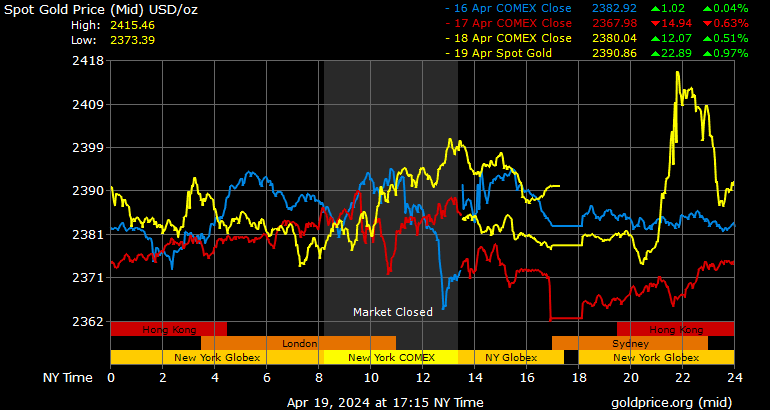
Price action. Gold closed around $4,130–$4,165/oz on Oct 7, 2026 https://www.kitco.com/charts/gold https://goldprice.net.in/gold-price-history, after a volatile year. It set a record high of ~$5,318–$5,589 in late January https://goldtickers.com/historical/2026 https://www.kitco.com/charts/gold https://preciousmetalscharts.com/gold-price-2026, fell to a low of ~$3,975–$3,985 in mid-2026 https://goldtickers.com/historical/2026 https://preciousmetalscharts.com/gold-price-2026, and has since recovered into the $4,000–$4,450 range https://goldtickers.com/historical/2026.
Year-to-date performance. The consensus is that gold is down roughly 4.2% YTD (Finding: -4.15% https://goldtickers.com/historical/2026; -4.20% https://goldprice.net.in/gold-price-history). One source cites a steeper -12.5% YTD decline https://preciousmetalscharts.com/gold-price-2026 — likely a different measurement basis (e.g., from a higher January opening) — so treat that figure with caution.
Recent volatility. Gold has swung sharply on Fed rate-hike expectations, inflation data, and labor signals: a "Hot Inflation" report triggered a third weekly loss, hawkish Fed commentary (including Warsh's Jackson Hole speech) sent gold sharply lower, while soft jobs data and fading rate-hike odds fueled a sharp rebound and recent rally https://goldprice.org/?lang=en.
Central-bank demand: a structural bid. Despite 2026's price chop, central banks bought a record 289 tonnes in Q2 2026 — up ~74% YoY and at a pace unseen since the late 1960s https://www.tftc.io/central-bank-gold-purchases-record-289-tonnes-q2-2026 https://www.algo-finance.com/stock-market/commodities/global-gold-reserves-central-bank-accumulation-2026/. Poland was the largest buyer (51t), followed by China (33t), with broad-based purchases from other nations https://www.gold.org/goldhub/research/gold-demand-trends/gold-demand-trends-q2-2026/central-banks. This buying was price-inelastic — occurring even as gold fell ~16% (its worst quarter since 2013) — pointing to structural reserve-building rather than speculation https://www.tftc.io/central-bank-gold-purchases-record-289-tonnes-q2-2026. The driver is de-dollarization and counterparty-risk concerns following the 2022 seizure of Russian reserves: 74% of reserve managers expect lower USD holdings over five years https://www.gold.org/goldhub/gold-focus/2026/07/central-bank-gold-statistics-central-banks-remain-committed-gold. Sentiment is exceptionally strong — 89% of respondents expect gold holdings to rise over the next year and a record 45% plan to increase their own holdings https://www.gold.org/goldhub/research/gold-demand-trends/gold-demand-trends-q2-2026/central-banks.
A broken correlation and divergent participants. Gold's historical inverse correlation with real yields broke down in 2025–2026, with record-high prices persisting despite elevated yields — creating a structural price floor https://www.algo-finance.com/stock-market/commodities/global-gold-reserves-central-bank-accumulation-2026/. Meanwhile, Western ETF investors have been net sellers while physical buyers (central banks, Asian demand) remain strong — a divergence in market psychology that suggests the price floor is supported by sovereign demand even as speculative investors waver https://www.algo-finance.com/stock-market/commodities/global-gold-reserves-central-bank-accumulation-2026/.
Long-term trend. Despite 2026's chop, multi-year trends remain strongly up (+4.2% 1yr, +137% 5yr, +231% 10yr) https://goldprice.net.in/gold-price-history. Central-bank accumulation and monetary-policy shifts sustain demand as a hedge against fiat devaluation https://goldtickers.com/historical/2026.
4. What We Know vs. What We Don't
Known:
- Gold's long-run purchasing-power preservation and reputation as a store of value https://goldprice.org/gold-price-history.html https://www.kitco.com/charts/gold.
- Gold has not been the single best-performing asset since 1974 — it trails equities, silver, and REITs most years https://www.bullionvault.com/gold-guide/annual-asset-performance-comparison.
- Gold's short-term inflation link is weak; near-term prices track real interest rates and the dollar more than CPI https://www.kitco.com/charts/gold.
- Central banks are buying at record, price-inelastic levels (289t in Q2 2026), driven by de-dollarization and post-2022 Russian-reserve-seizure counterparty risk https://www.tftc.io/central-bank-gold-purchases-record-289-tonnes-q2-2026.
- The Fed under Warsh has hardened its stance — inflation runs hot, forward guidance is absent, and rate hikes remain on the table — raising the opportunity cost of non-yielding gold https://www.cnbc.com/2026/08/28/kevin-warsh-jackson-hole-federal-reserve-inflation.html.
- Gold's inverse correlation with real yields broke down in 2025–2026, suggesting a structural price floor https://www.algo-finance.com/stock-market/commodities/global-gold-reserves-central-bank-accumulation-2026/.
Unknown:
- Whether the central-bank bid and broken yield correlation will hold if the Fed delivers sustained rate hikes — higher real rates could pressure gold even as sovereign demand supports it.
- Whether the de-dollarization bid is a durable structural shift or a multi-year cyclical trend that could reverse if USD trust rebuilds.
- Near-term direction: gold's path depends on Fed communication, labor data, and inflation prints, not on inflation alone — and Warsh's lack of forward guidance makes the path harder to predict.
- Whether the current ~$4,100 level represents a base case, or whether the LBMA's cited $5,000 forward target (or a deeper pullback) is more likely.
- How Western ETF flows will evolve — continued outflows could cap upside even as physical demand provides a floor.
Bottom Line

Gold is a proven long-run store of value and portfolio insurance, but not the "best" asset over the last century. In a USD-based world, its debasement-hedge role is compelling — and central-bank buying at record levels confirms this. But its near-term performance is hostage to Fed policy and real rates, and the current hawkish tilt under Warsh is a genuine headwind. For most people, gold is best held as a modest, diversified hedge rather than a timing-driven bet — sized for what it does best (preserving power and cutting volatility), not for what it cannot guarantee (beating the market or shielding against rising rates).