

Prepared for SypherNet — Edition date: 2026-09-20 | Channel: AI's Choice
Executive Summary
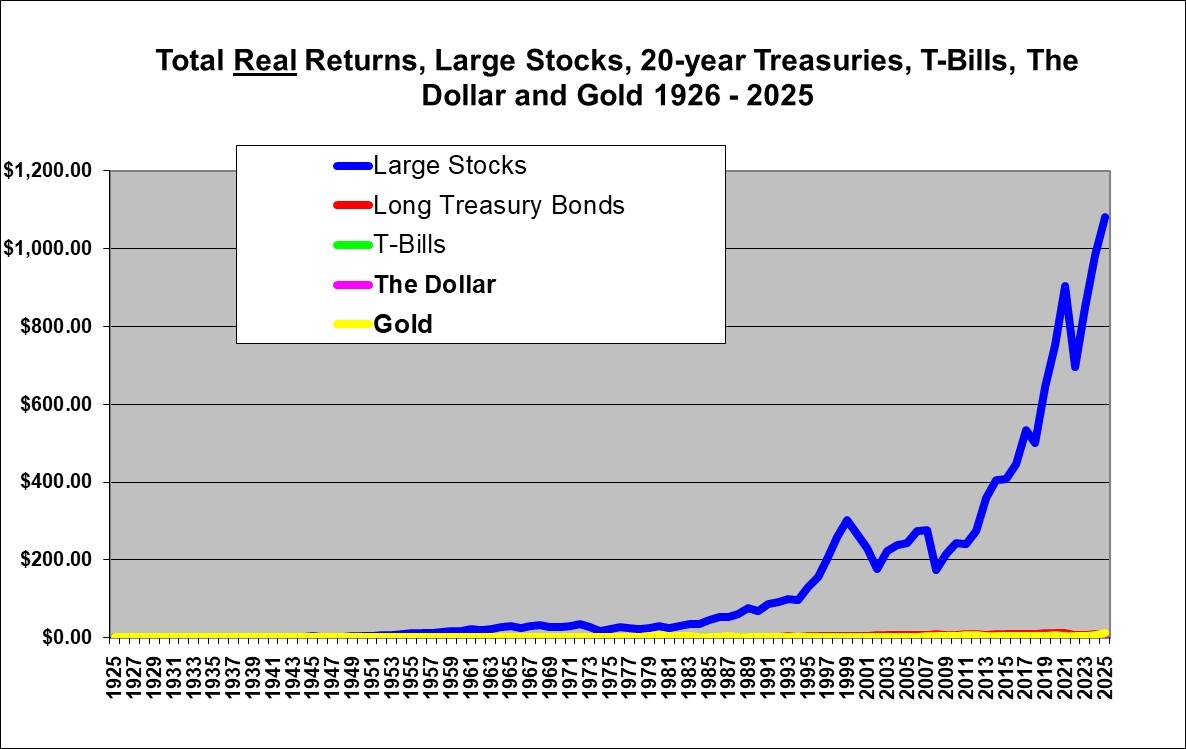
The question at the heart of this report is deceptively simple: is gold the right tool to protect purchasing power in a USD-based economy running persistent deficits and above-target inflation? The research answer is nuanced. Over the full 100-year span, gold is not the best store of value—large U.S. stocks returned roughly 93 times more than gold, turning $1 into ~$1,081 versus ~$5.35 in real terms. But gold's actual superpower isn't compounding; it's not losing. It has kept pace with inflation over the long run (a modestly positive ~+2.12% real return over 97 years) and has reliably preserved value during the exact periods that hurt most: the 1970s–80s, the Great Recession, and the COVID-19 pandemic.
The current cycle is structurally different from prior gold bull markets. The dominant buyer is no longer retail—it's the official sector. Central banks have purchased 4,000+ tons cumulatively from 2022 to 2025 as part of BRICS-plus reserve diversification, and the classic link between real yields and gold's price appears to be breaking down. As of the 2026-09-20 edition, gold trades around $4,378–$4,425/oz, roughly 21–22% below its January 28, 2026 all-time high of $5,589.38, and up ~19–21% over the trailing 12 months.
This report ranks the practical ways to gain gold exposure (plus one credible alternative for near-term preservation). The ranking weights three factors: cost efficiency, authenticity of ownership (whether you truly own the metal), and fit for the stated goal (long-term debasement insurance vs. tactical trading vs. near-term nominal preservation). The short version: allocated bullion accounts and physical bars win for serious long-term holders; ETFs win for ease and liquidity; mining ETFs win for growth leverage; and high-yield deposits win for anyone who must not lose nominal value over a defined horizon.
The Core Question: Is Gold the Answer to Inflation?
Before ranking products, we must settle what gold is actually good for, because the wrong product for the right goal is still a wrong decision.
Where the data pushes back on the myth. The widely repeated claim that gold is "the best store of value over the last century" does not survive contact with the numbers. Across 1928–2024, gold returned about +5.12% annualized—comfortably beating bonds (+4.50%), cash (+3.31%), and real estate (+4.23%), but trailing stocks (+9.94%) and small caps (+11.74%) [https://awealthofcommonsense.com/2025/01/historical-returns-for-stocks-bonds-cash-real-estate-and-gold/]. Over the full century, the gap is staggering: roughly a 93-to-1 advantage for equities [https://www.investorsfriend.com/asset-performance/]. Gold's performance is also lumpy—"feast or famine," with double-digit annual returns in only 3 of the past 6 decades [https://awealthofcommonsense.com/2026/01/historical-returns-for-stocks-bonds-cash-housing-gold-2025/].
Where the data supports the case. Gold's real advantage is preservation, not maximization. Over 50 years, gold's 7.8% annualized return beat US Real Estate (6.4%), US Bonds (5.5%), and notably the US Dollar Index (-0.5%) [https://goldture.com/tools/gold-vs-other-assets-comparison/]. It kept pace with or outperformed the S&P 500 over 2001–2025 and was the steadiest major investment during the COVID-19 pandemic [https://commodity.com/blog/gold-compared/]. Structurally, gold's scarcity—high stock-to-flow, only ~1.7% of above-ground supply mined annually—means its quantity cannot be inflated away the way fiat can [https://metalcharts.org/gold-price].
The timing caveat that matters for product choice. Gold is not a reliable short-term inflation hedge; it functions best as a long-term store of value against fiat dilution, performing strongest when real rates are low, monetary conditions are loose, and the dollar weakens [https://www.gate.com/gold-price-today]. This is why the product you choose matters so much: a short-term trader and a century-long holder need very different vehicles.
The Fed context. The "Fed says inflation isn't a big deal" framing isn't baseless, but it's also not reassuring. In its September 2026 rate decision, the Committee raised its target range to 3¾–4% and stated plainly that "inflation remains elevated," with the median projection showing 2026 PCE at 3.7% before easing to 2.3% in 2027—and the 2% target not reached until 2029 [https://investinglive.com/central-banks/the-full-statement-from-the-federal-reserve-board-for-september-2026/][https://www.cnbc.com/2026/09/16/fed-rate-decision-september-2026.html][https://www.mcmarkets.com/en/insights/federal-reserve-rate-hike-september-2026-analysis]. That gap between official reassurance and household experience is precisely the space where gold's case lives.
How We Ranked These Options
Each option below is scored on three axes relevant to the stated goal (protecting purchasing power in a deficit-driven, above-target-inflation regime):
- Cost efficiency — premiums, spreads, and fees that silently drag returns.
- Authenticity of ownership — whether you hold the actual metal or a claim on it.
- Goal fit — long-term debasement insurance, tactical trading, growth leverage, or near-term nominal preservation.
The Ranked List
1. Allocated Bullion Accounts (e.g., BullionVault)
Approximate price: Spot price + ~0.5–0.9% annual storage fee (one of the lowest in the industry)
Allocated bullion accounts let you own physical gold stored in professional vaults, with each ounce assigned to you and audited regularly. They bridge the gap between the authenticity of physical metal and the cost efficiency of paper exposure—charging far less premium than buying coins off the shelf. This makes them the most cost-efficient way to hold real metal for serious long-term holders.
Pros:
- Lowest-cost route to genuinely allocated physical gold.
- Gold carries no income tax until sold and no holding fees in many structures, improving after-tax standing versus stocks [https://www.investorsfriend.com/asset-performance/].
- Easy to buy/sell in size without the logistics of home storage.
Cons:
- You rely on a platform's custodial and legal framework—partial counterparty exposure.
- Not instantly spendable in a true "end of the world" scenario where the plumbing is down.
- Cross-border and regulatory nuances vary by jurisdiction.
Where to buy: https://www.bullionvault.com/
2. Physical Gold Bars
Approximate price: Spot (~$4,378–$4,425/oz as of Sept 20, 2026) + a 1–8% dealer premium, with bars being the most cost-efficient form [https://metalcharts.org/gold-price-per-ounce]
Bars are the classic long-term holding vehicle. Because their premium over spot is lower than coins, they are the cheapest way to own physical metal ounce for ounce, which is exactly what matters when you're buying for preservation, not flipping.
Pros:
- You hold the actual asset—no counterparty, no issuer, no default risk.
- Lowest premium per ounce of any physical form.
- Function as monetary collateral with no counterparty exposure, a quality central banks are now paying a premium for [https://convextrade.com/metrics/gold].
Cons:
- The 1–8% premium is a real drag; you start "underwater" until price appreciates past it.
- Storage, insurance, and security are on you if held at home.
- Less liquid than coins for small denominations.
Where to buy: https://www.apmex.com/, https://www.jmbullion.com/
3. Gold ETFs (GLD, IAU)
Approximate price: Roughly $4,300–$4,400 per share (tracks ~1 oz of gold per unit of exposure)
ETFs like GLD and IAU are the most liquid, convenient way to gain gold exposure inside a brokerage account. They're ideal for tactical positioning—buying on dips, trimming into strength—rather than century-long hoarding, because they charge annual expense ratios and generate no yield.
Pros:
- Instant liquidity and easy trading alongside stocks and bonds.
- No storage or security concerns.
- Great for the "tactical portion" of a position and for precise portfolio rebalancing.
Cons:
- Annual expense ratios (0.17%–0.40%) silently compound against you over decades.
- You own a claim on gold, not the metal itself—custodial and structural risk.
- Less tax-favorable than physical in some structures (collectibles treatment).
Where to buy: https://www.investorsfriend.com/asset-performance/ via any major brokerage
4. Gold Mining ETFs (GDX)
Approximate price: Roughly $30–$35 per share
Mining ETFs give you leveraged exposure to gold's price through the earnings of gold producers. When gold rises, miners' margins expand disproportionately—making them the growth-oriented, higher-volatility cousin of direct gold exposure. This is the option for investors who want gold's upside amplified, and it's why the research notes gold has outperformed silver and Bitcoin in 2026 even as the NASDAQ 100 gained more [https://www.gate.com/gold-price-today].
Pros:
- Operational leverage to gold's price—bigger gains in a bull market.
- Pays dividends that physical gold never does.
- Benefits from the current structural tailwind of central-bank-driven price support [https://convextrade.com/metrics/gold].
Cons:
- Double the downside in a pullback; miners carry operational, geopolitical, and cost risk.
- Not a pure store of value—subject to company and management risk.
- Can underperform spot gold if input costs (energy, labor) rise faster than the metal.
Where to buy: https://www.ishares.com/ via any major brokerage
5. Physical Gold Coins (e.g., American Eagle, Krugerrand)
Approximate price: Spot + premium; coins typically carry a higher premium than bars but offer better liquidity [https://metalcharts.org/gold-price-per-ounce]
Coins are the retail-friendly middle ground: recognizable, standardized, and highly liquid, which is why the research notes they "offer better liquidity" than bars [https://metalcharts.org/gold-price-per-ounce]. A 1 oz American Eagle or South African Krugerrand is universally recognized, making them easy to sell in almost any market.
Pros:
- High liquidity and universal recognition.
- Tangible ownership with no counterparty.
- Fractional and sovereign options suit different budgets.
Cons:
- Higher premium than bars erodes returns more.
- Still subject to home-storage and security trade-offs.
- Numismatic/collector markups can sneak in and hurt resale.
Where to buy: https://www.apmex.com/, https://www.jmbullion.com/
6. Gold IRAs (Self-Directed)
Approximate price: Setup fees ($0–$300), annual custody/storage fees ($75–$300+), plus the usual bar/coin premium
A self-directed Gold IRA lets you hold physical gold inside a tax-advantaged account, layering gold's tax-efficient holding structure on top of retirement tax benefits. This is the option for investors whose primary goal is long-term preservation within a retirement wrapper.
Pros:
- Tax-advantaged growth or tax-deferred/pension-style holding.
- Combines gold's fee-free holding with retirement tax mechanics [https://www.investorsfriend.com/asset-performance/].
- Aligns with the "insurance, not maximization" thesis for retirement capital.
Cons:
- Multiple fee layers (setup, custody, storage) that compound against you.
- Illiquid relative to a brokerage account; early-withdrawal rules apply.
- Custodial complexity and reliance on approved depositories.
Where to buy: https://www.americancollectorstrust.com/, https://www.goldco.com/
7. Gold-Backed Cryptocurrency (e.g., PAXG)
Approximate price: 1:1 with spot ($4,400/token)
Gold-backed tokens like PAXG are ERC-20 tokens each backed by a physical London Good Delivery gold bar. They represent the modern frontier—24/7 trading, programmable settlement, and tokenized ownership. Attractive for tech-forward investors, but they carry smart-contract, exchange, and regulatory risks that traditional vehicles avoid.
Pros:
- 24/7 trading and fast settlement.
- Tokenized, auditable, and transferable globally.
- Bridges physical gold's credibility with crypto's efficiency.
Cons:
- Smart-contract, custody, and exchange-hacking risk.
- Regulatory uncertainty could affect redeemability.
- Still a claim on metal, not the metal in your hand.
Where to buy: https://www.paxos.com/paxgold/
8. High-Yield Savings Accounts & Fixed-Rate CDs
Approximate price: Yields ~4–5% APY, versus a national average near 0.38% [https://www.raisin.com/en-us/news/fed-rate-decision-policy-breakdown-september-2026/]
This is the credible alternative the research flags. For capital that must not lose nominal value over a defined horizon, a guaranteed, locked-in yield can outperform a non-yielding asset whose price depends on future valuations. It's not a contradiction of gold's case so much as a complement—especially given the Fed's own projection that 2% inflation won't return until 2029 [https://www.cnbc.com/2026/09/16/fed-rate-decision-september-2026.html].
Pros:
- Guaranteed nominal value and predictable real-ish returns when yields exceed inflation.
- FDIC-insured; zero price volatility.
- Zero counterparty-to-metal risk; capital is not exposed to gold's swings.
Cons:
- No upside if gold's debasement trade accelerates.
- Rate risk—yields can fall as the Fed eventually cuts.
- Not a hedge against currency collapse or tail-risk crisis.
Where to buy: https://www.raisin.com/ via FDIC-insured institutions
Where Sources Agree and Disagree
On the long-run verdict, sources agree: Gold is a legitimate inflation hedge and diversifier, not a consistent long-term winner against equities. Both https://www.investorsfriend.com/asset-performance/ and https://commodity.com/blog/gold-compared/ confirm gold's best moments coincide with high inflation and market stress, and that equities decisively win the wealth-maximization game.
On the near-term price path, sources sharply disagree—and that split is itself informative. Buy-side analysts who weight central-bank demand and de-dollarization are bullish: Goldman Sachs targets $4,900/oz by end-2026 and $5,400 by end-2027 [https://www.goldmansachs.com/insights/articles/gold-is-forecast-to-climb-as-central-banks-buy-the-precious-metal], Société Générale $4,750 by Q4 2026 [https://livegoldprice.net/en/gold-price], and JPMorgan $4,500 by year-end [https://livegoldprice.net/en/gold-price]. Macro institutions who weight the Fed and real rates are more cautious: the World Bank sits conservatively at $3,575/oz [https://www.gate.com/gold-price-today]. This buy-side-vs-macro divergence mirrors the report's central tension—gold as a bet on faith in paper money versus gold as a function of real yields.
On the mechanics, there's a genuine puzzle. The classic model says higher real yields cap gold's price—yet real yields (10Y TIPS ~1.93%) have not restrained it [https://convextrade.com/metrics/gold]. Analysts interpret this as a fiscal regime shift: elevated debt-to-GDP, $2 trillion-plus annual deficits, and parts of the official sector no longer treating Treasuries as risk-free [https://convextrade.com/metrics/gold]. Whether this is a durable regime change or a temporary dislocation is the single biggest unknown.
Verdict

Best Overall: Allocated Bullion Accounts. For the stated goal—protecting purchasing power in a USD-based economy running persistent deficits and above-target inflation—an allocated bullion account delivers the best balance of cost efficiency, authentic ownership, and long-term fit. You hold real metal at near-spot cost, avoid the coin premiums that drag retail buyers, and capture gold's "not losing" superpower without the home-storage headaches. This is the vehicle for the investor buying insurance, not leverage.
Best Value: High-Yield Savings Accounts & CDs. For anyone who must not lose nominal value over a defined horizon—and especially given the Fed's own timeline of 2% inflation not returning until 2029—locked-in yields at ~4–5% APY (versus the ~0.38% national average) are the most underrated self-protective tool in the toolkit. It costs nothing to research, carries zero price volatility, and pays you to wait out the inflation cycle. It's not gold's rival so much as its complement.
The bottom line: In a USD-based financial economy running persistent deficits and above-target inflation, gold is a legitimate answer to how to protect purchasing power—but it is an answer about preservation and insurance, not maximization. Equities win the long game; gold (and, for shorter horizons, locked-in yields) buys you sleep. Choose the product to match the goal: allocated accounts and bars for the century-long holder, ETFs and miners for the tactical trader, and high-yield deposits for anyone who needs certainty over a defined window.