Executive Summary
As of August 12, 2026, gold is trading at approximately $4,385.60 per troy ounce, reflecting a sustained multi-decade appreciation that has more than doubled its previous all-time high of ~$2,000 set in 2011. This price level is not merely a reflection of speculative momentum; it is the market's verdict on a macro environment defined by persistent inflation, expansive central bank liquidity, and a fracturing consensus on monetary policy.
The Federal Reserve, having held rates at 3.50%–3.75% in a contentious 9-3 vote on July 29, 2026, signals deep internal division. With three regional presidents dissenting in favor of a rate hike and the Personal Consumption Expenditures (PCE) index running at 4.1%—more than double the 2% target—the Fed's ability to control the dollar's purchasing power is increasingly questioned. Simultaneously, the Fed's balance sheet has expanded to $6.7 trillion, underpinning a financial system where the velocity of money is reversing, a shift historically bullish for hard assets.
While the S&P 500 has delivered superior nominal compounding over the last century, gold has proven to be the superior store of value when measured against currency debasement and inflation. Institutional perspectives from J.P. Morgan and the World Gold Council characterize gold as a "debasement hedge" and a structural beneficiary of de-dollarization. However, recent volatility, amplified by CFD trading volumes and a parabolic 66% rally in 2025, suggests gold should be approached as a strategic portfolio stabilizer rather than a speculative momentum play. In a USD-centric economy facing fiscal and monetary headwinds, gold offers asymmetric downside protection, but it must complement, not replace, productive assets.
A Century of Verdicts: Gold vs. The Market and The Dollar
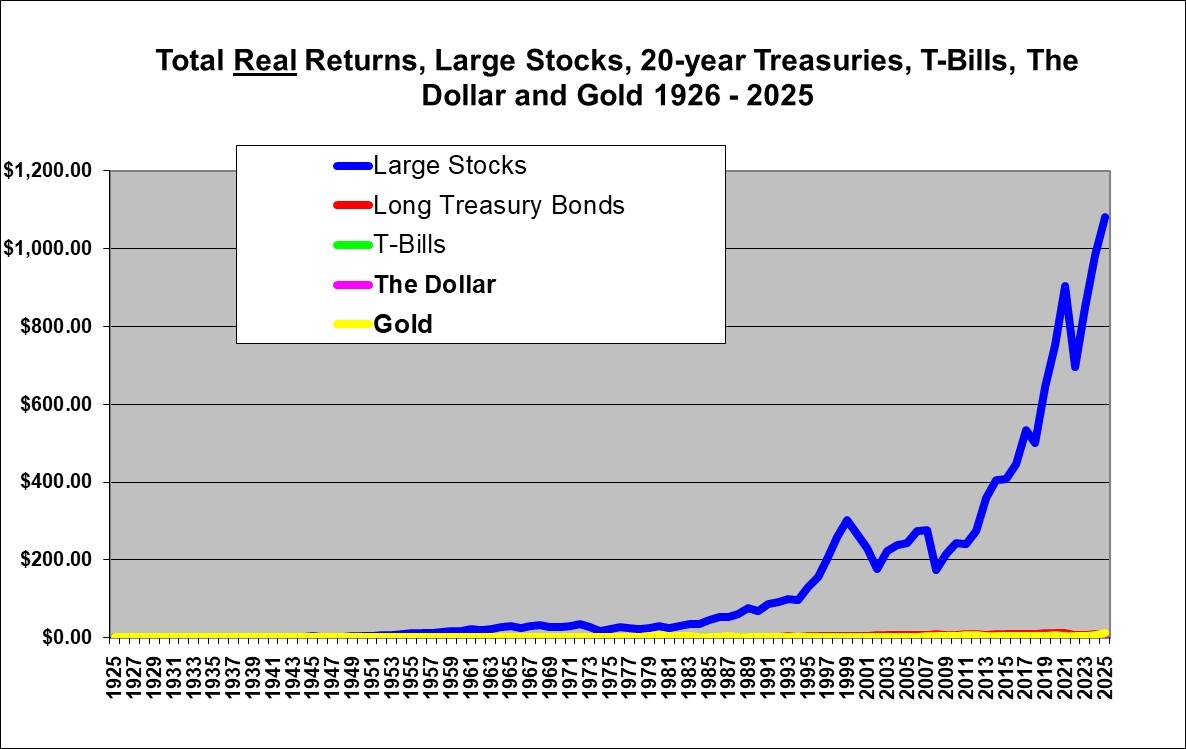
To understand gold's current valuation, one must look beyond the daily ticker and examine the century-long data. The debate over gold as an investment is often framed as a competition with equities, but this comparison misses the metal's primary function: wealth preservation.
The Nominal vs. Real Return Divergence
Historical data from 1926 to 2024 reveals a stark divergence between nominal growth and purchasing power preservation. The S&P 500 has vastly outperformed gold in nominal terms, delivering average annual returns of approximately 9% to 10% over the last century [source: https://pages.stern.nyu.edu/~adamodar/New_Home_Page/datafile/histretSP.html]. Broad equity markets and real estate investment trusts (REITs) similarly deliver superior long-term compounding. If the metric is pure nominal wealth accumulation, gold is not the champion.
However, when measured against the US Dollar Index, the narrative shifts dramatically. Over the same 50-year period, the US Dollar has effectively lost value, returning -0.5% annually in real terms [source: https://goldture.com/tools/gold-vs-other-assets-comparison/]. US bonds, often touted as a safe haven, have returned 5.5% annualized nominally, yet they fail to outpace the erosion of purchasing power during high-inflation regimes. Gold, by contrast, has consistently maintained its purchasing power. Its long-term trajectory reveals a structural bottom around 2016, followed by a sustained uptrend that accelerated through 2020–2026, driven by central bank diversification and fiat depreciation [source: https://goldprice.org/gold-price-history.html].
The Purchasing Power Test
The true test of gold as a store of value is its ability to buy the same basket of goods over time. A century ago, $20 could buy a fine suit; today, that same suit costs significantly more, yet gold's price has risen to reflect that inflation. The metal's appreciation from ~$1,100 to ~$4,385 underscores its role as a century-tested hedge against the erosion of USD-denominated systems. While equities win the race for compounding, gold wins the war for preservation. Investors who view gold solely through the lens of nominal returns risk ignoring its critical insurance value during periods of monetary instability.
The Macro Crucible: Fed Policy, Dissent, and the Inflation Trap
The current price of gold cannot be understood without analyzing the Federal Reserve's July 2026 policy stance. The central bank is navigating a treacherous path between economic slowdown and persistent inflation, a tension that has exposed deep fractures in its leadership.
The 9-3 Vote and the September Hike Risk
On July 29, 2026, the FOMC held interest rates at 3.50%–3.75% in a 9-3 vote, with three regional presidents dissenting in favor of a rate hike [source: https://rckanalytics.com/macroeconomy/us-macroeconomic-report-fed-holds-rates-as-growth-slows-inflation-cools-week-of-july-24-31-2026/]. This dissent is highly unusual and signals that the Fed is not united on the path forward. The hawkish dissenters argue that current inflation metrics warrant tighter policy, suggesting that a September rate hike remains a live possibility [source: https://www.techtimes.com/articles/322145/20260729/three-fed-dissenters-signal-september-hike-live-after-most-hawkish-fomc-vote-nearly-ten-years.htm].
This internal disagreement creates uncertainty. Markets hate uncertainty, and gold thrives on it. The dissent highlights a fundamental dilemma: the Fed must choose between supporting financial stability through accommodative policy and restoring price stability through aggressive hiking. Historically, when the Fed prioritizes financial stability over price stability, hard assets benefit.
Persistent Inflation and the "Transitory" Myth
The Fed's Monetary Policy Report confirms that inflation remains above the 2% target, driven by energy supply shocks and sticky core goods prices [source: https://www.federalreserve.gov/monetarypolicy/2026-07-mpr-part2.htm]. The PCE index is running at 4.1%, a level that would have been considered crisis-level a decade ago. While the Fed has historically downplayed inflation as "transitory," the persistence of core goods inflation and shifting market expectations highlight ongoing currency depreciation risks.
Chairman Warsh has emphasized that the central bank will not hesitate to act to achieve its 2% target, rejecting pre-emptive forecasts in favor of observing unfiltered market reactions [source: https://www.cnbc.com/2026/07/29/fed-meeting-today-live-updates.html]. However, bond yields have surged to multi-year highs, and recent CPI data shows mixed signals with temporary declines offset by rising oil prices. This environment—characterized by active monetary easing, expanding liquidity, and above-target inflation—creates a historically favorable backdrop for gold. The Fed's reluctance to aggressively hike rates, despite inflation persistence, signals a prioritization of financial stability, a dynamic that has historically benefited hard assets.
The Mechanics of Value: Why Gold is Rising

Gold's rally to $4,385 is not random; it is driven by specific macroeconomic mechanisms that favor the metal. Understanding these mechanics is essential for distinguishing between a temporary spike and a structural shift.
The Debasement Hedge and Money Velocity
J.P. Morgan Global Research characterizes gold primarily as a "debasement hedge"—protection against the loss of purchasing power due to inflation or currency debasement [source: https://www.jpmorgan.com/insights/global-research/commodities/gold-prices]. This characterization aligns with the current macro data. The Fed has expanded its balance sheet to $6.7 trillion through ongoing Treasury bill purchases, pushing reserve balances to approximately $3.1 trillion [source: https://www.federalreserve.gov/monetarypolicy/2026-07-mpr-part2.htm].
A critical mechanism has been the velocity of money. During the post-2020 Federal Reserve balance sheet expansion, inflation was initially suppressed because money circulated rapidly through the economy. However, recent analysis suggests this velocity is now reversing, a shift that historically provides key bullish signals for gold [source: https://goldsilver.com/industry-news/article/gold-vs-inflation-what-100-years-of-data-shows/]. When money velocity drops while the money supply expands, the result is often asset inflation and currency depreciation, both of which lift gold.
Central Bank Diversification and De-Dollarization
The World Gold Council (WGC) Q1 2026 demand trends highlight a "point break" in market dynamics, with central bank purchases and retail investment demand providing a floor for prices [source: https://www.gold.org/goldhub/research/gold-mid-year-outlook-2026]. The WGC notes that the underlying structural shift toward de-dollarization and reserve diversification continues to support long-term price discovery.
This trend is driven by geopolitical hedging. As nations seek to reduce reliance on the USD for trade and reserves, gold becomes the neutral settlement asset. This structural demand overrides traditional inverse correlations with the dollar. Gold posted a remarkable 66.22% return in 2025 alone, occurring despite a strengthening US dollar and rising Treasury yields, factors that traditionally pressure gold [source: https://pages.stern.nyu.edu/~adamodar/New_Home_Page/datafile/histretSP.html]. The divergence suggests that market participants are prioritizing geopolitical risk hedging and long-term inflation expectations over short-term dollar strength.
Current Market Dynamics: Volatility and the $4,385 Level
As of August 12, 2026, gold's trajectory has been marked by significant volatility leaning toward the upside. The asset has entered a stabilization phase following the 2025 parabolic run, but short-term dynamics are complex.
Market Snapshot and Trading Dynamics
August 2026 Market Snapshot:
- Spot Price: $4,385.60/oz (Aug 12, 2026), up +0.42% daily
[source: https://www.kitco.com/charts/livegold.html]. - 24-Hour Movement: Slight consolidation at $4,386.03/oz, down 0.34% over the trailing day
[source: https://pricegold.net/today/ounce/]. - Monthly Performance: +8.41% gain, with prices ranging between $4,043.36 and $4,406.31 per troy ounce
[source: https://mygoldcalc.com/gold-price/2026/08].
Recent analysis points to a stabilization phase following the 2025 parabolic run. Trading dynamics in August 2026 reflect a tug-of-war between macro uncertainty and technical resistance levels [source: https://www.analyticsinsight.net/trading/gold-price-outlook-2026-drivers-volatility-and-cfd-trading-dynamics]. Price movements are increasingly driven by CFD trading volumes and speculative positioning, adding short-term noise to an otherwise structurally bullish trend [source: https://www.iux.com/en/education/article/gold-volatility-2026-analysis].
Institutional Perspectives: Agreement and Divergence
Institutional forecasts offer a mix of consensus and divergence:
- J.P. Morgan notes that while gold has experienced volatile, sideways price action in the short term, structural demand remains intact. They emphasize that gold's lack of yield makes it sensitive to real interest rate shifts, but its role as a portfolio stabilizer during macro uncertainty is unmatched
[source: https://www.jpmorgan.com/insights/global-research/commodities/gold-prices]. - The World Gold Council highlights that while short-term trading volatility persists, the underlying structural shift toward de-dollarization continues to support long-term price discovery
[source: https://www.gold.org/goldhub/research/gold-demand-trends/gold-demand-trends-q1-2026/outlook].
Where They Agree: Both institutions agree that gold is a strategic diversifier driven by structural forces (debasement, de-dollarization) rather than a speculative momentum play. They both warn that short-term volatility is amplified by trading activity and technical factors.
Where They Diverge: J.P. Morgan places greater emphasis on gold's sensitivity to real interest rates, suggesting that a hawkish Fed could pressure prices in the near term. The WGC, conversely, focuses more on the demand floor provided by central bank purchases, implying that geopolitical hedging provides a stronger support level than rate sensitivity would suggest.
What We Know, What We Don't, and Strategic Implications

Synthesizing the evidence allows us to draw clear conclusions about gold's role in a USD-dominated financial system, while acknowledging the limits of our knowledge.
What We Know
- Gold preserves purchasing power better than cash, bonds, and the USD over century-long horizons
[source: https://pages.stern.nyu.edu/~adamodar/New_Home_Page/datafile/histretSP.html]. - It serves as an effective hedge during high-inflation environments and monetary expansions
[source: https://goldsilver.com/industry-news/article/gold-vs-inflation-what-100-years-of-data-shows/]. - The reversal of money velocity, expanding Fed liquidity ($6.7T balance sheet), and persistent PCE inflation (4.1%) suggest continued structural demand for hard assets
[source: https://goldsilver.com/industry-news/article/gold-vs-inflation-what-100-years-of-data-shows/]. - Central bank diversification and geopolitical hedging are driving sustained institutional demand
[source: https://www.gold.org/goldhub/research/gold-demand-trends/gold-demand-trends-q1-2026/outlook]. - Short-term volatility in August 2026 is being amplified by CFD trading activity and technical resistance, but underlying price floors are supported by central bank purchases
[source: https://www.iux.com/en/education/article/gold-volatility-2026-analysis].
What We Don't Know
- The exact trajectory of Fed policy: With three dissenters signaling a potential September rate hike, the path forward is unclear
[source: https://www.techtimes.com/articles/322145/20260729/three-fed-dissenters-signal-september-hike-live-after-most-hawkish-fomc-vote-nearly-ten-years.htm]. - Short-term gold volatility: After parabolic runs, corrections can be sharp and prolonged
[source: https://pages.stern.nyu.edu/~adamodar/New_Home_Page/datafile/histretSP.html]. - Geopolitical resolutions or escalations: These could trigger sudden shifts in safe-haven flows
[source: https://www.federalreserve.gov/monetarypolicy/2026-07-mpr-summary.htm]. - USD strength persistence: It remains to be seen whether the dollar's recent strength will erode as fiscal deficits expand
[source: https://goldture.com/tools/gold-vs-other-assets-comparison/]. - Precise timing of price targets: Bank and institutional forecasts for August 2026 vary, given sensitivity to real rates and dollar strength
[source: https://goldenarkreserve.com/blog/gold-price-forecast-august-2026/].
Strategic Recommendations
Relying exclusively on gold for inflation protection or as the "ultimate" store of value ignores historical evidence showing equities and real estate deliver superior long-term compounding [source: https://financialtoolset.com/tools/investment/asset-class-comparison/]. Chasing gold during periods of outperformance risks succumbing to recency bias and buying at elevated valuations [source: https://financialtoolset.com/tools/investment/asset-class-comparison/].
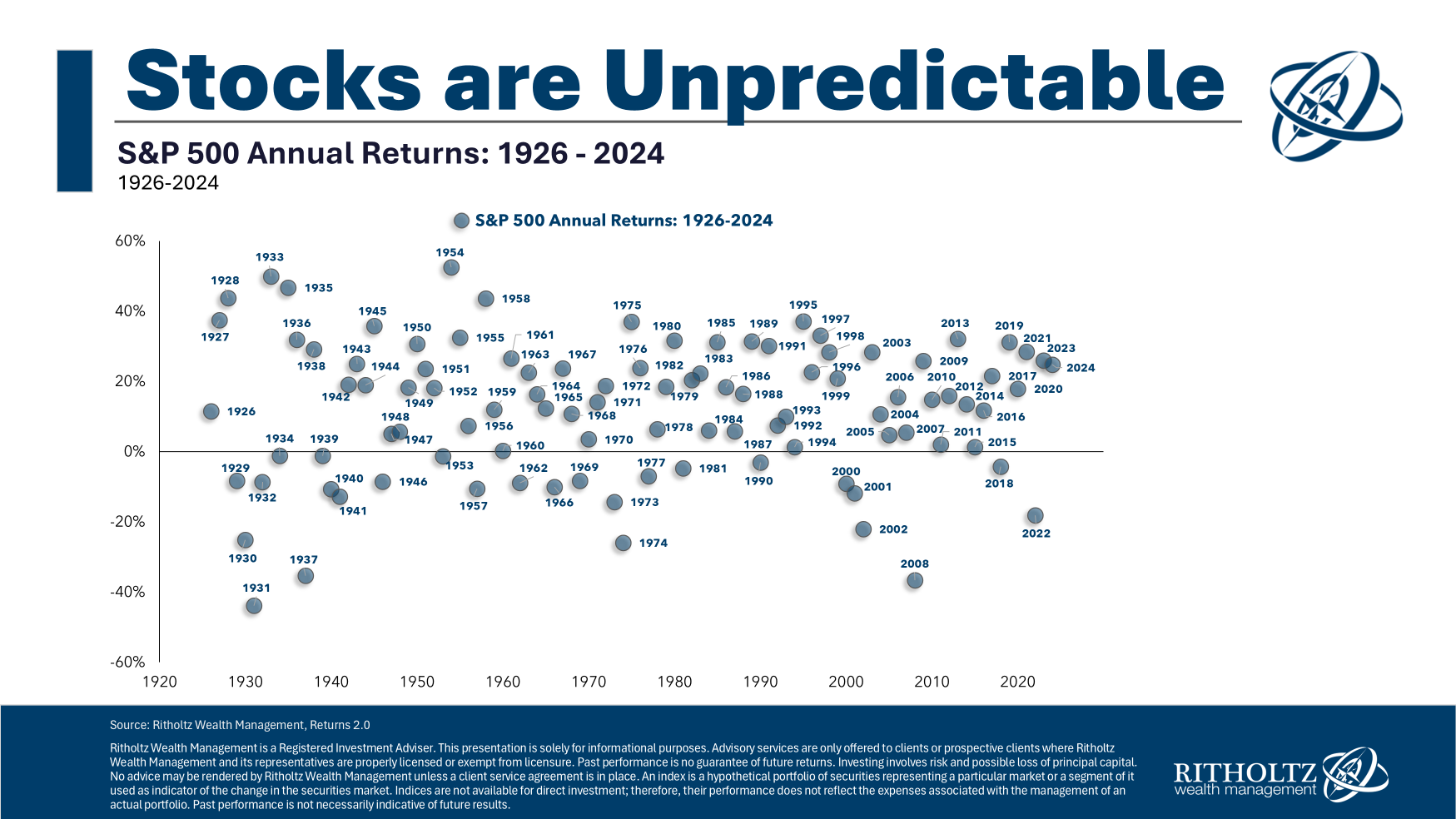
Instead, gold should be positioned as a strategic portfolio diversifier—typically 5–10% of a balanced allocation—alongside stocks, bonds, and real estate [source: https://financialtoolset.com/tools/investment/asset-class-comparison/]. For those concerned about USD debasement or persistent inflation, gold offers asymmetric downside protection, but it should complement, not replace, productive assets that generate cash flows. Annual performance remains highly unpredictable; decade-long rolling returns show that gold can experience extended periods of underperformance relative to equities, followed by sharp catch-up rallies [source: https://awealthofcommonsense.com/2026/01/historical-returns-for-stocks-bonds-cash-housing-gold-2025/]. Investors must distinguish between long-term wealth preservation and short-term trading dynamics.
Conclusion
Gold has undeniably earned its status as a century-tested store of value, particularly when measured against inflation and fiat currency depreciation. While it has lagged equities in nominal growth, its ability to preserve purchasing power during monetary expansions and geopolitical stress remains unmatched by cash or bonds. Trading near $4,385/oz as of August 12, 2026, gold has more than doubled its 2011 all-time high, reflecting sustained structural demand from central banks, inflation hedgers, and de-dollarization advocates.
The macro backdrop remains favorable for hard assets. With the Fed reporting persistent 4.1% PCE inflation, maintaining a $6.7 trillion balance sheet, and dissenting votes revealing policy uncertainty, the era of easy money and stable prices appears to be over. The reversal of money velocity and the prioritization of financial stability over price stability by the Fed create a tailwind for gold.
However, gold is not a crystal ball, and it is not a substitute for productive assets. Its recent volatility and parabolic 2025 returns warrant disciplined allocation rather than speculative chasing. In a USD-dominated financial system, gold is a proven insurance policy against the erosion of purchasing power. For investors navigating a world of Fed dissent, sticky inflation, and geopolitical fragmentation, a modest allocation to gold provides asymmetric downside protection and peace of mind. The question is no longer whether gold is a good store of value—the last century has answered that—but whether investors have the discipline to hold it through the noise of the next decade.