Executive Summary
Gold has firmly reasserted its position as the premier long-term store of value, particularly through the turbulent macro environment of the 2020s and into 2026. Historical data spanning nearly a century confirms that gold consistently preserves purchasing power across regimes of monetary instability, outperforming cash and bonds in real terms over multi-decade horizons. In the current landscape, gold reached a genuine inflation-adjusted all-time high in early 2026, with reported peaks ranging from $5,020 to $5,590 depending on aggregation methodology and intraday versus closing metrics, while the annual average hovered around $4,876 1. However, the metal has exhibited extreme volatility, round-tripping its annual gains and correcting sharply through mid-2026 as the Federal Reserve adopted a hawkish stance and geopolitical risk premiums temporarily faded.
As of August 10, 2026, gold trades at approximately $4,357.60 per ounce, recovering +7.39% through the month after dipping to $4,043 2. This volatility reflects a complex interplay of drivers: a transmission chain where oil prices influence inflation expectations, which dictate Fed policy, which in turn suppresses gold due to its lack of yield. A critical divergence has emerged: while retail ETF investors sold during the drawdown, central banks accelerated purchases to a record ~1,200 tonnes in 2025, treating gold as a non-price-sensitive reserve asset 3.
A defining feature of the current market is the stark divergence between Federal Reserve projections and economic reality. While the Fed projected in late 2025 that inflation would normalize to 2.0% by 2027-2028, actual data by June 2026 shows headline PCE inflation at 3.8% and core PCE at 3.3%, with interest rates expected to rise rather than fall 4. This policy failure reinforces gold's role as a hedge against monetary instability and fiscal dominance. For investors in a USD-denominated financial system, gold offers a critical hedge against monetary debasement, fiscal dominance, and geopolitical fragmentation. However, its non-yielding nature and price volatility demand disciplined risk management rather than passive accumulation. Gold should be positioned as strategic portfolio insurance, not a speculative momentum trade.
The Century of Gold: A Historical Track Record

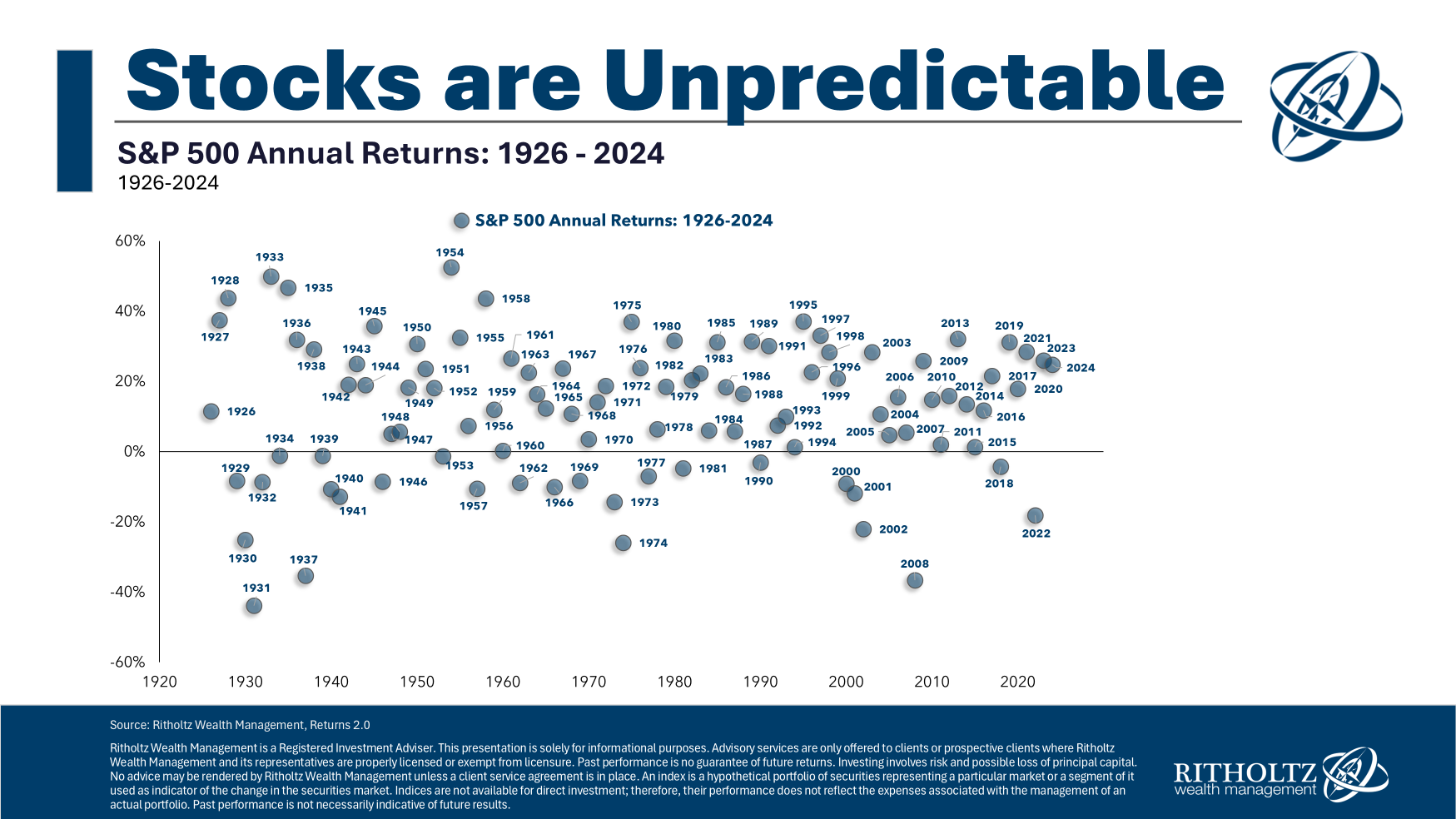
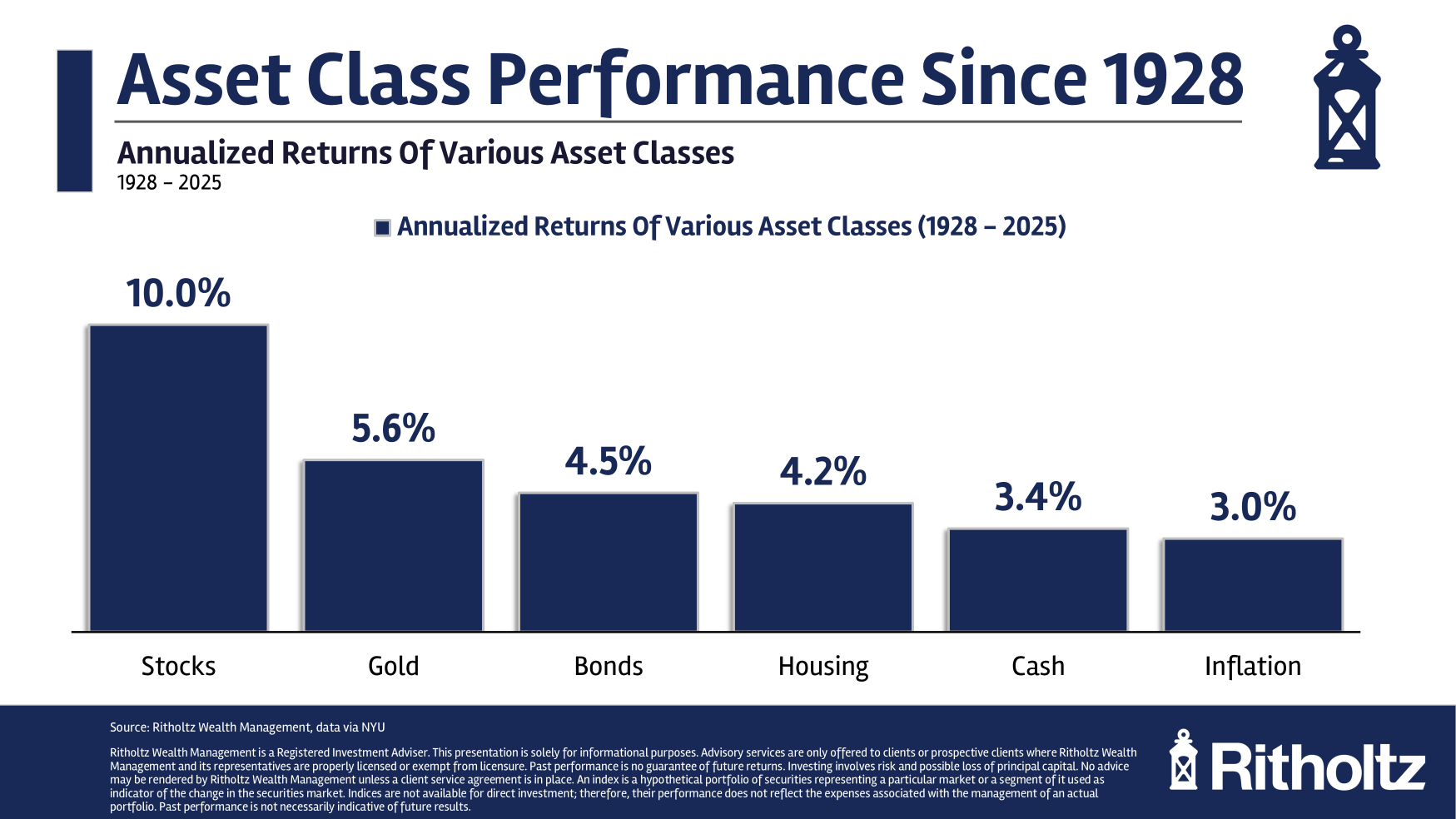
Gold's track record as a store of value is unmatched among non-yielding assets. Comprehensive data from NYU Stern School of Business and independent aggregators provide a rigorous comparison of gold versus the S&P 500, 10-Year Treasuries, 3-Month T-Bills, real estate, and inflation from 1928 to 2024 5. The findings are unambiguous: gold has been the best-performing US asset class in the 21st century, trailing only commercial real estate. It has topped annual performance tables five times since 1974, cementing its reputation as a crisis-era outperformer 6.
Over multi-decade horizons, gold consistently preserves purchasing power, often outperforming cash and bonds in real terms. Its returns are driven entirely by price appreciation, as it generates no dividends, coupons, or rental income. This distinguishes it fundamentally from equities and real estate, which compound through cash flow. When fiat currencies undergo sustained debasement, gold's lack of a counterparty liability becomes its greatest strength. It is not a claim on any government's promise to pay; it is a physical asset with finite supply and universal recognition.
However, gold is significantly more volatile than bonds or cash. It experienced severe underperformance during the low-inflation, high-real-rate environment of the 1990s and early 2000s, highlighting that gold's strength is regime-dependent. During periods of stable growth, anchored inflation expectations, and attractive real yields, the opportunity cost of holding non-yielding gold becomes prohibitive. This historical nuance matters: gold is not a perpetual bull market asset. It thrives when monetary policy is tested, when fiscal discipline erodes, or when geopolitical fragmentation accelerates.
Where sources largely agree is that gold's long-term compound annual growth rate trails the S&P 500 when dividends are reinvested. Where they diverge is in how that gap is interpreted. Traditionalists view gold's lower CAGR as evidence of its inferiority, while macro-focused analysts argue that comparing a non-yielding hedge to a productive asset class is a category error. Gold's value proposition is not absolute return maximization; it is purchasing power preservation during regime shifts. Over the full century, equities delivered higher nominal returns, but gold delivered higher real returns during the most inflationary decades, including the 1970s and the post-2020 monetary expansion.
The Inflation Illusion: Why the Fed’s Message Doesn’t Match Reality
The relationship between gold, inflation, and Federal Reserve policy is frequently oversimplified. Gold is often marketed as the ultimate inflation hedge, but historical evidence shows the correlation is neither perfect nor mechanical. Gold's price is driven primarily by real interest rates and inflation expectations, not headline CPI numbers. When real yields are negative or near zero, the opportunity cost of holding gold collapses, and prices tend to surge. When real yields rise meaningfully, gold typically underperforms, regardless of how high headline inflation may be.
This dynamic played out dramatically in the 1970s, when gold soared alongside double-digit inflation and rising nominal rates. It also explains gold's dormancy in the 1990s, when the Fed maintained high real interest rates to suppress inflation, making bonds far more attractive than non-yielding metal. The current environment mirrors neither era perfectly, but rather synthesizes elements of both.
A defining feature of the current market is the stark divergence between Federal Reserve projections and actual economic outcomes. In September 2025, the FOMC projected PCE inflation to remain elevated at 3.0% in 2025 before gradually declining to the 2.0% target by 2027-2028 7. The December 2025 projections maintained a similar trajectory, with the dot plot indicating only one rate cut in 2026 8. The Fed signaled confidence that inflation would normalize under appropriate monetary policy.
By June 2026, that confidence had been thoroughly tested. The San Francisco Fed reported that headline PCE inflation stood at 3.8% and core PCE at 3.3%, driven by geopolitical supply shocks, sticky core goods inflation, and elevated commodity prices 4. Interest rates are now expected to rise rather than fall, contradicting the Fed's earlier projections. The labor market remains in balance, but inflation persists significantly above the 2% target.
This policy failure narrative is precisely why gold continues to attract institutional and sovereign capital. Gold is hedging not just against inflation, but against the Fed's inability to control it. If the Fed is forced to pivot or engage in fiscal dominance to manage sovereign debt costs, gold could rally further. The rising rates paradox is also instructive: typically, rising nominal rates pressure gold. However, gold's continued strength suggests the market views rising rates as a symptom of inflation expectations outpacing the Fed, rather than a genuine tightening cycle. This dynamic mirrors the 1970s, where gold soared even as nominal rates rose, because real yields remained constrained by inflation inertia.
Sources largely agree that gold hedges monetary policy error and fiscal dominance more reliably than it hedges headline CPI. Where they disagree is on the timing and magnitude of the Fed's eventual pivot. Some analysts argue that persistent inflation will force a hawkish hold, temporarily suppressing gold. Others contend that fiscal pressures will ultimately force the Fed's hand, triggering a sustained rally. The market's current pricing reflects both scenarios simultaneously.
Current Market Dynamics: Volatility, Central Banks, and the Retail Divergence
Recent gold trends have been supported by structural shifts in demand and macro uncertainty, though short-term price action remains choppy. As of August 10, 2026, gold trades at approximately $4,357.60 per ounce, up 0.38% on the day, with an intraday range of $4,312.60–$4,366.00 9. Over 2026, gold round-tripped its annual gains, closing marginally down for the year despite the early-2026 all-time high. Reported peaks vary by source, ranging from $5,020 to $5,590, reflecting intraday volatility and differing aggregation methods, while the average price for the year sits around $4,876 10, 1. The metal corrected sharply through mid-2026 as the Fed adopted a hawkish stance and geopolitical risk premiums faded 11.
August 2026 brought a notable recovery. Gold gained +7.39%, recovering from a dip to $4,043, with a monthly range of $4,043–$4,363 2. Daily fluctuations remain significant, ranging between -0.48% and +3.33%, underscoring the metal's sensitivity to macro data releases and central bank commentary 12.
A critical divergence has emerged between sovereign and retail demand. Central bank purchases accelerated to a record ~1,200 tonnes in 2025, demonstrating that official-sector demand treats gold as a non-price-sensitive reserve asset 3. This sustained buying, averaging ~1,000 tonnes annually, represents roughly a quarter of annual mine supply, tightly constraining the global gold market and establishing a structural price floor 13. This trend reflects a strategic response to geopolitical fragmentation and a desire to reduce reliance on Western financial infrastructure 14.
Conversely, investment demand from retail ETF investors turned negative during the drawdown, as investors sold into volatility 6. This divergence highlights that gold's structural bull case is driven by sovereign accumulation rather than retail momentum. Retail investors are highly sensitive to price action and opportunity cost, while central banks are purchasing for strategic reserve diversification, largely indifferent to short-term price fluctuations.
Sources agree that this structural divergence is a positive long-term signal. Where they disagree is on whether retail demand can re-engage. Some analysts project that investment demand will stay positive, with retail accumulation shifting toward physical bars and coins due to limited alternative investments and inflation fears 15. Others warn that retail sentiment remains fragile and could reverse quickly if real yields rise meaningfully.
The Oil-Rate Chain and the De-Dollarization Tailwind
Gold's price is heavily influenced by a macro transmission mechanism that links energy markets, inflation expectations, and central bank policy. Oil prices affect inflation expectations, which in turn dictate Fed policy; higher rates suppress gold as it yields no income 6. Current rallies have been fueled by declining oil prices and a weak July jobs report, which reduced the market-implied probability of a September rate hike, shifting gold's rally from inflation fears to rate expectation adjustments 16.
This oil-inflation-rate chain remains a key driver of gold's volatility. When oil spikes, inflation expectations rise, the Fed is forced to consider tightening, and gold initially sells off on rate fears before rallying on inflation hedging demand. When oil stabilizes or declines, the rate hike probability fades, and gold's inflation hedge narrative regains traction. The chain is not perfectly linear, but it provides a reliable framework for understanding short-term price action.
Beyond cyclical dynamics, a structural tailwind is building: de-dollarization. The USD's share of global reserves has dropped to a 30-year low, reflecting a strategic diversification away from traditional reserve currencies 17. This structural shift is evidenced by central banks purchasing over 1,000 tonnes of gold annually, creating a durable price floor and signaling long-term institutional confidence in gold as a sovereign reserve asset 18. Gold now accounts for approximately one-fifth of all historically mined gold held in central bank reserves, underscoring its established role as a strategic diversifier 19.
Sources largely agree that de-dollarization is a multi-year, regime-level shift rather than a cyclical trade. Where they diverge is on the pace and geopolitical triggers. Some analysts argue that sanctions risk and reserve weaponization will accelerate central bank gold buying. Others contend that geopolitical détente or a strong dollar cycle could temporarily slow the trend. Regardless of pace, the structural bid for gold from official institutions remains one of the most durable demand drivers in modern market history.
What Should You Do? Positioning Gold in a USD-Based Economy
For individuals and institutions operating in a USD-denominated financial system, gold offers specific, well-documented benefits. It often rises when equities and bonds fall, providing a partial hedge against market downturns. It serves as "crisis alpha" in a diversified portfolio 20. Gold has a low correlation with traditional financial assets over the long term. Adding gold can reduce portfolio volatility and improve risk-adjusted returns 6. In a USD-based system, gold provides exposure to an asset that is not a liability of any government or central bank. This offers protection against tail risks involving the USD's purchasing power or the global financial system's stability 21.
Is it a good time to buy? The answer depends entirely on time horizon and risk tolerance.
Short-Term: Gold is volatile. Timing the market based on short-term price action is difficult and risky. Current prices may reflect significant uncertainty premiums that could reverse if the macro environment stabilizes 6. The round-trip nature of 2026 gains underscores the danger of momentum trading. Investors chasing gold's recent upside risk buying into a correction.
Long-Term: For investors with a multi-year horizon, gold remains a relevant allocation for diversification and inflation protection. The structural drivers (central bank demand, fiscal deficits, geopolitical shifts) suggest gold retains its role as a store of value 22. Institutional forecasts project 35–55% further upside through 2026, contingent on sustained central bank demand and moderate real yields, though risks from potential Fed rate hikes or dollar strength remain 23, 24.
Positioning: While gold offers a proven mechanism for protecting purchasing power in a USD-based financial system, its recent upward trend and heightened volatility mean that positioning requires disciplined risk management rather than passive accumulation 11. A modest allocation (e.g., 5–10% of a portfolio) can provide insurance without dominating returns 20. Dollar-cost averaging into positions during volatility spikes, rather than lump-sum buying at all-time highs, aligns with historical price behavior. Physical gold, allocated gold, or low-cost gold ETFs each offer distinct trade-offs between liquidity, counterparty risk, and storage costs. The vehicle matters less than the allocation discipline.
Knowns, Unknowns, and the Road Ahead
Knowns
- Gold has a century-long track record as a store of value, outperforming cash and bonds in real terms over long horizons 5, 8.
- Gold is the best-performing US asset class in the 21st century (behind commercial real estate) and has topped annual tables multiple times since 1974 6.
- Gold surges during high inflation and uncertainty but underperforms when real interest rates are high and the economy is stable 6.
- Central banks are net buyers, purchasing a record ~1,200 tonnes in 2025, with annual averages representing ~25% of mine supply, establishing a structural price floor 3, 13.
- Gold is volatile and offers no yield; it relies entirely on price appreciation 5, 8.
- The USD's reserve share is at a 30-year low, reinforcing gold's role as a sovereign and retail hedge 17.
- The Fed's late-2025 projections of inflation normalizing to 2.0% by 2027 have been invalidated, with June 2026 data showing PCE at 3.8% and rates rising 7, 4.
- Gold's price is driven by a chain reaction: oil prices affect inflation expectations, which dictate Fed policy; higher rates suppress gold 6.
- Retail ETF investors sold during the 2026 drawdown, while central banks accelerated buying, highlighting a structural divergence in demand 6.
Unknowns
- Fed Policy Trajectory: If the Fed successfully anchors inflation expectations while maintaining growth, gold may face headwinds from rising real rates. Conversely, if inflation resurges or the Fed is forced to prioritize debt sustainability, gold could rally further 6.
- Geopolitical Evolution: The extent to which de-dollarization and geopolitical fragmentation continue to drive central bank buying is uncertain 25.
- Correlation Breakdowns: In extreme stress scenarios, correlations between assets can shift. Gold's behavior during a liquidity crisis (where it may initially sell off alongside other assets) is less predictable than its behavior during inflationary periods 20.
- Market Sentiment: Short-term price movements are driven by sentiment, which can be influenced by factors not captured by fundamental analysis, such as regulatory changes or shifts in investor behavior 6.
- Oil-Rate Chain: It remains unclear how sustained oil price shocks will interact with Fed policy and gold valuations, particularly if the "oil -> inflation -> rates -> gold" chain breaks down 16.
- Retail vs. Institutional Divergence: The sustainability of gold's price depends on whether retail demand can re-engage after the current volatility, or if central bank buying alone is sufficient to support prices 15.
Outlook
Gold remains a vital component of a diversified investment strategy, particularly in an environment of fiscal expansion, geopolitical uncertainty, and potential inflation persistence. The failure of the Fed's inflation forecasts to materialize reinforces gold's structural bull case. While it is not a "get rich quick" asset, its historical performance and current structural support suggest it will continue to serve as a reliable store of value and portfolio insurance over the long term. Investors should focus on gold's role in risk management rather than short-term price speculation.
Conclusion

Gold has earned its reputation as the best long-term store of value over the past century, particularly when measured against cash, bonds, and fiat currencies in real terms. The data from 1928 to 2024 leaves little room for doubt: gold preserves purchasing power across regimes of monetary instability, outperforming during the most inflationary decades and serving as a critical hedge against fiscal dominance. The current macro environment only reinforces this historical pattern. The Federal Reserve's projection that inflation would normalize to 2.0% by 2027 has been invalidated, with June 2026 data showing headline PCE at 3.8% and core PCE at 3.3%. Interest rates are rising, not falling, and the USD's share of global reserves sits at a 30-year low. In this landscape, gold is not merely an inflation hedge; it is a hedge against monetary policy failure, sovereign debt unsustainability, and geopolitical fragmentation.
However, gold's recent price action demands respect for volatility. The metal round-tripped its 2026 gains, corrected sharply through mid-year, and continues to exhibit significant intraday swings. Retail investors sold into the drawdown, while central banks accelerated purchases to a record ~1,200 tonnes in 2025, treating gold as a non-price-sensitive reserve asset. This divergence underscores that gold's structural bull case is driven by sovereign accumulation, not retail momentum. For individuals in a USD-denominated economy, gold offers a proven mechanism for protecting purchasing power, but it requires disciplined positioning rather than passive accumulation. A modest 5–10% allocation, deployed via dollar-cost averaging during volatility spikes, aligns with historical price behavior and provides meaningful portfolio insurance without dominating returns.
What we know is that gold's century-long track record, central bank structural bid, and de-dollarization tailwind create a durable floor. What we do not know is the exact trajectory of Fed policy, the pace of geopolitical realignment, and how sustained oil price shocks will interact with real yields. Institutional forecasts project 35–55% further upside through 2026, contingent on multiple variables. The safest conclusion is that gold remains an essential component of long-term wealth preservation, particularly for those who recognize that fiat currencies are liabilities, not assets. Gold is not a speculative momentum trade. It is strategic insurance against a financial system built on debt, and in an era of policy uncertainty, that insurance has never been more valuable.